
Dementia Care at Home: The Complete Family Guide by Stage
Written by the HomeCare editorial team. Sources: Alzheimer's Association, National Institute on Aging (NIA), CareScout 2025 Cost of Care Survey.
If your mum or dad is living with dementia, this guide is for you. It is written for the adult daughter or son — often in their forties or fifties, often working, often also caring for children — who has quietly become the person holding everything together. You may have noticed the small changes first: repeated questions, a stove left on, a familiar route suddenly confusing, a parent who is frightened at night and exhausted by day. You may be searching at midnight for answers, and you may feel guilty for feeling tired yourself. This guide is here to give you a clear, honest picture of what care at home can look like, stage by stage, so you can plan rather than panic.
Dementia is not one illness and it is not a normal part of ageing, even though it becomes more common as people grow older. The word describes a group of symptoms — memory loss, confusion, difficulty with language, planning, and everyday tasks — caused by diseases that damage the brain, the most common being Alzheimer's disease. In the United States, about 7.2 million Americans aged 65 and older were living with Alzheimer's in 2025, according to the Alzheimer's Association, and nearly 12 million family members and friends provided unpaid dementia care in 2024. Most of those caregivers are women, and more than one in three are daughters. Behind every statistic is a family like yours, learning as it goes.
That learning is exactly what this guide supports. It does not pretend that home care is easy, and it does not pretend that it is right for every family at every stage. Instead, it walks through the early, middle, and late stages in turn, explains what a day can look like in each one, and shows what help is usually needed, what safety changes matter most, what care costs, and how to look after the caregiver too. You can read it from start to finish, or jump to the stage that matches your situation today. To understand the wider choices first, you may also want our Complete Guide to Home Care, and you can always contact our team to talk through a specific situation in confidence.
What Dementia Is, in Plain Language
Dementia is an umbrella term. Alzheimer's disease is the most common cause, but there are others, including vascular dementia, Lewy body dementia, and frontotemporal dementia. Different causes affect the brain in different ways, which is one reason why two people with dementia can behave quite differently, even at a similar stage. What they share is a gradual change in how the brain works: remembering recent events becomes harder, finding the right word takes longer, following a recipe or paying a bill becomes confusing, and judging risk — a hot stove, a busy road, a stranger at the door — becomes less reliable.
Those changes are not the person's fault, and they are not something the person can simply try harder to overcome. A person with dementia is not being difficult when they repeat the same question, refuse a bath, or become upset in the evening. They are usually responding to confusion, fear, tiredness, pain, or an environment that has become hard to read. Keeping that in mind changes everything about care: the goal is not to correct the person, but to make the day calmer, safer, and more familiar. The best care often looks small from the outside — a routine kept, a chair by a sunny window, a familiar song, a door that is easy to find — and it matters enormously.
One more thing to hold on to: a diagnosis, or the lack of one, belongs with a doctor. This guide will not help you decide whether your parent has dementia, and you should not use it to do so. If memory or behaviour has changed, the right next step is a medical appointment, where a doctor can check for other causes, review medicines, and arrange assessment. Early conversations with a doctor also give the family time to plan — legal and financial arrangements, care preferences, and support — while the person can still take part in those decisions. That planning is a kindness to everyone, and it is much harder to do in a crisis.
How to Use This Guide
Dementia is often described in three broad stages — early, middle, and late — and this guide follows that shape because it is how families actually experience change: first a little help, then a lot of help, then full-time care. But stages are only a rough map, not a timetable. Some people stay in the early stage for years; others move faster. Some days are better than others, and a cold, an infection, poor sleep, or a change of routine can make confusion worse for a while. If a change is sudden, treat it as a reason to call a doctor, not as a new stage.
As you read, notice the pattern that repeats in every stage: keep routines steady, keep the home safe and easy to read, keep communication simple and kind, and keep checking what help the family needs — not just the person with dementia. The checklists in this guide are starting points, not rules. Adapt them to your parent, your home, and your family. And remember that asking for help is part of good care, not a failure of it. The pages on who we are and how we work explain how professional care can fit alongside family care, and our other guides cover home safety and respite in more detail.
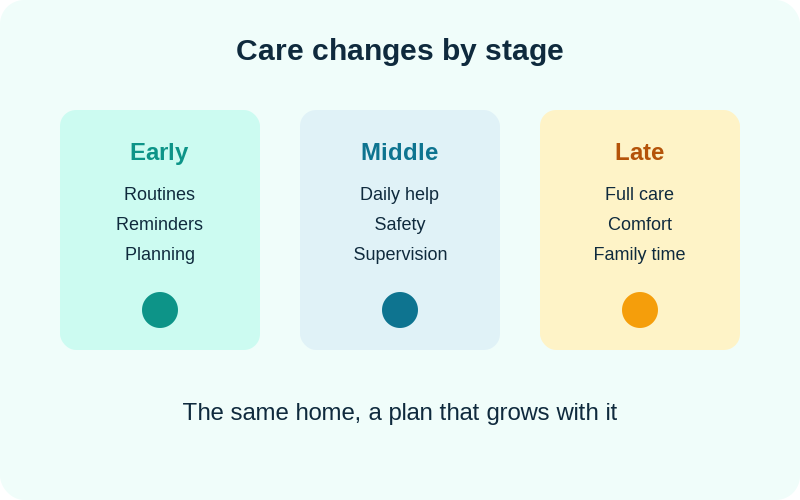
Early Stage: A Little Help, and a Lot of Planning
In the early stage, your parent may still live largely independently. They may forget recent conversations, lose track of appointments, struggle with a new phone or a bank statement, or need more time to find a word. They usually know that something is changing, and they may feel frightened, embarrassed, or determined to hide it. The most helpful thing a family can do now is to protect independence while quietly putting support in place: a wall calendar and a whiteboard for the day's plan, a phone with large, familiar numbers, bills on direct payment where possible, and a simple routine for keys, wallet, and glasses, always in the same place.
This is also the best time for the conversations that are hardest later. Talk — gently, and more than once — about wishes for future care, who should help with decisions, and what matters most: staying at home, seeing grandchildren, a favourite walk, music, faith, or food. Help with legal and financial paperwork while your parent can still take a full part: a power of attorney, an advance care plan, a will, and a list of accounts, medicines, doctors, and emergency contacts. Keep copies where the family can find them, and tell your parent's doctor that you are involved, with your parent's permission. These conversations are not giving up; they are how your parent's voice stays in the room later.
Care at home in the early stage is often light: a companion visit a few times a week, help with shopping, cooking, or transport, and a regular check that all is well. A caregiver at this stage is as much a friendly visitor as a helper, and that matters — loneliness and boredom make confusion worse, while company, conversation, and a walk outside can lift mood and keep the day structured. Encourage your parent to keep doing what they enjoy and can still do safely, even if it takes longer. Doing things for someone too early can take away confidence faster than the illness itself.
Middle Stage: Daily Help, Supervision, and Safety
The middle stage is usually the longest, and often the hardest for families. Memory loss deepens, language becomes harder, and help is needed with dressing, bathing, eating, and moving around the house. Your parent may not recognise a familiar place, may repeat the same question many times, may become agitated in the evening, or may try to leave the house at night. Supervision becomes important, not because your parent is a child, but because judgement about safety — a stove, a road, a stranger — is no longer reliable. Many families find that this is when a few hours of help a week becomes daily help, and daily help becomes overnight or live-in support.
Routines become your best tool. Keep waking, meals, walks, and bedtime at the same times each day, and keep the house calm and uncluttered. Break tasks into one small step at a time — "here is your shirt" rather than "get dressed" — and allow plenty of time. Use short, simple sentences, a calm voice, and gentle eye contact. If your parent is upset, do not argue about facts; acknowledge the feeling first. "You sound worried. I am here. Let us sit together for a moment" often works better than any correction. Keep a familiar object nearby — a photograph, a blanket, a favourite song — and use it when the day feels confusing.
Personal care needs patience and privacy. Bathing is one of the most common flashpoints: the bathroom is cold, slippery, and private, and being helped can feel humiliating. Warm the room first, run the water before your parent steps in, offer a choice where you can — "shower or bath today?" — and keep a towel ready so your parent is never cold or exposed. If bathing becomes a daily battle, try a different time of day, a different caregiver, or a sponge wash on difficult days, and talk to a doctor or nurse if skin, pain, or fear is part of the problem. The same approach works for dressing, eating, and toileting: choice where possible, privacy always, and no rushing.
This is also the stage to make the home safer in earnest — door alarms or locks that prevent wandering at night, good lighting, clear walkways, grab rails in the bathroom, a stove shut-off, and medicines locked away. The section on wandering below gives a full plan, and our guide to home safety covers the room-by-room detail. Do not wait for a fall or a night-time walk to make these changes. Families often say they wish they had made them sooner, when everyone was calmer and had more time to get used to them.
Late Stage: Full Care, Comfort, and Family Time
In the late stage, your parent will need full-time help with almost everything: eating, drinking, washing, dressing, moving, and toileting. Speech may become very limited, and your parent may not recognise family members, or may recognise them only sometimes. This is painful, and it is normal to grieve even while your parent is still alive. Grief does not mean you have stopped caring; it means you are already missing the person you knew, and that deserves kindness, including kindness to yourself.
Care now is about comfort, dignity, and presence. Keep your parent warm, clean, and comfortable, offer small sips of water and soft food often, and watch for signs of pain, constipation, a urinary infection, or skin damage — and raise them with a doctor or nurse promptly, because a person who cannot explain pain may show it as restlessness, crying, or refusal to eat. Hold a hand, play familiar music, read aloud, or simply sit together. Even when words are gone, a calm voice, a familiar smell, and a gentle touch still reach a person. Talk to your parent as an adult, use their name, and tell them who you are when you arrive: "It is Sarah, your daughter. I am here."
Full-time care at home is a big undertaking, and many families combine family care with professional help at this stage: overnight care, live-in care, or visits from a nurse under a doctor's direction. If your parent's needs grow beyond what can be safely provided at home, that is not a failure. It is a sign that the care needed has changed, and the honest question becomes where that care can best be given. The section on home care versus memory care below works through that decision without judgement. Whatever you decide, keep the focus on comfort, safety, and the person's wishes as you understand them, and keep asking the doctor and the care team what good care looks like now.
A Day at Home: Routines That Help
A steady day is the single most helpful thing a family can build. Dementia makes the world harder to predict, so a predictable day gives your parent something solid to hold on to. Wake at the same time, open the curtains, and greet the day in the same words. Breakfast at the same table, a short walk after, a rest in the afternoon, and a calm evening with no surprises. Write the day's plan on a whiteboard where it can be seen — "Today is Tuesday. After lunch, Anna is coming. Dinner at six." — and cross items off as they happen, so the day feels finished rather than endless.
Build the day around what your parent can still do, not only around what they cannot. Folding laundry, watering a plant, stirring a pot, sorting photographs, listening to the radio — these are not chores to fill time, they are proof that your parent still matters in the household. Keep tasks short, offer one at a time, and praise the effort rather than the result. If a task becomes frustrating, switch to something easier without making a fuss. A good day with dementia is rarely a busy day; it is a day with a few familiar pleasures, a little fresh air, and no unnecessary hurry.
Food and drink deserve a place in the routine too. Offer regular meals and drinks, keep water within reach, and watch for weight loss or a parent who forgets to eat. Finger foods, small portions, and a favourite plate can help when a full meal feels overwhelming. If swallowing, chewing, or appetite changes, talk to a doctor or a dietitian — do not improvise with thickened drinks or special diets without professional advice. The same applies to sleep: a regular bedtime, a dark quiet bedroom, and daylight in the morning help the body's clock, while long daytime naps can make nights harder.
Sundowning: Why Evenings Are Harder
Many families notice that confusion, restlessness, and distress grow worse in the late afternoon and evening. This pattern is often called sundowning, and it is one of the most exhausting parts of dementia care. Your parent may pace, repeat questions, try to leave the house, become suspicious, or say they want to "go home" even when they are already home. It is frightening to watch, and it is frightening for the person experiencing it. The first thing to know is that sundowning is common, it is not your fault, and it is not your parent being difficult on purpose.
Nobody knows exactly why evenings are harder, but tiredness, low light, hunger, pain, needing the toilet, and a day full of small confusions all add up. That is why the most useful response is often the simplest: make the evening calmer before it starts. Keep the afternoon quiet, avoid visitors and outings late in the day, and begin winding down an hour or two before sunset. Turn lights on before it gets dark, so the house never slides into shadow. Close the curtains, put on familiar music, and offer a warm drink and a light snack. Keep the same evening routine every day, so your parent's body learns what comes next.
When sundowning happens, stay calm, even if you are tired yourself. Do not argue, do not raise your voice, and do not try to reason your parent out of a fear that feels real to them. Acknowledge the feeling, offer a simple reassurance, and gently redirect: "I can see you are worried. I am here with you. Let us sit in the kitchen and have some tea." A short walk, a familiar photograph, or a task with your hands can break the loop. If evenings become unsafe — your parent tries to leave the house, becomes aggressive, or cannot be settled — talk to a doctor promptly, and do not change any medicine without medical advice. Keep a note of what happened, when, and what seemed to help, so the doctor can see the pattern.
Wandering and Getting Lost: A Home-Safety Plan
Wandering is one of the most feared parts of dementia care, and with good reason: a person can become lost in a familiar street, cross a road without noticing traffic, or leave the house at night in cold weather. It helps to understand why it happens. Your parent may be looking for something — a childhood home, a parent who has died, a toilet, a way out of a confusing room — or may simply be restless, bored, or in pain. Wandering is rarely random, even when the reason is hard to guess. Asking "what might they be looking for?" often leads to a better answer than "how do I stop them?"
Start with the house. Fit a door alarm or a chime that sounds when an outside door opens, and consider a lock that needs a key or a code from the inside at night — but only if everyone in the house can still get out safely in a fire, and only after talking it through as a family. Keep a coat and shoes by the door rather than hidden away, so leaving is not a secret mission. Make the garden safe and enclosed, with a seat and a clear path, so restlessness has somewhere safe to go. At night, use motion-sensor lights in the hallway and bathroom, and keep a night light on so your parent can find the toilet without waking the whole house.
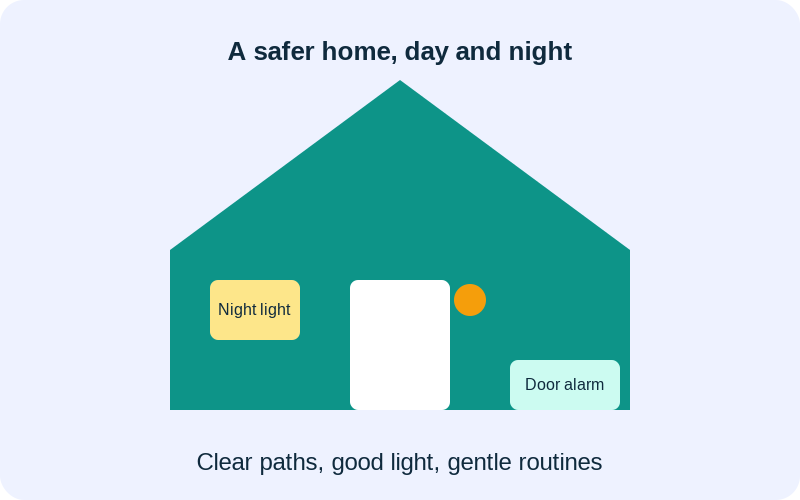
Next, prepare for the possibility that your parent does leave. Keep a recent photograph and a short description — height, build, clothes, favourite places — where you can find them quickly. Consider a GPS tracker or an identity bracelet, and tell neighbours what to do if they see your parent out alone. Agree a plan with the family: who searches where, who calls whom, and when to call the police. In the first hour, check the usual places first — the old house, a favourite shop, a park, a church — and call the police sooner rather than later if your parent is not found. It is always better to call early. Tell the police that the person has dementia, where they were last seen, and what they were wearing.
Finally, reduce the need to wander by filling the day. A walk in the morning, a task in the afternoon, and a calm evening leave less restless energy for the night. If your parent keeps trying to "go home", do not correct them harshly. Try "tell me about home" and listen, or offer a cup of tea and a photograph, and let the feeling pass. If wandering becomes frequent or unsafe despite these steps, talk to a doctor and to your care provider about more support — more hours, overnight cover, or a different care arrangement. Safety is not about locking a person in; it is about making the home the easiest, calmest place to be.
Home Safety, Room by Room
Most accidents at home can be prevented with simple changes, and with dementia those changes matter even more, because judgement about risk is weaker. Start with the rooms your parent uses most, and work through them one at a time rather than trying to change everything in a weekend. In the bathroom, fit grab rails beside the toilet and in the shower, use a non-slip mat and a shower chair, keep the water temperature limited so it cannot scald, and store medicines, razors, and cleaning products in a locked cupboard. A night light in the bathroom helps enormously, and a toilet seat in a contrasting colour is easier to see than a white one on a white floor.
In the kitchen, the risks are fire, sharp objects, and confusion. Consider a stove shut-off device or removing knobs when the stove is not in use, keep knives in a drawer rather than a block, and store cleaning products out of reach. Label cupboards with words or pictures — "cups", "plates", "tea" — so your parent can find things without opening every door. In the bedroom, keep a lamp within reach, a clear path to the bathroom, and a phone or personal alarm by the bed. On the stairs, fit handrails on both sides, mark the edge of each step, and keep the stairs free of clutter. Throughout the house, remove loose rugs and trailing cords, improve lighting, and keep everyday items within easy reach so your parent does not need to climb.
Technology can help, but keep it simple. A medical alert system with fall detection, a GPS tracker, a door alarm, and a simplified phone are all useful, and they are the kind of safety products that fit naturally into dementia care. Choose devices your parent can actually use — one button, not five — and test them together. Tell the family how they work, and check them regularly. Our Complete Guide to Home Care has a longer home-safety checklist, and you can ask our team through the contact page if you would like to talk through a home safety discussion as part of planning care.
Eating, Sleeping, and Bathing
Daily living is where dementia shows up most, and where small kindnesses make the biggest difference. At mealtimes, keep the table calm and uncluttered, offer one course at a time, and use a plate in a colour that contrasts with the food so it is easy to see. Sit with your parent, eat together, and allow plenty of time. If your parent forgets how to use cutlery, offer finger foods without making a fuss about it. Offer water regularly, and watch for signs of dehydration — confusion, dark urine, unusual tiredness — and raise them with a doctor if you are worried.
Sleep is often broken, both for the person with dementia and for the family. A regular bedtime, daylight in the morning, a short walk in the afternoon, and no long naps after lunch all help. Keep the bedroom dark, quiet, and cool, and avoid caffeine late in the day. If your parent wakes at night, keep the response calm and brief — a toilet visit, a drink of water, a reassuring word — and avoid turning on bright lights or starting a conversation that wakes everyone fully. If nights become unsafe or exhausting for the family, talk to a doctor and consider overnight care, even for a few nights a week, so the family can sleep.
Bathing and dressing need privacy, warmth, and choice. Warm the bathroom first, run the water before your parent steps in, and offer a choice — "shower or bath today?" — so your parent still has a say. Lay clothes out in the order they are put on, and choose clothes that are easy to fasten. If a task becomes a battle, stop, try again later, or try a different time of day. A sponge wash on a difficult day is not a failure; it is a sensible compromise. If skin, pain, or fear is part of the problem, ask a doctor or nurse for advice rather than struggling alone.
Talking, Listening, and Repetitive Questions
Communication changes with dementia, and families often find this the hardest part. Your parent may repeat the same question, lose the thread of a conversation, struggle to find a word, or say something that is not true. The instinct is to correct them — "you already asked that", "that is not right" — but correction usually increases distress without improving memory. A kinder approach is to answer the feeling behind the words, briefly and calmly, and then gently move on. If your parent asks when their mother is coming, when their mother died long ago, try "you miss her, don't you? Tell me about her" rather than a blunt correction that forces the grief to be relived.
Keep your own communication simple: one idea at a time, short sentences, a calm voice, and plenty of pauses. Use your parent's name, make eye contact, and check that you have their attention before you speak. Write important things down, and use photographs, objects, and music to start conversations when words fail. A photograph album, a favourite song, or a familiar smell can reach a person when a question cannot. And remember that your parent is still an adult, still the person they were, even when memory fades. Speak to them as you would want to be spoken to, and never talk about them as if they are not in the room.
Respite and Looking After the Caregiver
Most dementia care is provided by family, and most family caregivers are exhausted. The Alzheimer's Association reports that nearly 12 million family members and friends provided unpaid dementia care in 2024, and 59 percent of dementia caregivers report high to very high emotional stress. Many are in their forties and fifties, working full time, and also caring for children — the so-called sandwich generation. If that is you, please hear this clearly: feeling tired, resentful, or guilty does not make you a bad daughter or son. It makes you a human being doing a very hard job for a very long time.
Respite — planned, trusted cover so a family caregiver can rest — is not a luxury, it is part of the care plan. Even a few hours a week can give you time to sleep, see a doctor, work, or simply sit quietly. Start small if the idea feels hard: a companion visit while you go for a walk, a day of care while you attend an appointment, a weekend of cover while you visit friends. Write a short handover note for the respite caregiver — routines, medicines, likes and dislikes, what calms your parent, and who to call — so you can actually relax while you are away, rather than worrying the whole time.
Watch for burnout in yourself, not just in your parent. Warning signs include exhaustion that sleep does not fix, irritability, poor sleep, headaches, skipping your own medical appointments, and feeling that nothing you do is enough. If you notice those signs, talk to your own doctor, tell another family member, and ask for help before you reach breaking point. A support group — in person or online — can help enormously, because other caregivers understand in a way that well-meaning friends often cannot. You can also read our guide to supporting family caregivers for more on sharing tasks and taking breaks without guilt.
How Much Does Dementia Care at Home Cost?
Cost is one of the first questions families ask, and one of the hardest to answer, because it depends on hours, location, and the type of care. The most useful anchor figure comes from the CareScout 2025 Cost of Care Survey, released in March 2026, based on more than 25,000 rates collected in the United States: the national median is $35 an hour for a non-medical caregiver at home, and $90 an hour for private-duty skilled nursing at home. Those are medians — half of rates are above them, half below — and they are United States figures, so treat them as a starting point for planning, not as a quote for your area. Always ask for a written quote before you commit.
Worked examples help. At the $35 median, ten hours a week costs about $350 a week, or about $1,517 a month; twenty hours a week costs about $700 a week, or about $3,033 a month; forty hours a week costs about $1,400 a week, or about $6,067 a month. Overnight and live-in care cost more, and skilled nursing at $90 an hour costs far more still. Compare those figures with the same survey's median for assisted living — about $6,200 a month — and you can see why families often start with part-time home care and increase hours as needs grow. Keep a simple record of hours and spending, and review the budget every few months, because dementia care is a long journey and costs change as needs change.
Who pays is a separate question, and the answer is often "several sources together". Some families pay privately from savings or income, some use long-term care insurance, some use veterans' benefits, and some use Medicaid waivers where they qualify. Medicare does not generally pay for long-term non-medical home care, although it may cover skilled home health care for a limited period under a doctor's direction — check the current rules with Medicare or a benefits adviser before you assume anything. Ask your care provider for a written breakdown, ask what is included, and ask about minimum visit lengths, evenings, weekends, and cancellation fees. Clear answers now prevent painful surprises later, and our Terms & Conditions explain how fees are agreed in writing before care begins.
Home Care or Memory Care? An Honest Comparison
At some point, most families ask whether home is still the best place, or whether a memory care community would be safer. It is a painful question, and it deserves an honest answer rather than a sales pitch. Home care is usually best when your parent is safe with the support in place, when the home can be made safe, when family and professional help can cover the hours needed, and when your parent is happier at home. It keeps familiar rooms, routines, neighbours, and memories, and it can be increased gradually — a few hours, then daily, then overnight — as needs grow.
Memory care may be safer when supervision is needed around the clock and cannot be provided at home, when wandering, falls, or medical needs have become unmanageable, when the family caregiver's health is suffering, or when your parent is distressed, isolated, or unsafe despite more help. A good memory care community offers secure outdoor space, staff trained in dementia care, structured days, and company — things that can be hard to provide at home in the late stage. Choosing it is not abandonment; it is choosing safety, and many families find that their relationship with their parent improves once the daily strain of care is shared.
Do not decide alone, and do not decide in a crisis if you can avoid it. Visit communities in advance, at different times of day, and ask how they handle sundowning, wandering, personal care, and family involvement. Talk to your parent's doctor, and talk to your parent about what matters most to them, while they can still take part. And remember that the decision can be revisited: a short stay for respite in a memory care community can tell you a lot, without committing to a permanent move. Whatever you decide, the goal is the same — safety, comfort, and dignity — and that goal does not change when the setting changes.
When Home Care May No Longer Be Enough
There are signs that home care is reaching its limits, and recognising them early gives your family more choices. Watch for frequent falls, weight loss, repeated infections, wounds that do not heal, a parent who wanders at night despite safety measures, aggression that puts family or caregivers at risk, or a family caregiver who is exhausted, ill, or unable to cope. Any one of these deserves a conversation with a doctor and with your care provider, not a silent decision to carry on regardless. A good provider will tell you honestly when more help is needed, even if that means recommending a different setting.
If someone is in immediate danger — a fall with injury, confusion that came on suddenly, chest pain, difficulty breathing, or a person who cannot be found — call your local emergency number straight away. Sudden confusion can have a medical cause, such as an infection or a reaction to medicine, and it needs urgent medical attention. Keep a list of medicines, allergies, and emergency contacts by the phone, and keep a small bag ready with essentials, so a hospital visit does not become a frantic search. You can read more about planning for change in our Complete Guide to Home Care, and our Privacy Policy explains how we handle the personal information you share with us.
Finding a Caregiver You Can Trust
A good caregiver for dementia care needs more than a kind manner, although kindness matters enormously. Ask whether caregivers have training in dementia care, how they are supervised, whether the same caregiver will visit regularly, and what happens if they are ill or on holiday. Continuity matters: a familiar face notices small changes, and your parent will settle more quickly with someone they know. Ask for an introduction before care begins, watch how the caregiver speaks to your parent, and trust your instincts — if your parent seems relaxed and respected, that is a good sign.
Agree a written care plan together, covering routines, medicines, meals, appointments, safety measures, and emergency contacts, and review it regularly as needs change. Keep a simple daily log — sleep, appetite, mood, any incidents — and share it with the care team, because patterns only become visible over time. And keep the lines of communication open: a short weekly call with the provider can prevent small problems from becoming crises. To learn more about how we work, see About Us, and when you are ready, contact us for a free, no-obligation conversation about your parent's situation.
Frequently Asked Questions
Can a person with dementia live safely at home? Many can, especially in the early and middle stages, with the right support: steady routines, a safe home, regular supervision, and a care plan that grows as needs change. Safety depends on the person, the home, and the hours of help available, so it should be reviewed regularly with a doctor and the care team.
How do I know which stage my parent is in? Only a doctor can assess and describe a person's condition. Stages in this guide are a rough map for families, not a diagnosis. If you are unsure, or if things have changed suddenly, please talk to a doctor rather than trying to stage your parent yourself.
What should I do when my parent keeps asking the same question? Answer briefly and calmly, acknowledge the feeling behind the question, and gently redirect. Do not argue about facts, and do not say "you already asked that" — it usually increases distress without helping memory.
How much does dementia care at home cost? The CareScout 2025 survey gives a United States national median of $35 an hour for non-medical care at home and $90 an hour for skilled nursing. Your actual cost depends on hours, location, and the type of care, so always ask for a written quote.
When should I get respite care? Before you reach breaking point. Even a few hours a week can help you sleep, work, and keep caring well for longer. Asking for respite is part of good care, not a failure of it.
Sources and Further Reading
This guide draws on the following sources, all accessed 29 November 2026. Figures are given as reported by those sources, with their dates, so you can check them yourself.
- Alzheimer's Association — Facts and Figures: 7.2 million Americans aged 65 and older living with Alzheimer's in 2025; nearly 12 million family caregivers in 2024; 59 percent of dementia caregivers report high to very high emotional stress. alz.org/alzheimers-dementia/facts-figures
- National Institute on Aging (NIA) — information on Alzheimer's disease, dementia, and caregiving. nia.nih.gov/health/alzheimers-and-dementia
- CareScout 2025 Cost of Care Survey, released 2 March 2026 — national median $35 an hour for a non-medical caregiver at home, $90 an hour for private-duty nursing, $95 a day for adult day health care, based on more than 25,000 rates. investor.genworth.com
- AARP Caregiving in the US 2025 — family caregiving, sandwich generation, and caregiver hours. aarp.org/caregiving
If this guide helped you, please share it with another family who needs it, and read our other guides on home safety and respite. If you would like to talk about care for your parent, start on our homepage or contact us — a friendly advisor is ready to listen, with no obligation.
Last reviewed: 22 June 2026. This guide is general information and is reviewed regularly. It is not a substitute for medical advice. Always talk to a doctor about diagnosis, treatment, or any change to care or medication.