
Home Care for Alzheimer Support: Paying for Care and Planning Ahead
Written by the HomeCare editorial team. Sources: Alzheimer's Association, National Institute on Aging (NIA), CareScout.
Paying for care is one of the hardest parts of caring for a parent with Alzheimer disease, and it is often the part families think about last. That is understandable. When you are worried about memory, safety, and the day-to-day, money feels like a problem for later. But care costs money, and the sooner you understand what it can cost, and how families pay for it, the more choice you will have. Planning ahead does not mean you have to decide everything now. It means you know what the options are, what questions to ask, and what paperwork to gather, so that when care is needed, you are ready.
This guide gives an overview of paying for Alzheimer home care and planning ahead. It is written for adult children caring for a parent at home, and it covers what home care can cost, what affects the price, how families pay, and what to ask a care provider. It is general information, not financial advice, and costs and rules vary widely by location and by individual circumstances. Always ask providers for their own prices in writing, and talk to a qualified local adviser about benefits, insurance, or financial planning. If you would like the wider picture first, read our complete family guide to dementia care at home and our guide to planning respite for family caregivers.
Why Plan Ahead
Planning ahead matters because Alzheimer disease changes over time, and care needs grow. A parent who needs a few hours of help a week today may need help every day in a year or two, and may need overnight care later. If you wait until care is urgent — after a fall, a hospital stay, or a crisis — you will have less choice, less time to compare providers, and less chance to plan how to pay. Planning ahead, even in small steps, gives you more control.
Planning ahead also helps the whole family. When the plan is written down, and everyone knows what it is, there are fewer arguments about money, fewer surprises, and less stress. It also helps your parent, because it means their wishes can be heard while they are still able to express them. Talk to your parent, if you can, about what matters to them: staying at home, keeping the same caregiver, or having family nearby. Write down what they say, and keep it with the plan. A plan made together, in advance, is far better than a plan made in a crisis. Our guide to building a daily care plan shows how to start with the day-to-day, and this guide looks at the longer term.
What Home Care Can Cost
Home care is usually charged by the hour, and the total cost depends on how many hours you need. As a general guide, the median cost of home care in the United States is about $35 per hour, according to CareScout (2025). That figure is a national median, which means half of families pay more and half pay less, and it does not include every kind of care. Costs vary widely by location, by the level of need, and by the provider. A few hours a week costs far less than full-time care, and overnight care costs more than daytime care.
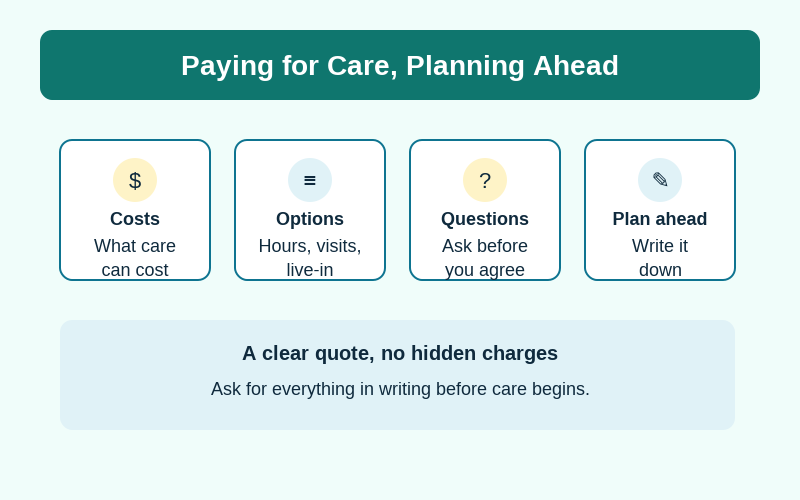
It is important not to treat any single figure as a price for your parent. The only way to know what care will cost for your family is to ask providers for their own prices, in writing, for the hours and the level of care your parent needs. Ask for a clear, written quote, with no hidden charges, and ask what is included: travel, meals, personal care, and any extra charges for evenings, weekends, or holidays. Compare quotes from more than one provider, and ask the same questions of each, so you can compare like with like. If a quote seems very low, ask what is included, and what is not. A clear quote, in writing, is the foundation of any plan.
What Affects the Price
Several things affect what home care costs, and understanding them helps you plan. The number of hours is the biggest factor: a few hours a week costs less than care every day, and overnight care costs more than daytime care. The level of need matters too. Help with washing, dressing, and meals costs less than care that includes close supervision, help with mobility, or support through the night. The location matters as well, because costs vary by area, and care in a large city often costs more than care in a smaller town.
The provider matters too. Different providers charge different rates, and they include different things in their price. Some include travel, meals, and supervision in the hourly rate. Others charge separately. Some charge more for evenings, weekends, or holidays. Some require a minimum number of hours per visit. Ask each provider what their rate includes, and what it does not, and get it in writing. If your parent's needs change, the price will change too, so ask how the provider handles changes, and how much notice they need. A provider who is clear about prices, and who explains them in writing, is easier to trust than one who is vague.
Ways Families Pay for Care
Families pay for home care in different ways, and the right way depends on your parent's circumstances, where you live, and what support is available. Some families pay from savings, or from a pension or other regular income. Some families share the cost between siblings, or between family members. Some families use insurance, if your parent has a policy that covers home care, and some receive help from local benefits or community services. Rules vary widely by location, and they change over time, so it is important to check what applies where you live, and to talk to a qualified local adviser.
Do not assume that a particular benefit, insurance, or programme will pay for your parent's care. Ask a local adviser, or a social worker, or your parent's doctor, about what support may be available, and what the rules are. Bring a list of questions, and write down the answers. If you are unsure about anything to do with money, benefits, or legal matters, talk to a qualified professional, not to a neighbour or a website. Financial decisions are important, and they deserve proper advice. If you would like to talk about care, read more about who we are or contact us, and we can help you work out what questions to ask.
Getting a Clear Quote
A clear quote is the most important document in paying for care, and it is worth taking time to get it right. Ask each provider for a written quote that sets out the hourly rate, the number of hours, the total cost per week, and what is included. Ask about extra charges: evenings, weekends, holidays, travel, and any minimum hours per visit. Ask how often the price is reviewed, and how much notice the provider gives before a price change. Ask what happens if your parent needs more hours, or fewer hours, and how quickly the provider can change the plan.
Compare quotes from more than one provider, and ask the same questions of each. Do not choose on price alone. A provider who is clear, honest, and easy to contact is worth more than a provider who is cheap but hard to reach. Check what is included in the price: a named caregiver, a care plan, supervision, and a clear way to raise concerns. Ask for the quote in writing, and keep it with the care plan. If anything in the quote is unclear, ask. A good provider will explain, in plain language, and will not pressure you to decide quickly. If you feel pressured, walk away, and talk to another provider.

Questions to Ask a Care Provider
Before you agree to care, ask the provider a set of questions, and write down the answers. The questions below are a starting point. Add your own, based on your parent's needs.
- What is the hourly rate, and what is included? Ask for the rate in writing, and ask what is included: travel, meals, personal care, and any extra charges.
- Is there a minimum number of hours per visit? Some providers require a minimum, and that affects the total cost.
- Who will be the caregiver, and will it be the same person each time? Consistency matters, especially for a person with Alzheimer disease.
- What happens if the regular caregiver is ill or on holiday? Ask who covers, and how much notice you will get.
- How is the care plan made, and how often is it reviewed? Ask who writes the plan, and how you can change it.
- What happens in an emergency? Ask who to contact, and what the provider does if your parent is unwell or has fallen.
- How do I raise a concern or make a complaint? Ask for a clear process, in writing, and a named person to contact.
- How much notice do I need to give to change or stop care? Ask about notice periods, and about any charges for cancelling.
Take your time with these questions, and do not feel rushed. A good provider will welcome them, and will answer clearly. If a provider is vague, or pressures you to decide quickly, that is a sign to talk to another provider. You can read more about our approach on our About Us page, and our complete guide to home care has more on choosing a provider.
Planning for Changing Needs
Alzheimer disease changes over time, and care needs grow. A parent who needs a few hours of help a week today may need help every day in a year or two, and may need overnight care later. Planning for changing needs means thinking ahead, not just about today, but about what might be needed in six months, or in a year. It does not mean you have to decide everything now. It means you know what the options are, and you have a plan for how to pay for them.
Talk to your care provider about how they handle changing needs. Ask how quickly they can increase hours, whether they can provide overnight care, and what happens if your parent needs more support than home care can provide. Ask about respite, so you can take a break, and about what happens if you are ill or away. Review the plan once a month, and adjust it as needs change. Keep a record of what has changed, and when, so you can see the trend. Our guide to planning respite for family caregivers shows how to arrange a break, and our complete family guide to dementia care at home describes how care changes through the stages.
Paperwork to Gather
Paperwork is boring, but it matters, and gathering it in advance saves time and stress later. Keep the following in one folder, where you can find it easily: your parent's identification, a list of medicines and allergies, contact details for the doctor and any other professionals, a list of family members and their contact details, and any legal documents your parent has made, such as a power of attorney or an advance directive. If you are unsure about legal documents, talk to a qualified local adviser, not to a website.
Keep a copy of the care plan, the provider's quote, and any agreements you have signed, in the same folder. Keep a short daily note — sleep, appetite, mood, any incidents — so you can tell a doctor what has changed, and when. Keep receipts and invoices, so you can see what care has cost, and when. If your parent is unable to make decisions, talk to a doctor and to a qualified local adviser about what to do. Do not sign anything you do not understand, and do not agree to anything under pressure. Take your time, ask questions, and get advice.
Talking About Money as a Family
Talking about money is hard for many families, and it is harder when it involves a parent's care. But it is better to talk about it early, while your parent can still take part, than to argue about it later, in a crisis. Choose a calm moment, in private, when nobody is tired or rushed. Start with care, not with numbers. "I want to make sure you get the care you need, and I want us to plan together" is kinder than "We need to talk about money".
Involve your parent as much as possible, and respect their wishes. If your parent has made decisions about their care, or about their money, write them down, and keep them with the plan. Involve siblings and other family members, and agree together how costs will be shared, and who will do what. Write it down, so everyone knows what was agreed. If family members disagree, talk it through, and if needed, ask a neutral person — a doctor, a social worker, or a local adviser — to help. Money is emotional, and it is easy to argue about it when you are tired and worried. A clear, written plan, agreed together, helps everyone. If you would like to talk about care, contact our team.
Frequently Asked Questions
How much does home care cost? It depends on how many hours you need, where you live, and the level of care. As a general guide, the median cost of home care in the United States is about $35 per hour, according to CareScout (2025), but costs vary widely. Ask providers for their own prices in writing, for the hours your parent needs.
How do families usually pay for home care? In different ways: from savings or regular income, shared between family members, through insurance, or with help from local benefits or community services. Rules vary by location, so talk to a qualified local adviser about what applies where you live.
What should I ask before agreeing to care? Ask for a written quote, with the hourly rate, the number of hours, the total cost per week, and what is included. Ask who the caregiver will be, what happens if they are ill, and how to raise a concern. Do not agree to anything under pressure.
What if my parent's needs change? Review the plan once a month, and talk to your care provider about how quickly they can increase hours or provide overnight care. Planning ahead, and keeping a record of changes, helps you adjust the plan as needs grow.
Where can I get advice about paying for care? Talk to a qualified local adviser, a social worker, or your parent's doctor. Bring a list of questions, and write down the answers. Do not rely on general information alone, because rules vary by location and by individual circumstances.
Sources and Further Reading
This guide draws on the following sources, all accessed 29 November 2026.
- Alzheimer's Association — Facts and Figures, and information on Alzheimer disease and caregiving. alz.org/alzheimers-dementia/facts-figures
- National Institute on Aging (NIA) — information on Alzheimer's disease, dementia, and caregiving. nia.nih.gov/health/alzheimers-and-dementia
- CareScout — 2025 cost of care survey, median home care cost of $35 per hour in the United States. carescout.com/cost-of-care
If this guide helped you, please share it with another family who needs it, and read our other guides on Alzheimer support at home. If you would like to talk about care for your parent, start on our homepage or contact us — a friendly advisor is ready to listen, with no obligation. You can write to us at hello@homecare.biz.id.
Tags: alzheimer home care, home care cost, senior care planning
Last reviewed: 25 June 2026. This guide is general information and is reviewed regularly. It is not a substitute for medical advice. Always talk to a doctor about diagnosis, treatment, or any change to care or medication.