
Home Care for Alzheimer Support: Planning Respite for Family Caregivers
Written by the HomeCare editorial team. Sources: Alzheimer's Association, National Institute on Aging (NIA).
Caring for a parent with Alzheimer disease is one of the hardest jobs a family can do, and it never really stops. There is no clocking off, no weekend, and no holiday from worry. Even when you are not with your parent, you are thinking about them: Did they eat? Did they sleep? Are they safe? Over weeks and months, that constant worry wears you down. You sleep badly, you skip your own appointments, you lose touch with friends, and you start to feel that nothing you do is enough. That is not a failure. It is a sign that you need a break, and that break has a name: respite.
This guide shows how to plan respite in Alzheimer home care, so family caregivers can rest and recharge. It is written for adult children caring for a parent at home, and it covers the main kinds of respite, from a few hours a week to a longer break, and shows how to plan them in advance, not in a crisis. It does not give medical advice. It simply helps you look after yourself, so you can go on looking after your parent. If you would like the wider picture first, read our complete family guide to dementia care at home and our guide to when to ask for extra help at home.
What Respite Is
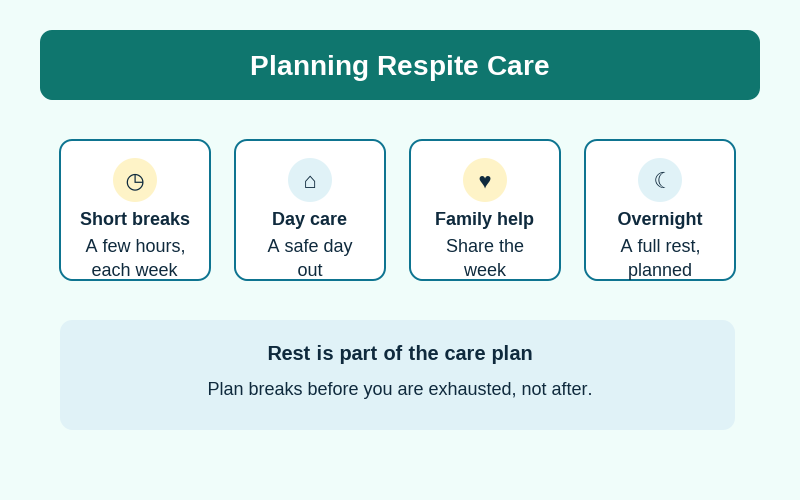
Respite is a planned break from caring, during which someone else looks after your parent, so you can rest. It can be short — a few hours a week — or longer — a day, a weekend, or a week. It can happen at home, with a professional caregiver or a family member stepping in, or it can happen elsewhere, such as a day centre or a short residential stay. The form matters less than the fact that it happens regularly, and that it is planned, not left until you are already exhausted.
Respite is not a luxury, and it is not selfish. It is part of the care plan, for your parent as well as for you. A rested caregiver is a better caregiver: more patient, more alert, and more able to cope. A caregiver who never rests is more likely to become ill, to make mistakes, or to reach breaking point, and that helps nobody. Many families find that respite also helps their parent, because it brings a change of scene, a new face, or a new activity, and because it means the main caregiver comes back refreshed. If you have never had respite, start small. A few hours a week is enough to begin, and it is easier to arrange than a long break.
Why Rest Matters
Rest matters because caring is tiring in ways that are easy to underestimate. It is physically tiring: helping with washing, dressing, and moving, lifting, and being on your feet all day. It is mentally tiring: remembering appointments, medicines, meals, and safety, and making decisions all day. And it is emotionally tiring: watching a parent change, managing distress, and carrying the worry that something might go wrong. Over time, that tiredness builds up, and it can affect your health.
Watch for the signs of caregiver burnout: exhaustion that sleep does not fix, irritability, poor sleep, headaches, skipping your own medical appointments, losing interest in things you used to enjoy, and feeling that nothing you do is enough. If you notice these signs, do not wait. Talk to your own doctor, tell another family member, and ask for help. Burnout is not a sign of weakness. It is a sign that you have been carrying too much for too long, and that you need support. Rest is not the opposite of caring. It is part of caring, and it is what allows you to go on caring well. Our guide to building a daily care plan shows how to build breaks into the week.
Short Breaks: A Few Hours Each Week
Short breaks are the simplest form of respite, and often the most useful. A few hours a week, at the same time each week, can make a surprising difference. Use the time for something that restores you: a walk, a cup of coffee with a friend, a swim, a nap, or simply an hour alone in a quiet house. Do not use the break to do chores, run errands, or catch up on paperwork, unless that is what you truly want. The point is rest, not more work.
Arrange short breaks in advance, and write them into the week's plan, so they happen regularly and are not cancelled when life gets busy. Ask a family member to cover a specific time, or arrange a professional caregiver for a few hours a week. Prepare a short note for the person covering: the main times, what your parent likes and dislikes, and any safety notes. Keep it short, so a new carer can read it in five minutes. If your parent is anxious about you leaving, keep the goodbye short and calm, and say when you will be back. "I am going out for two hours, and I will be back for tea" is easier to hear than a long explanation. Our guide to meaningful activities at home has ideas for what your parent can do while you are out.
Day Care and Group Activities
Day care is a place where your parent can spend the day, with activities, meals, and supervision, while you have the day to yourself. Day centres vary, but most offer a mix of social time, gentle activities, music, and a meal, in a safe, supervised setting. For many people with Alzheimer disease, a day centre provides stimulation, company, and routine, and for the caregiver, it provides a full day's break, every week.
Visit a day centre before you decide, and go with your parent if you can. Look at the rooms, meet the staff, and ask what a typical day looks like. Ask how many people attend, what activities are offered, and how the centre handles distress or confusion. Try a short visit first, for an hour or two, and see how your parent responds. Some people love day care from the start. Others need time to get used to it. Start slowly, and build up. If your parent does not like it, try a different centre, or a different day, before giving up. A good day centre can become a highlight of the week, for your parent and for you.
Family and Friends Sharing Care
Family and friends are often the best source of respite, because they know your parent, and your parent knows them. But sharing care needs to be organised, or it will not happen. Sit down together, as a family, and agree who does what, and when. Write it down, with names and times, so that cover is clear and nobody is left guessing. Be specific: "Anna covers Saturday morning, from nine to one" is far more useful than "Anna will help sometimes".
Be honest about what you need, and be specific about what would help. "I need two hours on Wednesday afternoon, so I can go to my own doctor" is easier to agree to than "I need help". If a family member cannot help in person, they may be able to help in another way: by paying for a few hours of professional care, by doing the shopping, or by taking your parent out for a walk. If family relationships are difficult, do not let that stop you asking. A short, clear request is easier to say yes to than a vague appeal. And if a friend offers help, say yes. People often want to help but do not know how. Give them a specific task, and a specific time, and they will be glad to do it.
Professional Respite at Home
Professional respite at home means a trained caregiver comes to your home, for a few hours, a day, or longer, so you can take a break. The caregiver follows your parent's care plan, and you can leave the house knowing your parent is safe. This is often the easiest form of respite to arrange, because your parent stays in their own home, with their own routine, and you do not have to pack a bag or travel anywhere.
When you arrange professional respite, be clear about what you need. Write a short care plan, with the main times, likes and dislikes, and safety notes, and share it with the caregiver. Meet the caregiver first, if you can, and introduce them to your parent. Start with a short visit, while you are still at home, so your parent can get used to a new face. If it goes well, build up to longer visits, and then to times when you leave the house. Ask the care provider what happens if the regular caregiver is ill, and who to contact in an emergency. A good provider will have a clear answer. If you would like to talk about care, read more about who we are or contact us.

Overnight and Longer Breaks
Overnight and longer breaks are important, especially if nights are difficult or if you need a real rest. An overnight break can mean a professional caregiver stays overnight, so you can sleep, or it can mean your parent stays somewhere else for a night or a weekend, such as a short residential stay. A longer break, of a week or two, can mean a holiday for you, while your parent is cared for at home or elsewhere.
Plan overnight and longer breaks well in advance, and prepare your parent gently. Explain simply what is happening, and when you will be back. "I am going away for a few days, and Anna will be here with you. I will be back on Monday" is easier to hear than a long explanation. Prepare a detailed care plan, with all the information a new carer needs, and make sure it is where it can be found. Leave contact numbers, and check in by phone if that helps. If your parent becomes distressed, keep the goodbye short and calm, and trust the carer to settle them. Many families find that the first longer break is the hardest, and that it gets easier after that, for everyone.
Planning Ahead, Not in a Crisis
The best time to plan respite is before you need it, not when you are already exhausted. A crisis is the worst time to find a caregiver, visit a day centre, or arrange a residential stay, because everything takes longer when you are tired and stressed. Plan respite when things are relatively calm, and build it into the routine, so it happens regularly, not only when you are at breaking point.
Start by writing down what you need: how many hours a week, at what times, and for how long. Then work out who can provide it: family, friends, a professional caregiver, or a day centre. Try one form of respite first, for a short time, and see how it goes. If it works, make it regular. If it does not work, try another form. Keep a list of options, with contact details, so you are not starting from scratch when you need help. Review the plan once a month, and adjust it as needs change. A respite plan that is written down, shared, and reviewed is far more likely to happen than a vague intention to rest "sometime". Our guide to paying for care and planning ahead can help with the financial side of respite.
Guilt, and How Families Handle It
Guilt is one of the most common feelings family caregivers have about respite. "I should be able to do this myself." "My parent would not want a stranger." "I am abandoning them." These thoughts are normal, and they are not true. Taking a break does not mean you love your parent less. It means you are looking after yourself, so you can go on looking after them. A parent who loves you would not want you to become ill from caring.
It helps to talk about guilt with someone who understands: another family member, a friend, a support group, or your own doctor. Many families find that talking to other caregivers helps more than anything else, because they understand in a way that others cannot. If guilt is strong or persistent, and it stops you from taking a break, talk to your doctor. You do not have to carry guilt alone. And remember that respite is good for your parent too. A change of scene, a new face, or a new activity can be a pleasure, and a rested caregiver is a kinder, more patient caregiver. Rest is not a reward for good caring. It is part of good caring.
Paying for Respite
Respite costs money, unless it is provided by family or friends, and it is important to plan for it. The cost depends on how many hours you need, what kind of respite it is, and where you live. A few hours of professional care a week costs less than a full day, and a day centre costs less than a residential stay. Ask for a clear, written quote before you agree to anything, with no hidden charges, and ask what is included.
As a general guide, home care in the United States has a median cost of about $35 per hour, according to CareScout (2025), but costs vary widely by location, hours, and level of need, and respite is often charged in the same way as home care. Do not assume a figure from one place applies in another. Ask providers for their own prices, in writing, and compare them. Talk to your care provider about what is available, and ask whether any local support, benefits, or community services can help with the cost. Rules vary, and a local adviser can tell you what applies where you live. Our guide to paying for care and planning ahead has more on costs, options, and questions to ask.
Frequently Asked Questions
What is respite, and why do I need it? Respite is a planned break from caring, during which someone else looks after your parent. You need it because caring is tiring, and a rested caregiver is a better caregiver. Respite is part of the care plan, not a luxury.
How do I start with respite? Start small, with a few hours a week, at the same time each week. Ask a family member, or arrange a professional caregiver. Write a short care plan, and build respite into the week's routine.
What if my parent does not want respite? Start slowly, with a short visit, while you are still at home. Explain simply what is happening, and keep goodbyes short and calm. If your parent strongly resists, try a different form of respite, or a different time, before giving up.
I feel guilty about taking a break. Is that normal? Yes, guilt is very common, and it is not true. Taking a break does not mean you love your parent less. Talk to another family member, a support group, or your doctor. Rest is part of good caring.
How do I pay for respite? Ask providers for a clear, written quote, and compare prices. Costs vary by hours, type, and location. Talk to your care provider about local support, benefits, or community services that may help. Rules vary, so ask a local adviser what applies where you live.
Sources and Further Reading
This guide draws on the following sources, all accessed 29 November 2026.
- Alzheimer's Association — Facts and Figures, and information on Alzheimer disease and caregiver support. alz.org/alzheimers-dementia/facts-figures
- National Institute on Aging (NIA) — information on Alzheimer's disease, dementia, and caregiving. nia.nih.gov/health/alzheimers-and-dementia
- CareScout — 2025 cost of care survey, median home care cost of $35 per hour in the United States. carescout.com/cost-of-care
If this guide helped you, please share it with another family who needs it, and read our other guides on Alzheimer support at home. If you would like to talk about care for your parent, start on our homepage or contact us — a friendly advisor is ready to listen, with no obligation. You can write to us at hello@homecare.biz.id.
Tags: alzheimer home care, respite care, family caregiver
Last reviewed: 25 June 2026. This guide is general information and is reviewed regularly. It is not a substitute for medical advice. Always talk to a doctor about diagnosis, treatment, or any change to care or medication.