
Home Care for Alzheimer Support: Daily Care Plan for Loved Ones
Written by the HomeCare editorial team. Sources: Alzheimer's Association, National Institute on Aging (NIA).
Caring for a parent with Alzheimer disease at home can feel like holding many threads at once: meals, washing, medicines, appointments, rest, safety, and your own life, all tangled together. A daily care plan is a simple way to untangle them. It is a written plan for one day, kept in one place, that says what happens, when it happens, and who does it. It does not need to be long or complicated. One page is often enough. What matters is that it is written down, shared with everyone who helps, and followed in roughly the same order every day.
This guide shows how to build a daily care plan for a loved one with Alzheimer disease, from morning to night. It is written for adult children caring for a parent at home, and it works whether you are the only carer or one of several. The plan covers routines, meals, and rest in one place, so that nothing important is left to memory alone. If you would like the wider picture first, read our complete family guide to dementia care at home and our guide to a calm daily routine.
What a Daily Care Plan Is
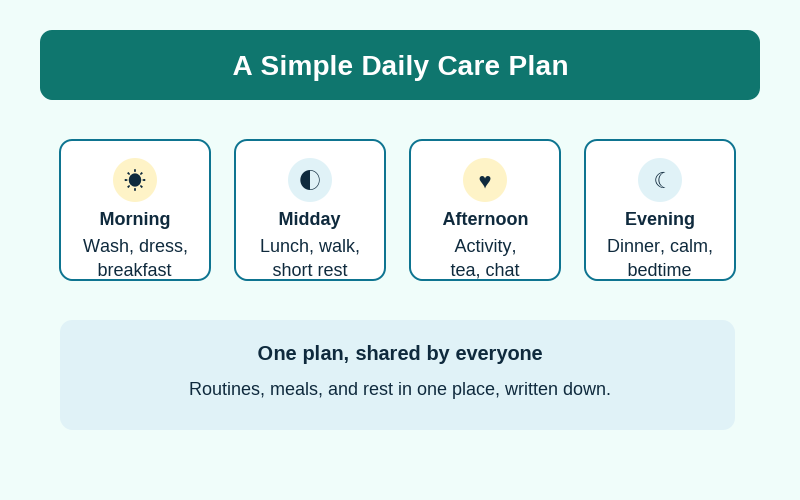
A daily care plan is a short, written plan for a single day of care. It lists the main parts of the day — waking, washing, dressing, meals, activity, rest, and bedtime — with rough times, simple steps, and notes about what your parent likes, dislikes, and needs help with. It is not a medical document, and it does not replace advice from a doctor. It is a practical tool for the family: a shared record of how the day works, so that everyone who helps follows the same day.
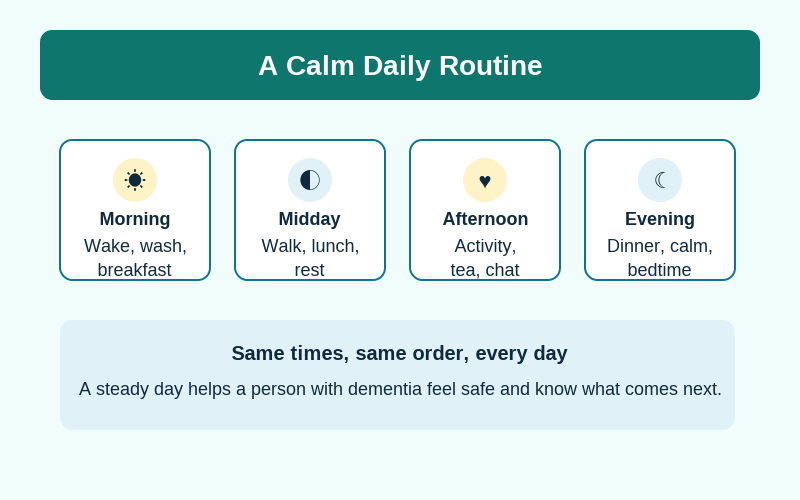
A good care plan does three things. First, it makes the day predictable for your parent. When the same things happen at the same times, in the same order, your parent does not have to work out what comes next, and that reduces confusion and anxiety. Second, it makes the day manageable for you. When the plan is written down, you do not have to hold it all in your head, and you can see at a glance what has been done and what is left. Third, it makes care consistent. If a sibling, a friend, or a professional caregiver steps in, they can follow the same plan, and your parent does not have to adjust to a different day every time a different person arrives. Our guide to helping with memory and orientation shows how routine itself acts as a reminder.
Start With What You Know
Before you write a plan, spend a few days noticing the day you already have. Write down what actually happens: what time your parent wakes, when they eat, when they are most alert, when they become tired or restless, and when they sleep. Notice the good moments too. Is there a time of day when your parent is calmer, more talkative, or more willing to do things? That pattern is the foundation of your plan, and it is more useful than any plan copied from a book.
Next, write down the facts a carer needs to know. What does your parent like to eat, and what do they dislike? What time do they usually wake and sleep? What helps them settle when they are upset? What should a carer never do? Keep it short and practical. A page of facts, written in plain language, is worth more than a long document nobody reads. Then talk to your parent, if you can, about what matters to them in a day. Ask simple questions, one at a time, and listen. A plan built around your parent's likes and dislikes is far more likely to work than one built around what a family thinks a day should look like.
Morning: Waking, Washing, Breakfast
Mornings are often the best time of day for a person with Alzheimer disease. Sleep has cleared some of the tiredness, the house is quiet, and the light is bright. That makes the morning a good time for the tasks that need the most cooperation, such as washing, dressing, and eating breakfast. Your plan should protect the morning from rushing. If you need to be somewhere, allow extra time, and prepare what you can the night before, so the morning itself is calm.
Write the morning down as a short list of steps, in order. Open the curtains, let in the daylight, and greet your parent by name, in a warm voice. Say what day it is and what is happening today, in one or two short sentences. Lay clothes out in the order they are put on, and offer a choice where you can. Break washing and dressing into one step at a time, and allow plenty of time. If your parent resists a task, do not push it into a battle. Try again a little later, or try a different approach. Breakfast deserves a calm place too: sit together, eat at the same table, and allow plenty of time. Our guide to safe bathing and personal care has more ideas for mornings when washing is hard.
Midday: Lunch, Movement, and Rest
By midday, energy often starts to dip, and that is normal. Your plan should include a short walk or some time outside in the morning, followed by lunch at the same time each day, at the same table. The walk does not need to be long. A slow walk around the garden, to the end of the street and back, or around a local park can be enough. Fresh air and daylight help the body clock, and gentle movement can improve mood and appetite. Walk at your parent's pace, not yours, and choose a familiar route.
Lunch should be simple and familiar, served one course at a time. After lunch, many people with Alzheimer disease benefit from a short rest in a comfortable chair, with a book or music. Midday is also a good time for small household tasks that give your parent a role in the home: folding laundry, watering a plant, or sorting photographs. Offer one task at a time, keep it short, and praise the effort rather than the result. Write these into the plan so that anyone helping knows what to offer, and when. Our guide to nutrition and hydration covers food in detail.
Afternoon: Activity and Connection
The afternoon is often the best time for an activity your parent enjoys. Music, looking through photographs, a simple puzzle, gardening, listening to the radio, or a gentle craft can all work, as long as the activity is matched to what your parent can still do. The goal is engagement, not achievement. Keep activities short: twenty or thirty minutes, followed by a rest, is often better than an hour that ends in frustration. Write one or two favourite activities into the plan, with a note about what works and what does not.
Connection matters more than activity. A phone call from a grandchild, a visit from a neighbour, a shared cup of tea, or a conversation about an old photograph can lift the whole afternoon. As the afternoon goes on, start to slow the house down. Turn off the television if it is only background noise, and avoid starting anything new or demanding. A calm afternoon makes a calm evening far more likely. Our guide to meaningful activities at home has more ideas, and our guide to activities that support daily engagement covers the same ground for dementia care more broadly.
Evening: Dinner and Winding Down
Evenings are often the hardest part of the day. Confusion, restlessness, and distress can grow worse in the late afternoon and evening, a pattern often called sundowning. Your plan should begin winding down an hour or two before sunset: turn the lights on before it gets dark, close the curtains, put on familiar music, and offer a warm drink and a light snack. Dinner should be at the same time, at the same table, and kept simple.
After dinner, a quiet activity — a photograph album, a familiar song, or simply sitting together — can help the evening feel settled. Avoid visitors, outings, and difficult conversations late in the day. When restlessness happens, stay calm. Do not argue or raise your voice. Acknowledge the feeling, offer a simple reassurance, and gently redirect. Write the evening steps into the plan, including what to do if your parent becomes restless, so that anyone helping knows the same calm approach. Our guide to managing sundowning at home covers this in detail.
Night: Sleep and Safety
Sleep is often broken, both for the person with Alzheimer disease and for the family. Your plan should include a regular bedtime, at the same time each night, with the same steps: a warm drink, a wash, night clothes, a short, calm conversation, and lights out. A dark, quiet bedroom helps, as does daylight in the morning. A familiar object by the bed — a photograph, a blanket, a favourite book — can help your parent feel safe in the dark.
If your parent wakes at night, the plan should say what to do: a toilet visit, a drink of water, a reassuring word, and then back to bed. Use a night light in the hallway and bathroom, so your parent can find the toilet without waking the whole house. Keep a clear path from the bed to the bathroom, with nothing to trip over. If nights become unsafe or exhausting, talk to a doctor and consider overnight help, even for a few nights a week. Our guide to supporting sleep and rest has more ideas for safer, calmer nights.
Meals and Daily Reminders
Meals and reminders deserve their own section in the plan, because they are easy to forget and hard to improvise. Write down the meal times, what is usually served, and any foods your parent likes or dislikes. Note who prepares meals, and what to do if your parent refuses to eat. Keep water within reach through the day, and note the reminders that work: a glass by the chair, a drink offered with each meal, a gentle prompt rather than a command.
Daily reminders cover more than food. Your parent may need reminders about washing, dressing, and taking medicines. The plan should say how reminders are given: one at a time, in simple words, at the right moment, not as a long list in the morning. For medicines, the plan should record the routine — the times, the organiser, and who checks — without giving medical advice. Never change a medicine, a dose, or a schedule without a doctor's advice, and if you are unsure about anything to do with medicines, talk to a doctor or pharmacist. Our guide to medication reminders and daily organisation has more on building a safe routine.
Sharing the Plan With Family and Carers
A care plan only works if everyone who helps can see it and follow it. Put the plan where everyone can find it: on the fridge, on a whiteboard, or in a folder by the front door. Give a copy to every family member who helps, and to any professional caregiver. Keep it short enough that someone new can read it in five minutes and understand the day. If the plan is long, add a one-page summary at the front: the main times, the most important likes and dislikes, and the safety notes.
Talk through the plan with other family members, and agree who does what, and when. Write names and times into the plan, so that cover is clear and nobody is left guessing. If a family member disagrees with part of the plan, talk it through and adjust it together. A plan that everyone has agreed is far more likely to be followed than one person has written alone. Review the plan together once a month, or sooner if something changes. If you would like help building a plan, you can contact our team or read more about who we are and how we work.
When the Plan Needs to Change
Care plans are not fixed. Alzheimer disease changes over time, and the plan must change with it. Review the plan whenever something changes: your parent's sleep, appetite, mood, mobility, or safety. If a change is sudden — your parent is much more confused than usual, cannot be woken, has a fever, has fallen, or is in pain — talk to a doctor promptly, not as a bad day to wait out. Sudden changes are not part of the usual pattern, and a doctor should know about them.
When you update the plan, change one thing at a time, and note the date of the change, so everyone knows which version is current. Keep old versions for a short while, so you can see what has changed and when. If the plan no longer works — if evenings are regularly difficult, if nights are unsafe, or if you are exhausted — that is a sign to ask for more help, not a sign that you have failed. Talk to a doctor and to your care provider about more hours, overnight cover, or respite. Our guide to planning respite for family caregivers shows how to arrange a break, and our guide to when to ask for extra help at home can help you decide when to ask.
Frequently Asked Questions
How long should a daily care plan be? One or two pages is enough for most families. The plan should be short enough that a new carer can read it in five minutes. If it is longer, add a one-page summary at the front with the main times and safety notes.
What if my parent does not want to follow the plan? A plan is a guide, not a timetable enforced to the minute. Offer choices, try again later, and keep the order roughly the same. If refusal becomes frequent, talk to a doctor, because pain, fear, or discomfort may be part of the problem.
How often should I update the plan? Review it once a month, and sooner if something changes. Change one thing at a time, note the date, and share the new version with everyone who helps.
Who should see the care plan? Everyone who helps with care: family members, friends who visit regularly, and any professional caregiver. Keep a copy where it can be found easily, such as on the fridge or by the front door.
Does a care plan replace medical advice? No. A care plan is a practical tool for the family. It does not diagnose, treat, or change any medicine. Always talk to a doctor about diagnosis, treatment, or any change to care or medication.
Sources and Further Reading
This guide draws on the following sources, all accessed 29 November 2026.
- Alzheimer's Association — Facts and Figures, and information on Alzheimer disease and caregiving. alz.org/alzheimers-dementia/facts-figures
- National Institute on Aging (NIA) — information on Alzheimer's disease, dementia, and caregiving. nia.nih.gov/health/alzheimers-and-dementia
If this guide helped you, please share it with another family who needs it, and read our other guides on Alzheimer support at home. If you would like to talk about care for your parent, start on our homepage or contact us — a friendly advisor is ready to listen, with no obligation. You can write to us at hello@homecare.biz.id.
Tags: alzheimer home care, dementia care, family caregiver
Last reviewed: 24 June 2026. This guide is general information and is reviewed regularly. It is not a substitute for medical advice. Always talk to a doctor about diagnosis, treatment, or any change to care or medication.