
Home Care and Caregiver Support: Respite Care Options Explained Simply
Written by the HomeCare editorial team. Sources: Alzheimer's Association, National Institute on Aging (NIA).
If you are caring for a parent at home, you have probably heard the word "respite" and wondered what it actually means. In simple terms, respite care is care that gives the main caregiver a break. Someone else looks after your parent for a few hours, a day, or longer, while you rest, catch up on your own life, or simply do nothing for a while. That is all it is. It is not a sign that you have failed. It is not a step towards moving your parent out of the home. It is a normal, practical part of caring, and it is one of the best ways to keep home care working over months and years.
This guide explains respite care simply, in plain English, for adult children caring for a parent at home. It covers the main options, from a few hours of help at home to a longer stay somewhere else, and it explains how to choose between them, what they cost, and how to plan your first break without stress. You will not find jargon here, and you will not find pressure to choose the biggest or most expensive option. The best respite is the one that fits your parent, your family, and your life, and for most families that starts small. For the wider picture of caring at home, read our complete guide to home care and our complete family guide to dementia care at home.
What Respite Care Is
Respite care is any care that lets the main caregiver take a break while someone else looks after the person who needs care. It can be informal, such as a brother or sister sitting with your parent for an afternoon, or a friend taking them out for a walk. It can also be formal, such as a professional caregiver coming to the home, a day program your parent attends, or a short stay in a care home. Both kinds count, and both kinds matter. The informal kind is often the easiest to start with, because it uses people your parent already knows and trusts. The formal kind is often the most reliable, because it can be booked in advance and repeated every week.
Respite is sometimes confused with giving up, and that confusion stops many families from using it. It helps to be clear about what respite is not. It is not a care home move. Your parent comes home afterwards, and nothing about their living arrangement changes. It is not a sign that you cannot cope. Every caregiver needs breaks, just as every worker needs days off, and taking a break is how you keep going. And it is not only for the caregiver. Many people who receive respite enjoy it. They get company, a change of scene, new activities, and time with other people. A parent who spends the day at a day program may come home happier and more settled than a parent who has spent the whole day alone with one tired caregiver.
Respite can also be planned or unplanned. Planned respite is booked in advance, on a regular basis, such as every Tuesday afternoon, or one weekend a month. This is the most useful kind, because it lets you plan your rest, your appointments, and your own life around it. Unplanned respite is for emergencies, such as when the caregiver becomes ill, or when a family crisis means you cannot be there. It is worth knowing what unplanned options exist in your area before you need them, so that you are not searching for help in the middle of a crisis.
Why a Break Matters
A break matters because caregiving, done without breaks, wears people out. That is not a criticism of caregivers. It is a simple fact about human energy. When you care for someone day after day, with no time off, your body and mind run down. Sleep gets worse, patience gets shorter, and small problems start to feel enormous. Many caregivers notice that they get ill more often, skip their own appointments, and stop seeing friends. Over time, that slow wearing down can become burnout, and burnout is what makes home care fall apart. Our guide to avoiding burnout while caring explains the warning signs in detail, and a regular break is the single most effective protection against them.
A break also matters for your parent. A tired caregiver is a less patient, less attentive caregiver, and your parent will feel the difference. After a proper rest, most caregivers come back kinder, calmer, and more able to enjoy time with their parent. That is not a small thing. Care is not only about tasks. It is about the quality of the time you spend together, and quality depends on energy. A break also gives your parent a change of company. Seeing a different face, talking to someone new, or spending time in a different place can be stimulating and enjoyable, especially for a parent who spends most of the day with one person.
There is another reason a break matters, and it is easy to overlook. If you never take a break, nobody else learns how to care for your parent. Brothers, sisters, friends, and professional caregivers never get the chance to learn the routine, and your parent never gets used to being cared for by anyone else. Then, when you are ill or away, there is no one who can step in, and a small problem becomes a crisis. Regular respite builds a small team around your parent, so that care does not depend on one person alone. That team is one of the most valuable things you can build, and it starts with a single break.
Short Breaks at Home
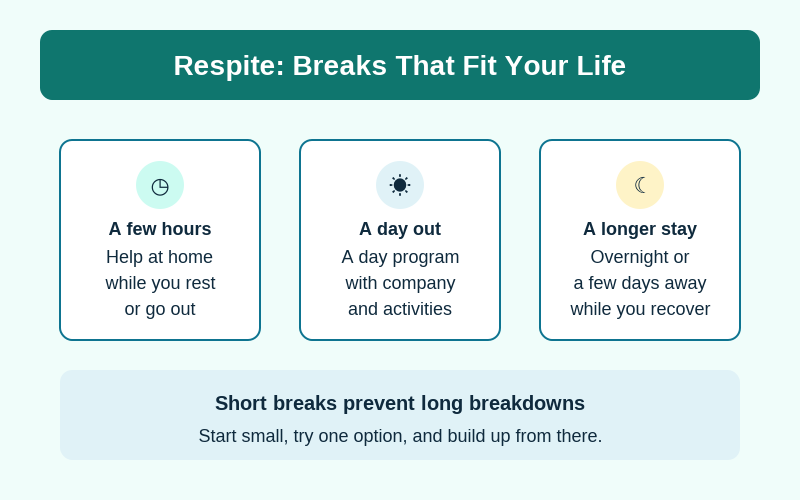
The simplest kind of respite is a short break at home. A professional caregiver comes to your parent's home for a few hours, while you go out, rest, or catch up on your own life. During those hours, the caregiver can help with washing, dressing, meals, and companionship, or simply sit with your parent while you are away. Your parent stays in their own home, in their own chair, with their own things around them, which is reassuring, especially for a parent living with dementia. For many families, this is the best place to start, because it is the least disruptive option.
Short breaks at home can be arranged in different ways. Some families use a home care agency, which sends a trained caregiver and handles the scheduling, the paperwork, and cover if the usual caregiver is ill. Others hire a caregiver directly, which can be more flexible but means the family handles the arrangements. Some families use a mix: a family member covers some breaks, and a professional covers others. The length of the break can vary too. Two or three hours is enough for a walk, a rest, or a trip to the shops. Four or five hours is enough for a longer outing, a medical appointment of your own, or a proper afternoon off. Start with the shortest break that would genuinely help, and build up from there.
To make a short break work well, prepare a simple note for the caregiver. Write down your parent's routine, their likes and dislikes, what they eat and drink, where things are kept, and what to do if something goes wrong. Keep the note short, one page, and update it when things change. It is also worth introducing the caregiver to your parent before the first break, even for a short visit and a cup of tea. A familiar face is far less unsettling than a stranger arriving on the day you leave. If your parent is unsure about a new person, start with a short break while you are still in the house, in another room, and then build up to leaving. Our guide to building a weekly care schedule shows how to write regular breaks into the week, so they happen by plan, not by chance.
Day Programs and Outings
A day program is a place your parent goes to for the day, usually for several hours, where they can take part in activities, share a meal, and spend time with other people, while trained staff look after them. Day programs are sometimes called day centres, and they vary a lot. Some are small and homely, with a handful of people, a shared lunch, music, and conversation. Others are larger, with organised activities such as crafts, gentle exercise, games, and outings. Some are designed for people living with dementia, with staff who understand memory problems and routines that feel calm and familiar.
Day programs have two advantages that other kinds of respite do not. First, they give your parent company and stimulation, which can be hard to provide at home, especially if you are busy with tasks all day. Many parents who are quiet or withdrawn at home become more talkative and lively at a day program, because they are with other people their own age, doing things they enjoy. Second, they give you a full day, not just a few hours. A full day is enough to rest properly, to catch up on sleep, to see a friend, to go to your own appointments, or simply to have a day that belongs to you. For many caregivers, one day a week at a day program is the break that makes the rest of the week possible.
To find a day program, ask your local council, a community organisation, or a dementia support service what is available in your area. Visit the program before your parent starts, and look at the place with fresh eyes. Is it clean and welcoming? Are the staff kind and patient? Do the people there look settled and content? Ask what a typical day looks like, what meals are served, and how they handle a parent who becomes confused or distressed. Then try a short visit first, perhaps an hour or two, with you there, before building up to a full day. Some parents take to a day program straight away. Others need a few visits to settle. Give it a few weeks before deciding whether it works, and talk to the staff about how your parent is settling in.
Overnight and Longer Stays
Overnight help is for the nights. A professional caregiver stays overnight, either at your parent's home or at yours, so that you can sleep properly. This is especially useful if your parent wakes at night, needs help to the toilet, or becomes restless or anxious in the dark. Broken sleep is one of the fastest routes to burnout, and it is not something you can adapt to by willpower. Even a few nights of unbroken sleep a week can make a real difference to a caregiver's energy, mood, and health. Overnight help can be arranged for a single night, for a few nights a week, or for a longer stretch, depending on what you need.
A longer stay, sometimes called a short stay or a residential break, is when your parent stays somewhere else for a few days or a week, while you take a longer break. This might be in a care home that offers short stays, or with another family member. A longer break is the right choice when you need more than a day: when you are exhausted and need a proper rest, when you need to travel, when you have a family event, or when you simply need a week to recover. Many families use a longer stay once or twice a year, as a planned break that everyone looks forward to, and some use it as a trial, to see how their parent settles in a care setting, in case a longer stay is ever needed.
Longer stays need more planning than a short break. Visit the place first, and check that it feels welcoming and well run. Ask what a typical day looks like, what meals are served, and how they handle medicine, personal care, and a parent who becomes confused or distressed. Prepare a short note about your parent, like the one you would leave for a home caregiver, and pack familiar things: a favourite blanket, photographs, a book, or a familiar item of clothing. Tell your parent about the stay in simple, honest words, and frame it positively: a short holiday, a change of scene, a chance to meet new people. And plan your own break too. A longer stay is not a time to fill with chores and paperwork. It is a time to rest, to sleep, to see friends, and to do things you enjoy. If you spend the whole week catching up on tasks, you will come back just as tired as you left.
Choosing the Right Option
With so many options, choosing can feel overwhelming. It helps to start with three questions. First, what does your parent need? A parent who is settled at home and dislikes new places may do best with help at home. A parent who is lonely, or who enjoys company and activities, may do best at a day program. A parent who needs help at night may need overnight help. Second, what do you need? If you need a few hours to rest, a short break at home may be enough. If you need a full day, a day program may be better. If you need a week, a longer stay is the answer. Third, what is available where you live? Options vary by area, and it is worth finding out what exists locally before deciding.
It also helps to try before you commit. Start with the smallest option that could help, and try it once. If it works, try it again, and then make it regular. If it does not work, try a different option, or try the same option in a different way. A parent who dislikes a day program may enjoy it after a few short visits. A caregiver who feels awkward about leaving may feel better after the first break, when they come home and find that everything went well. Give each option a fair chance, and talk to the people providing the care about what could work better.
Finally, involve your parent in the choice, as far as you can. Ask what they would enjoy, and listen to the answer. A parent who has chosen their own respite is far more likely to enjoy it than a parent who feels it has been imposed on them. If your parent has dementia and finds choices hard, offer a simple choice between two options, not an open question. And if your parent says no to every option, do not give up. Try a short break while you are still nearby, or a visit to a day program with you there, and let your parent get used to the idea slowly. Many parents who resist respite at first come to enjoy it, and many ask when they can go again.
What Respite Care Costs
Cost is a real worry for many families, and it is worth facing it honestly. Respite care costs vary widely by place, by the kind of help, and by how long it lasts. A few hours of help at home costs less than a full day at a program, and a full day costs less than a week-long stay. Prices also vary by area, so the best way to know what respite costs near you is to ask local providers for their prices, and to ask what support might be available. Do not be put off by the first price you hear. There may be community services, charities, or local support that costs less, or that offers help free of charge.
As a guide to the scale of professional help, CareScout reports a median cost of $35 per hour for home care in the United States in 2025. That figure is for home care in general, and respite at home is often priced in a similar way, by the hour. A few hours a week at that level can make a real difference to a caregiver's energy, and many families find that a small amount of paid help, combined with family help and community support, is enough to keep care sustainable. Day programs and longer stays are usually priced by the day or by the week, so ask for the full price, including meals and activities, and ask whether there is a charge for a trial visit.
When you think about cost, it helps to think about what a break is worth. A caregiver who never rests becomes ill, exhausted, or unable to continue, and that can lead to a crisis that costs far more, in money and in distress, than a regular break would have cost. Talk to your family about sharing the cost of respite, and ask local providers, community organisations, and support services what help might be available. Some families find that a brother or sister who cannot help with hands-on care is happy to help pay for it. That is a fair way to share the load, and it is worth suggesting. If you would like to talk about care for your parent, you can contact our team by email at hello@homecare.biz.id, and read more about who we are and how we work.
Planning Your First Break
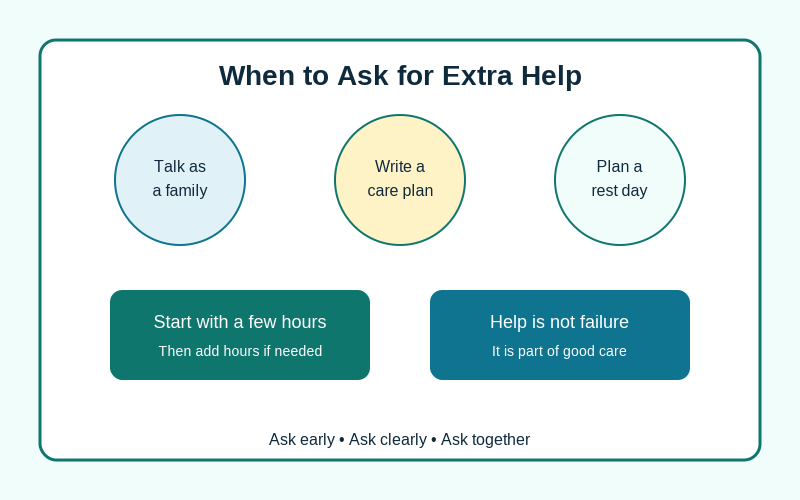
Planning your first break is easier than it feels, if you take it one step at a time. Start by choosing the smallest option that would genuinely help, and decide when it will happen. Write the date in the calendar, in ink, and tell your family. Then arrange the cover: book the caregiver, the day program, or the stay, and confirm the time, the place, and what is included. Prepare the short note about your parent's routine, likes, and dislikes, and pack anything your parent will need. Introduce the caregiver or the place to your parent before the day, if you can, even for a short visit.
Then, and this is the part most caregivers find hardest, plan what you will do with the break. Do not leave it empty, or it will fill itself with chores. Decide in advance: a walk, a rest, a visit to a friend, a meal you enjoy, or simply an afternoon with no demands. Write it down, and treat it as an appointment you cannot cancel. If guilt comes, as it often does, let it sit beside you without obeying it. Guilt is a feeling, not a fact. Feeling guilty does not mean you have done something wrong. It often means you are doing something new, and new things feel uncomfortable at first.
After the break, take a few minutes to think about how it went. What worked? What was hard? Did your parent enjoy it? Did you come back feeling rested? Write down one thing to keep the same next time, and one thing to change. Then book the next break, before the good feeling fades. Regular respite works best when it is regular, not when it happens once and is forgotten. Put it in the calendar, make it part of the weekly routine, and let it become as normal as any other part of the week. Our guide to building a weekly care schedule shows how to do that, and our guide to avoiding burnout while caring explains why it matters so much.
Frequently Asked Questions
Is respite care only for people with dementia? No. Respite care is for any family where one person is doing most of the caring, and needs a break. It is used by families caring for parents with many different needs, and by families caring for a parent who is frail, unwell, or recovering. If you are tired, respite is for you.
Will my parent feel abandoned if I use respite care? Most parents do not, especially when respite is introduced gently and framed positively. A short break at home, or a day program with company and activities, is often enjoyable for the parent too. Start small, introduce new people or places gradually, and talk to your parent honestly about what is happening.
How often should I use respite care? As often as you need it, and as often as you can arrange it. Many families start with a few hours a week, and build up to a full day a week, or a longer break every few months. A regular, planned break is more useful than an occasional one, because it lets you plan your rest and your life around it.
What if I cannot afford respite care? Start with informal respite, from family and friends, which costs nothing. Then ask local community organisations, charities, and support services what is available in your area. Some offer help free of charge, or at a lower cost. Talk to your family about sharing the cost, and remember that even a few hours a week can make a real difference.
What if my parent refuses respite care? Do not give up after one refusal. Try a short break while you are still nearby, or a visit to a day program with you there, and let your parent get used to the idea slowly. Offer a simple choice between two options, rather than an open question. Many parents who resist at first come to enjoy respite, and ask when they can go again. If refusal is frequent and distressing, talk to a doctor, because fear or discomfort may be part of the problem.
Sources and Further Reading
This guide draws on the following sources, all accessed 29 November 2026.
- Alzheimer's Association — Facts and Figures, and information on dementia care at home. alz.org/alzheimers-dementia/facts-figures
- National Institute on Aging (NIA) — information on Alzheimer's disease, dementia, and caregiving. nia.nih.gov/health/alzheimers-and-dementia
- CareScout — median home care cost of $35 per hour in the United States, 2025.
If this guide helped you, please share it with another family who needs it, and read our other guides on home care and caregiver support. If you would like to talk about care for your parent, start on our homepage or contact us — you can write to us at hello@homecare.biz.id. And if you are tired right now, book one small break this week. A few hours of rest, taken before you are exhausted, is worth far more than a week taken after you have already broken down.
Tags: home care caregiver, respite care, senior home care
Last reviewed: 27 June 2026. This guide is general information and is reviewed regularly. It is not a substitute for medical advice. Always talk to a doctor about diagnosis, treatment, or any change to care or medication.