
Home Care and Caregiver Support: Building a Weekly Care Schedule
Written by the HomeCare editorial team. Sources: Alzheimer's Association, National Institute on Aging (NIA).
If you are caring for a parent at home, your week may feel like a long list of things that never quite gets finished. Meals, washing, shopping, appointments, cleaning, and night-time help all blur together, and it is hard to know what has been done, what still needs doing, and who is supposed to do it. A weekly care schedule does not make the work disappear, but it makes it visible. When every task has a name, a time, and a person attached to it, the week becomes easier to manage, easier to share, and far less likely to fall on one person's shoulders alone.
This guide is written for adult children caring for a parent at home. It shows how to build a weekly care schedule that fits your parent, your family, and your own life. You will learn how to see the week as it really is, how to sort tasks into blocks, how to share them fairly, and how to put rest into the schedule, not just work. The guide ends with a sample week you can copy and adapt. You do not need any special tools to start: a sheet of paper, a pen, and an honest hour are enough. For the wider picture of caring at home, read our complete guide to home care and our complete family guide to dementia care at home.
Why a Schedule Helps
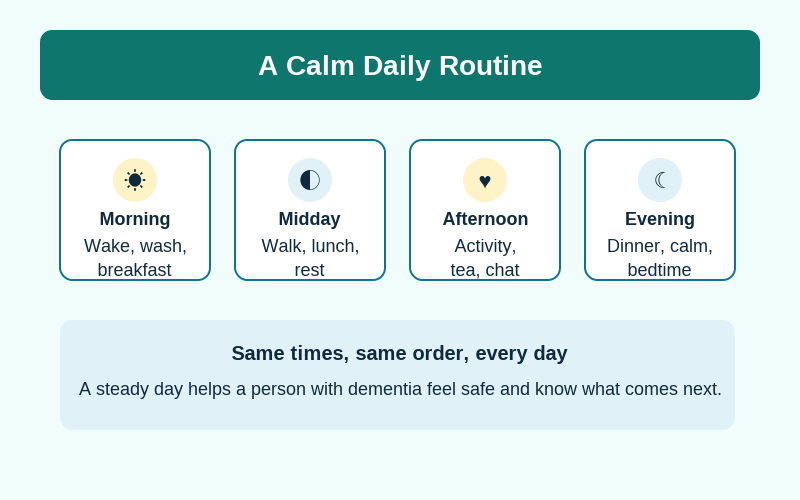
A schedule helps in three ways, and each one matters. First, it helps your parent. People who need care, especially people living with dementia, feel safer when the day has a familiar shape. When meals, washing, and rest happen at roughly the same times each day, your parent does not have to work out what comes next. The day itself tells them. A steady week also means fewer surprises, fewer rushed mornings, and fewer moments when your parent feels confused or pressed. Our guide to a daily routine for dementia care explains this in detail, and a weekly schedule is the same idea, stretched across seven days.
Second, a schedule helps the caregiver. When the week is written down, you no longer have to hold everything in your head. You can see at a glance what needs doing today, and what can wait until tomorrow. That alone reduces stress, because a task written on a page is smaller than a task circling in your mind at three in the morning. A schedule also protects your time. When rest is written into the week, in ink, it is much harder for care tasks to swallow it. And when you can see the whole week, you can spot the overloaded days before they arrive, and move a task to a lighter day, or ask for help in advance, instead of coping in a crisis.
Third, a schedule helps the whole family. Without a schedule, care work is invisible. The main caregiver does it quietly, and everyone else assumes it is being done. A written schedule makes the work visible, and visible work can be shared. When a brother or sister sees that you are doing the morning routine, the shopping, the cooking, and the night-time help, every single day, it becomes much harder to say that they are helping enough. A schedule also means that when someone else steps in, they know exactly what to do, and care stays steady whoever is there.
Before You Start: See the Week as It Is
Before you build a new schedule, spend a few days noticing the week you already have. This step is important, because a schedule built on guesswork will not fit real life. For three or four days, write down what actually happens: what time your parent wakes, when meals happen, when washing and dressing take place, when appointments fall, when your parent is most alert, and when they become tired or restless. Write down what you do too: the cooking, the cleaning, the shopping, the driving, the night-time help, and the time each task takes. Be honest, and include the small things, like reminding your parent to drink water, or helping them find their glasses.
Next, talk to your parent, if you can, about what matters to them in a week. Ask simple questions, one at a time, and listen to the answers. What do they enjoy most? A walk, a garden, music, a visit from a grandchild, a particular meal? What do they dislike? Being rushed in the morning, a noisy afternoon, a long day with no rest? A schedule built around likes and dislikes is far more likely to work than one built around what a family thinks a week should look like. Then talk to the other people who help with care, and find out what they can realistically do. Ask about their work hours, their other commitments, and the tasks they are willing to take. It is better to know the truth now than to build a schedule that depends on help that never arrives.
Finally, look at the week you have written down, and notice the patterns. Are mornings the hardest part of the day? Is there a day when everything seems to pile up, while another day is almost empty? Is there a time of day when your parent is calmer, more talkative, or more willing to do things? That pattern is your starting point. A good schedule does not fight the pattern. It works with it, putting the hardest tasks at the best times, and the rest at the times when your parent needs it most. Keep your notes, because you will need them when you build the schedule, and because they are useful to show a doctor or a care provider when they ask how things are going.
The Building Blocks of a Care Week
A care week is made of a few kinds of blocks, and it helps to sort tasks into them before you start filling in times. The first block is daily care: the things that happen every day, such as waking, washing, dressing, meals, drinks, and bedtime. These are the backbone of the week, and they should happen at roughly the same times each day. The second block is health and appointments: doctor visits, medicine reminders, and any regular check-ups. These do not happen every day, but they need a place in the week, and they often need transport and time set aside around them.
The third block is the household: shopping, cooking, cleaning, laundry, and the small jobs that keep a home running. These are easy to forget in a schedule, because they do not feel like care, but they are part of care, and they take real time. The fourth block is activity and connection: walks, music, looking through photographs, visits from family and friends, and time in the garden. These are not extras. They are what make a week worth living, for your parent and for you. The fifth block is rest, for your parent and for you. Rest is not the gap left over when everything else is done. It is a block of its own, with a time and a name, and it belongs in the schedule just as firmly as meals do.
It also helps to sort tasks by who can do them. Some tasks need you, because your parent trusts you, or because the task needs a particular skill. Many tasks do not need you specifically. Shopping, cooking, laundry, and sitting with your parent for an afternoon can be done by other family members, by a friend, or by a professional caregiver. When you sort tasks this way, you will usually find that more of them can be shared than you thought. That is the point of the exercise: to see which tasks only you can do, and to share everything else. Our guide to avoiding burnout while caring explains why sharing matters, and what happens when one person carries everything alone.
Building Your Schedule, Step by Step
Start with a blank week. A large sheet of paper works well, with seven columns, one for each day, and rows for morning, midday, afternoon, and evening. Or use a simple table in a notebook, or a shared calendar on a phone, if your family prefers that. The tool does not matter. What matters is that everyone who helps with care can see the schedule, and that it is easy to change when life changes. Put the fixed points in first: the times that do not move, such as your parent's waking time, meal times, regular appointments, and your own work hours. These are the anchors of the week, and everything else fits around them.
Next, add the daily care blocks: washing, dressing, meals, and bedtime, at the times your parent prefers. Then add the household tasks, and spread them across the week instead of piling them onto one day. Shopping on one day, laundry on another, a bigger clean on a third. Then add the activity and connection blocks: a walk on some days, a visit on others, music or photographs in the afternoon. Keep activities short, twenty or thirty minutes, followed by a rest.
Then, and this is the step most families skip, add the rest blocks. Write in your own breaks, in ink, with a name attached to the person who will cover for you. "Tuesday, two to four in the afternoon: rest. Covered by Sarah." A break without cover is a wish, not a plan. If nobody can cover, write in the help you need, and use it as the starting point for a family conversation or for arranging outside help. Finally, add the names. Every task in the schedule should have a person's name next to it. A task with no name is a task that will fall back on the main caregiver by default. When every task has a name, the load is shared, and it is clear who is doing what, and when.
A Sample Week You Can Adapt
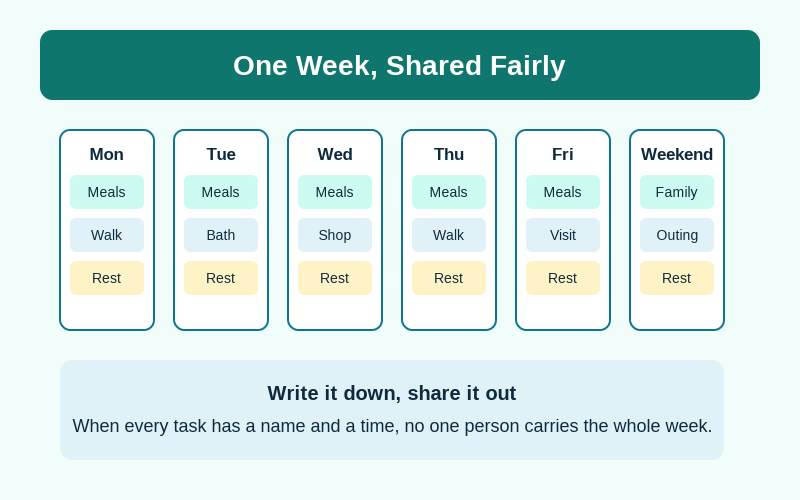
The sample week below is a starting point, not a rule. It is written for a parent who lives at home and needs help with daily tasks, and a family where one adult child does most of the care, with help from a brother or sister and a professional caregiver for a few hours a week. Adapt it to your parent, your home, and your family, and change it as needs change. Keep the order steady, keep the times roughly the same, and keep the week calm.
- Monday: Morning routine and breakfast together, then a short walk. Midday: lunch, then rest. Afternoon: music or photographs, then a cup of tea. Evening: dinner, a calm activity, and the same bedtime steps each night. Caregiver break: one hour in the afternoon, covered by a family member.
- Tuesday: Morning routine and breakfast. Midday: lunch, then a doctor or appointment visit if needed. Afternoon: rest, then a simple household task, such as folding laundry together. Evening: dinner and bedtime. Caregiver break: two hours in the afternoon, covered by a professional caregiver.
- Wednesday: Morning routine and breakfast, then shopping, with your parent if they enjoy it, or while a family member sits with them. Midday: lunch and rest. Afternoon: a visit from a grandchild or a friend. Evening: dinner and bedtime.
- Thursday: Morning routine and breakfast, then a short walk or time in the garden. Midday: lunch, then rest. Afternoon: a favourite activity, such as gardening or a simple craft. Evening: dinner and bedtime. Caregiver break: one hour in the morning, covered by a family member.
- Friday: Morning routine and breakfast. Midday: lunch, then a visit or an outing if your parent enjoys it. Afternoon: rest, then a cup of tea and a quiet conversation. Evening: dinner and bedtime. Caregiver break: the evening free, covered by a family member.
- Saturday: A slower morning, with breakfast together and no rushing. Midday: a family lunch, with brothers, sisters, or grandchildren if possible. Afternoon: a shared activity, such as looking through photographs. Evening: dinner and bedtime. The main caregiver takes the day off from the heaviest tasks, and another family member takes the lead.
- Sunday: A rest day for everyone. Morning routine and breakfast, a short walk if the weather is good, lunch, and a long afternoon rest. Evening: a simple dinner, and an early bedtime. The main caregiver takes a full break in the afternoon, covered by a family member or a professional caregiver.
Try this shape for two weeks, and keep a short note each day: what went well, what was hard, and what time of day felt best. At the end of the two weeks, adjust one thing. Perhaps the walk works better before lunch, or the shopping day needs to move, or the break on Tuesday needs to be longer. Small adjustments, made one at a time, are how a schedule becomes yours. Share the updated schedule with everyone who helps with care, so the week looks the same whoever is there. If you would like help building a schedule, you can contact our team by email at hello@homecare.biz.id, or read more about who we are and how we work.
Sharing Tasks Fairly
A schedule only works if the tasks are shared fairly, and fairness is often the hardest part to get right. The first step is honesty. Many families never talk about who does what, and the main caregiver quietly does more and more, while everyone else assumes the work is shared. A written schedule changes that, because it makes the work visible. When the whole family can see the week, it is much harder to pretend that the load is equal when it is not. Show the schedule to your family, and talk about it calmly, as a practical problem to solve together, not as an accusation.
Ask for specific help, not general help. "Can you help more?" is easy to agree to and easy to forget. "Can you take Saturday mornings, and do the shopping on Wednesdays?" is clear, and it can be written into the schedule. Remember that help does not have to mean hands-on care. A brother who lives far away can manage paperwork, pay bills, research care options, or order groceries online. A sister who dislikes personal care can cook meals for the freezer, do the laundry, or sit with your parent for an afternoon. A grandchild can visit, read aloud, or look through photographs. Every task that someone else takes is a task you do not have to carry, and every task written into the schedule with a name next to it is a task that will actually happen.
It also helps to build in a regular review. Once a week, even for ten minutes, sit down with the people who help and ask three questions: what went well this week, what was hard, and what needs to change next week? A short, regular review stops small problems from growing into big resentments, and it gives everyone a chance to say when they are struggling. If a family member cannot help as much as you hoped, that is important information, not a failure. It tells you that you need help from outside the family, and you should not feel guilty about seeking it. Our guide to talking to family about care needs has more ideas for these conversations, and our guide to respite care options explains the outside help that is available.
Putting Rest Into the Schedule
Rest is the block most families leave out of the schedule, and it is the block that matters most. A schedule that is full of tasks and empty of rest is not a plan. It is a list of things that will wear the caregiver out. Rest belongs in the schedule in ink, with a time, a length, and a person covering for you. It is not the gap left over when everything else is done. It is a block of its own, just as firmly fixed as a meal or an appointment.
There are three kinds of rest to put into the week. The first is short daily breaks: ten or twenty minutes, once or twice a day, when you step away from care completely. A short walk, a cup of tea in the garden, a few pages of a book. The second is longer breaks: an hour or two, a few times a week, when someone else takes over and you leave the house, or at least leave the caring role behind. Use these breaks for something you enjoy, not for chores. The third is a full day off, at least once a week if you can manage it, when another family member or a professional caregiver takes the lead, and you do not do care tasks at all. If a full day feels impossible, start with a full afternoon, and build up from there.
If you find it hard to rest, ask yourself why. Many caregivers feel guilty about resting, as if rest were a betrayal of the person they care for. But rest is what lets you keep caring. A caregiver who never rests becomes ill, exhausted, or resentful, and then cannot care at all. Rest protects your parent as well as you, because a rested caregiver is a kinder, safer, more patient caregiver. Write your breaks into the schedule, arrange cover for them, and then take them without apology. If you need more ideas, our self-care tips for caregivers and our guide to avoiding burnout while caring both cover rest in detail.
When the Week Falls Apart
Even the best schedule will have weeks that fall apart. Your parent may become unwell, an appointment may be cancelled, a family member may be away, or you may simply be too tired to follow the plan. That is normal. A schedule is a tool, not a test, and a week that falls apart is not a failure. It is information. When the week falls apart, simplify. Keep only the most important blocks: waking, meals, drinks, a little fresh air, and bedtime. Drop the activity, shorten the walk, offer a simpler meal. The schedule will still be there next week, and it will help again.
It also helps to have a backup plan, written down, for the times when things go wrong. Who do you ask for help if you are ill? Who can cover if a family member is away? What is the simplest version of the day that still keeps your parent safe and comfortable? Write the answers down, and share them with your family, so that nobody has to work them out in a crisis. If a change is sudden, your parent is much more confused than usual, cannot be woken, has a fever, has fallen, or is in pain, talk to a doctor promptly, not as a bad week to wait out.
After a difficult week, be kind to yourself. Talk to another family member or a support group, write down what helped, and then let the week go. Then, when you are ready, look at the schedule again, and change one thing. Perhaps a task needs to move to a different day, or a break needs to be longer, or a family member needs a different task. One small change at a time is enough. A schedule is never finished. It grows and changes as your parent's needs change, as your family's life changes, and as you learn what works. The goal is not a perfect week. The goal is a week that works well enough, most of the time, for everyone in it.
Frequently Asked Questions
How detailed should a weekly care schedule be? Detailed enough that anyone who steps in knows what to do, but simple enough that you will actually keep it. Morning, midday, afternoon, and evening blocks for each day, with a task and a name for each block, is usually enough. Avoid planning every hour, because real life will not follow it, and a schedule that is too detailed is the first one to be abandoned.
What if my parent resists the schedule? Do not turn it into a battle. A schedule is a rhythm, not a timetable enforced to the minute. Keep the order and the rough times steady, and allow the day to bend when your parent is tired or unwell. If a task is regularly refused, try a different time of day, or a different approach, and talk to a doctor if refusal becomes frequent, because pain, fear, or discomfort may be part of the problem.
What if different family members follow the schedule differently? Write the schedule down where everyone can see it, and give a copy to everyone who helps with care. A shared, written schedule means your parent does not have to adjust to a different plan every time a different person arrives. Review it together once a week, and agree on any changes as a group.
How do I fit my job into a care schedule? Start by writing your work hours into the schedule as fixed points, and then build care around them. Be honest with your family about what you can and cannot cover, and ask for help with the hours you are at work. If work and care are clashing badly, our guide to balancing work and family care has more ideas.
When should I change the schedule? Change it when it stops working. Review it once a week, and make one small change at a time. Change it more quickly if your parent's needs change, if a family member's availability changes, or if you notice that you are exhausted most days. A schedule that never changes is a schedule that nobody is looking at.
Sources and Further Reading
This guide draws on the following sources, all accessed 29 November 2026.
- Alzheimer's Association — Facts and Figures, and information on dementia care at home. alz.org/alzheimers-dementia/facts-figures
- National Institute on Aging (NIA) — information on Alzheimer's disease, dementia, and caregiving. nia.nih.gov/health/alzheimers-and-dementia
If this guide helped you, please share it with another family who needs it, and read our other guides on home care and caregiver support. If you would like to talk about care for your parent, start on our homepage or contact us — you can write to us at hello@homecare.biz.id. And if you are building your first schedule this week, start with one day, not seven. One steady day, repeated, is how a good week begins.
Tags: home care caregiver, care schedule, family caregiver
Last reviewed: 27 June 2026. This guide is general information and is reviewed regularly. It is not a substitute for medical advice. Always talk to a doctor about diagnosis, treatment, or any change to care or medication.