
Home Care and Caregiver Support: How to Avoid Burnout While Caring
Written by the HomeCare editorial team. Sources: Alzheimer's Association, National Institute on Aging (NIA).
If you are caring for a parent at home, you probably know the feeling: you wake up tired, you spend the day helping with meals, washing, medicine reminders, and appointments, and by evening there is nothing left for yourself. You love your parent, and you want to do this well, but the tiredness keeps building. That slow, heavy tiredness has a name. It is caregiver burnout, and it is one of the most common experiences in home care. It does not mean you are a bad caregiver. It means you have been giving more than you have been getting back, for longer than anyone can sustain.
This guide is written for adult children caring for a parent at home. It explains what burnout looks like, why it happens even to the most devoted caregivers, and what you can actually do about it, in small, practical steps. You will not find a perfect plan here, because there is no perfect plan. What you will find are habits that fit into a real day, ways to set limits without feeling guilty, and ways to share the work so that care does not rest on one person's shoulders alone. If you are already feeling worn out, start with the smallest step in this guide and do only that for a week. Small steps, repeated daily, are how caregivers recover their strength. For the wider picture of caring at home, read our complete guide to home care and our complete family guide to dementia care at home.
What Burnout Looks Like
Burnout does not arrive all at once. It creeps in slowly, and many caregivers do not notice it until they are already deep in it. At first, the signs look like ordinary tiredness. You sleep badly and wake up unrefreshed. You feel impatient with your parent over small things, and then feel ashamed of the impatience. You stop doing things you used to enjoy, because there never seems to be time. You cancel plans with friends, skip your own appointments, and eat whatever is quickest. Each of these things on its own seems small. Together, they are the early signs that your body and mind are running on empty.
As burnout grows, the signs become harder to ignore. You may feel exhausted even after a full night of sleep, or find that you cannot sleep at all because your mind keeps going over the day. You may feel sad or tearful without knowing why, or feel numb, as if you are going through the motions. Some caregivers notice that they get ill more often, with colds or headaches that linger. Others notice that they start to resent the person they care for, and then feel terrible guilt about that resentment. Resentment does not mean you do not love your parent. It means you are tired, and tired people have less patience. It is a signal, not a character flaw.
It also helps to know the difference between ordinary stress and burnout. Stress is the feeling of having too much to do in too little time, and it often eases when the busy period passes. Burnout is what happens when the pressure never passes. It is the feeling of having nothing left to give, of being empty rather than busy. A stressed caregiver might say, "I have so much to do today." A burned-out caregiver is more likely to say, "What is the point?" or to feel nothing at all. If you recognise yourself in the second description, take it seriously. Burnout is not a weakness, and it is not something you can push through by trying harder. Pushing through is usually what made it worse. The answer is to change the shape of your days, so that rest and help become part of the routine, not things you hope for after everything else is done.
Why Burnout Happens to Good Caregivers
Burnout happens most often to the caregivers who care the most. That sounds unfair, but it makes sense when you look at how caregiving works. Most adult children do not plan to become caregivers. It starts with a small thing, helping with shopping or a lift to an appointment, and then grows, a little at a time, until one person is doing nearly everything. Because the growth is gradual, nobody stops to ask whether the load is fair or sustainable. The caregiver keeps adapting, and the family keeps letting them, until the caregiver is doing the work of two or three people while also holding down a job and looking after their own household.
Another reason burnout is so common is that caregiving is emotional work as well as physical work. You are not only cooking meals and helping with washing. You are watching a parent change, sometimes slowly, sometimes suddenly, and grieving the person they used to be while still caring for the person they are now. That grief does not have a clear end, and it is easy to carry it silently. Many caregivers also feel alone in the role. Brothers and sisters may live far away, or may help in ways that feel unequal. Friends may not understand what the days are really like, and may stop asking. Loneliness makes everything heavier, and it makes asking for help feel harder, because you start to believe that nobody really understands.
There are also practical reasons. Caregiving rarely comes with a clear job description, a schedule, or days off. There is no end to the working day, because the person you care for lives in the same house, or because you are the person they turn to at night. Sleep is often broken, and broken sleep makes everything harder the next day. Money can add pressure too, especially if you have cut back on work hours or paid for help out of your own pocket. And many caregivers believe that a good daughter or son should manage alone, should never complain, and should always be patient. That belief turns a hard job into a lonely one, and it is the fastest road to burnout. Good care is sustainable care, and sustainable care always includes help.
Small Daily Habits That Protect You
The most useful protection against burnout is not a holiday, though a holiday helps. It is a set of small habits, repeated every day, that keep your energy from running to zero. The habits below are small on purpose. Each one takes a few minutes, and each one can fit into a day that is already full. Choose one or two to start with, and keep them for a week before adding another. The goal is not to transform your life in a day. It is to build a floor under your energy, so that a bad day does not empty you completely.
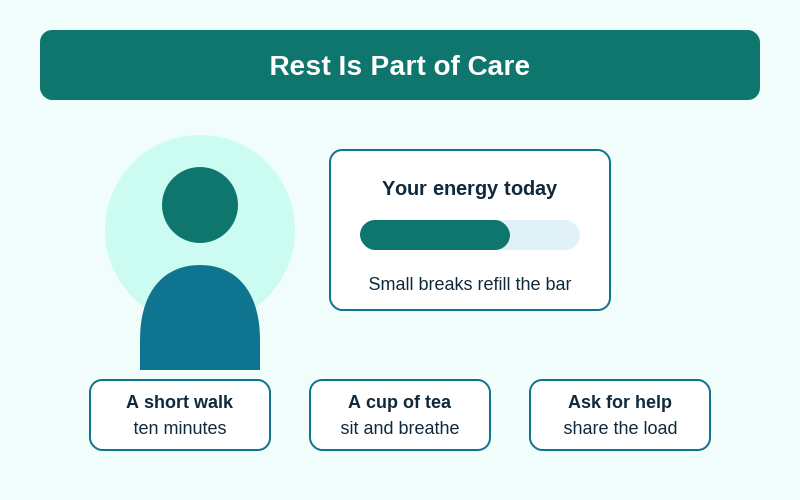
Start with the basics of the body. Drink a glass of water when you wake up, and keep a bottle of water near you during the day. Eat a real lunch, sitting down, even if it is only a sandwich and a piece of fruit. Caregivers often skip meals, and then wonder why they feel shaky and short-tempered by the afternoon. Step outside for ten minutes every day, even if it is only to stand in the garden or walk to the end of the street. Daylight and fresh air help your mood and your sleep, and a short walk is one of the simplest ways to clear a crowded mind. Treat the walk as a fixed appointment, not a luxury you can skip.
Next, protect a few minutes of quiet. Many caregivers spend the whole day responding to other people's needs, and never have a moment when nobody needs anything. Even five minutes of quiet can help. Sit with a cup of tea before the house wakes up. Listen to a favourite song while you prepare lunch. Write three lines in a notebook at night: what went well today, what was hard, and one thing you need tomorrow. That short note does two things. It helps you notice patterns, such as which times of day are hardest, and it gives you something concrete to tell a doctor or a family member when they ask how things are going. A notebook is also a kinder record than memory, because memory on a tired day tends to keep only the worst moments.
Setting Boundaries Without Guilt
Boundaries are the lines that protect your time, your energy, and your health. Many caregivers find them hard, because saying no to a parent feels like saying no to love. But a boundary is not a rejection. It is a way of making sure you can keep caring tomorrow as well as today. Saying no to some things now is what lets you keep saying yes to the important things later.
Start by naming what you can and cannot do. You might be able to cook and help with washing, but not be able to lift your parent safely, or not be able to stay awake all night. Those are not failures. They are facts about your body and your limits, and naming them honestly is the first step to getting the right help. Write your limits down, in plain words, and share them with your family. For example: "I can do mornings and evenings, but I need someone else to cover the afternoons." Or: "I can manage weekdays, but I need the weekend free."
It also helps to set boundaries around time. Decide when your caregiving day ends, and protect that hour. If you care for a parent who lives with you, that might mean closing the door to your own room at nine in the evening and not answering non-urgent requests after that time. If your parent lives elsewhere, it might mean not visiting after a certain hour, and letting them know when you will be back. Tell your parent the boundary kindly and clearly, in simple words, and repeat it gently when it is tested. Many parents, even those with memory problems, can learn a routine around your availability, especially if the boundary is steady and predictable. And if guilt comes, as it often does, let it sit beside you without obeying it. Guilt is a feeling, not a fact. Feeling guilty does not mean you have done something wrong. It often means you are doing something new, and new things feel uncomfortable at first.
Rest Without Guilt
Rest is the single most important protection against burnout, and it is the thing caregivers feel most guilty about. Many caregivers believe that rest must be earned, that they can only rest when everything is done. But in caregiving, everything is never done. There is always another meal, another wash, another question. If you wait until everything is done, you will never rest, and your body will eventually force rest on you, through illness or collapse. Rest is not a reward for finishing. It is part of the work, like fuel for a car. A car that never stops for fuel does not go further. It stops, in the middle of the road.
There are different kinds of rest, and you need more than one. Sleep is the first, and it deserves protection. Keep a regular bedtime, even on weekends, and keep the bedroom dark and quiet. If your parent wakes at night, keep the response brief and calm, and then return to bed. If nights are regularly broken, talk to a doctor and consider overnight help, even for a few nights a week. Broken sleep is one of the fastest routes to burnout, and it is not something you can adapt to by willpower. Our guide to sleep support and nighttime routine has more ideas for calmer nights.
Then there is rest during the day: short breaks that give your mind a chance to stop. A ten-minute break, taken before you are exhausted, is worth far more than an hour taken after you have already broken down. Plan your breaks in advance, and write them into the day. A break can be as simple as sitting in the garden with a cup of tea, listening to the radio, or reading a few pages of a book. The key is that during the break, you are not also doing care tasks. And if your parent needs company during your break, arrange for someone else to sit with them, even for twenty minutes. That is what respite care options are for, and our guide explains them simply.
Finally, there is the rest that comes from doing something enjoyable, not just from doing nothing. A walk with a friend, a favourite meal, a film in the evening, or a hobby you love can refill energy in a way that sleep alone cannot. Schedule one enjoyable thing each week, write it in the calendar, and treat it as an appointment you cannot cancel. If you need help to make it happen, ask for it. That is what family is for, and that is what a weekly care schedule can help you organise.

Sharing the Load With Family
One of the hardest parts of caregiving is that the work often falls unevenly. One child does most of the daily care, while brothers and sisters help occasionally, or not at all. Sometimes that is because they live far away, or because they do not see how much work there really is. If you are the main caregiver, the first step is to stop saying "I am fine" when you are not. People cannot help with a problem they do not know about, and many family members genuinely do not realise how much you do, because you have been doing it quietly.
Start with a family conversation, and prepare for it. Write down everything you do in a typical week: cooking, washing, dressing, reminders, appointments, shopping, cleaning, night-time help, and the time each task takes. Many caregivers are surprised, when they write it down, to see that they are doing thirty or forty hours of care a week on top of everything else. Share that list with your family, not as an accusation, but as information. Then ask for specific help, not general help. "Can you help more?" is easy to agree to and easy to forget. "Can you take Saturday mornings, and drive Mum to her appointment on Tuesday?" is clear, and it can be written into a schedule. Our guide to talking to family about care needs has more ideas for these conversations.
Help does not have to mean hands-on care. A brother who lives far away can still help by managing the paperwork, paying bills, researching care options, or ordering groceries online. A sister who dislikes personal care can cook meals for the freezer, do the laundry, or sit with your parent for an afternoon so you can rest. Every task that someone else takes is a task you do not have to carry. And if family cannot help, or will not help, that is important information too. It tells you that you need help from outside the family, from a professional caregiver or a community service, and you should not feel guilty about seeking it. Good care is not a test of family loyalty. It is a practical job, and practical jobs need enough hands.
When to Get Extra Help
Many caregivers wait too long to get extra help. They tell themselves they will manage for one more month, or that they will ask for help when things get really bad. But "really bad" usually means a crisis: a fall, a hospital stay, or the caregiver becoming ill. It is far better to get help early, when you can choose it calmly, than to get it in a crisis, when you have no choice. If you are reading this guide and recognising the signs of burnout in yourself, that is already a good time to look for help.
There are several kinds of help, and they fit different needs. A professional home caregiver can come for a few hours a week to help with washing, dressing, meals, or simply to sit with your parent while you rest. A day program can give your parent company and activities for a day, while you have a full day to yourself. Overnight help can cover the nights, so you can sleep properly. And respite care, which we explain in detail in our guide to respite care options explained simply, can give you a longer break, from a few days to a week or more.
Cost is a real worry for many families, and it is worth facing it honestly. Home care costs vary widely by place and by the kind of help needed, so it is best to ask local providers for their prices and to check what support is available in your area. As a guide, CareScout reports a median cost of $35 per hour for home care in the United States in 2025, which can help you understand the scale of professional help. Even a few hours a week at that level can make a real difference to a caregiver's energy, and many families find that a small amount of paid help, combined with family help, is enough to keep care sustainable. Talk to your family about sharing the cost, and ask local providers and community organisations what support might be available. If you would like to talk about care for your parent, you can contact our team by email at hello@homecare.biz.id, and read more about who we are and how we work.
A Simple Weekly Plan to Stay Steady
A plan does not need to be complicated to work. In fact, the simpler it is, the more likely you are to keep it. The plan below is a starting point. Adapt it to your week, write it down, and share it with anyone who helps with care. The aim is not to fill every hour with tasks. It is to make sure that rest, help, and your own life have a place in the week, written down where everyone can see them.
- Every day: Drink water, eat a real lunch sitting down, and step outside for ten minutes. Keep one short quiet moment for yourself, even if it is only a cup of tea before the house wakes up.
- Twice a week: Take a longer break of at least an hour, while someone else sits with your parent. Use it for something you enjoy, not for chores.
- Once a week: Talk to a friend, a family member, or a support group, even if only by phone or message. Tell them honestly how the week has been.
- Once a week: Review the week with your family. What went well? What was hard? What needs to change next week? One small change at a time is enough.
- Once a month: Look at the bigger picture. Is the load still fair? Do you need more help? Is there a task you can hand to someone else? Write down one change to try next month.
Keep the plan somewhere visible, such as on the fridge or in a shared notebook, and review it honestly. Some weeks will fall apart, because caregiving is unpredictable and life gets in the way. That is information, not failure: look at what went wrong, adjust one thing, and try again. The plan is a tool, not a test. If you want a fuller version, our guide to building a weekly care schedule walks through the whole process step by step, and our self-care tips for caregivers has more ideas for looking after yourself.
Frequently Asked Questions
Is burnout a sign that I am failing as a caregiver? No. Burnout is a sign that you have been giving more than you have been getting back, for too long. It happens most often to devoted caregivers, not to careless ones. It is a signal that the shape of your days needs to change, not a judgement on your character.
How do I know if I am burned out or just tired? Tiredness usually eases after rest. Burnout does not. If you feel exhausted even after sleeping, if you feel numb or resentful, if you have stopped enjoying things you used to like, or if you feel that nothing you do is enough, those are signs of burnout. If you are unsure, talk to your own doctor, and be honest about how you feel.
What if my family will not help? Start by sharing a written list of what you do each week, and asking for specific tasks, not general help. If family still cannot or will not help, look for help outside the family, from professional caregivers or community services. You should not carry the whole load alone.
Is it selfish to take a break when my parent needs me? No. A break is what lets you keep caring. A caregiver who never rests becomes ill, exhausted, or resentful, and then cannot care at all. Taking a break is part of good care, and it protects your parent as well as you. Plan breaks in advance, arrange cover, and then take them without apology.
When should I talk to a doctor about how I feel? Talk to your own doctor if you feel exhausted for weeks, if you cannot sleep, if you feel sad or hopeless most days, or if you have stopped looking after your own health. A doctor can help you understand what is happening and what support is available. If someone is in immediate danger, call your local emergency number.
Sources and Further Reading
This guide draws on the following sources, all accessed 29 November 2026.
- Alzheimer's Association — Facts and Figures, and information on dementia care at home. alz.org/alzheimers-dementia/facts-figures
- National Institute on Aging (NIA) — information on Alzheimer's disease, dementia, and caregiving. nia.nih.gov/health/alzheimers-and-dementia
- CareScout — median home care cost of $35 per hour in the United States, 2025.
If this guide helped you, please share it with another family who needs it, and read our other guides on home care and caregiver support. If you would like to talk about care for your parent, start on our homepage or contact us — you can write to us at hello@homecare.biz.id. And if you are tired right now, start with the smallest step in this guide, and do only that today. Small steps, repeated daily, are how caregivers recover their strength.
Tags: home care caregiver, caregiver burnout, respite care
Last reviewed: 27 June 2026. This guide is general information and is reviewed regularly. It is not a substitute for medical advice. Always talk to a doctor about diagnosis, treatment, or any change to care or medication.