
Home Care for Dementia: Creating a Calm and Familiar Home
Written by the HomeCare editorial team. Sources: Alzheimer's Association, National Institute on Aging (NIA).
When a parent is living with dementia, home is much more than a building. It is memory in physical form: the chair by the window, the kettle in the same cupboard, the photograph on the wall, the sound of the garden gate. Long after recent conversations fade, these familiar places and objects can still offer comfort and a sense of knowing where you are. A calm, familiar home does not cure anything, and it does not stop dementia from changing over time, but it can make each day easier, safer, and less frightening for the person living there, and for the family caring for them.
This guide is written for adult children caring for a parent at home. It is practical, not medical, and it focuses on small, affordable changes you can make one at a time. You do not need to redecorate the whole house or buy expensive equipment. The best changes are usually the simplest: less clutter, better light, clear signs, familiar objects kept where they have always been, and a steady routine that helps your parent know what comes next. For the wider picture, read our complete family guide to dementia care at home and our complete guide to home care. If you would like to talk through your parent's situation, you can contact our team, and about how we work explains how professional care can fit alongside family care.
Why the Home Itself Matters So Much
Dementia changes how the brain handles new information, remembers recent events, and makes sense of what the eyes see. A room that once felt obvious can become confusing: a patterned carpet may look like steps, a mirror may seem to show a stranger, a dark hallway may feel like a dead end, and a busy kitchen may feel overwhelming. At the same time, older memories and long-held habits often remain strong for much longer. Your parent may still know how to make tea, recognise a song from decades ago, or settle into a favourite chair without thinking. A home that supports those remaining strengths, and reduces new confusion, can make a real difference to mood, sleep, appetite, and confidence.
Think of the home as a set of cues. Every object, light, sign, and sound either helps your parent understand where they are and what to do next, or makes that understanding harder. A clear path to the bathroom helps. A pile of shoes in the hallway does not. A large clock showing the day and date helps. A television left on loudly in the next room does not. A familiar blanket on a familiar chair helps. A room rearranged without warning does not. Together, these cues shape whether a day feels calm or chaotic, and whether your parent feels at home or lost in their own house. When the home is easier to read, your parent needs less prompting, makes fewer mistakes, and is less likely to become distressed or to try to leave, which also makes the home safer.
Start Where Your Parent Is
Before you move anything, spend a few days watching how your parent actually uses the home. Where do they sit, and for how long? Which rooms do they use, and which do they avoid? Where do they get stuck, look confused, or ask for help? Where do they go at night? What do they reach for first in the morning? These small observations tell you far more than any checklist, because every home and every person is different. One parent may struggle most with the bathroom, another with the stairs, another with finding the kitchen at night. Start with the place where confusion or risk is greatest, and leave the rest alone for now.
Calm First: Less Noise, Clutter, and Surprise
Calm is the foundation of a dementia-friendly home, and calm usually means less, not more. Less noise, less clutter, fewer patterns competing for attention, fewer people talking at once, and fewer surprises in the day. Look at each room with fresh eyes, as if you were seeing it for the first time. Is there a pile of magazines on the table, a coat over a chair, a tangle of cables by the television, a rug that curls at the corner? Each of these is a small obstacle for a person whose attention and judgement are already stretched. Clearing them does not make the home bare or cold. It makes it easier to move through, easier to clean, and easier to understand.
Keep Familiar Things in Familiar Places
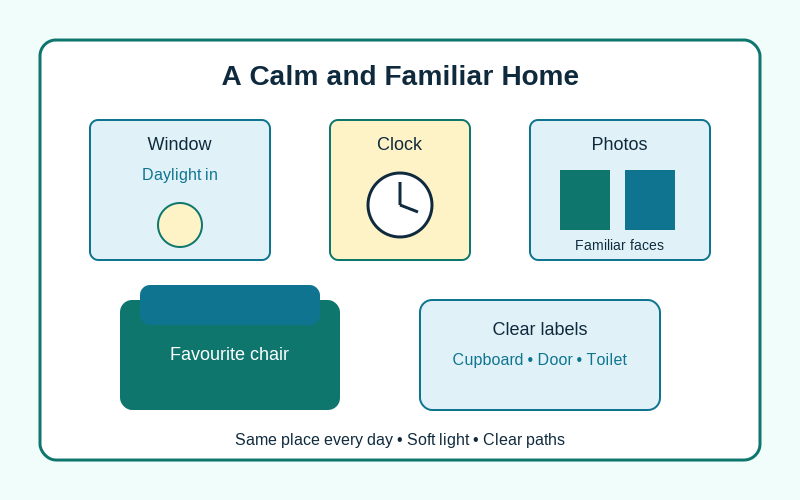
Familiar objects are anchors. A favourite chair, a well-worn blanket, a familiar mug, a photograph of a wedding day, a clock that has ticked in the same place for years — these things carry meaning that does not depend on recent memory. They tell your parent, without words, that this is home, that they belong here, and that some things have not changed. Keep those objects where they have always been, and resist the urge to tidy them away because they look old or worn. If a chair is comfortable and familiar, its age does not matter. What matters is that your parent can find it, touch it, and feel settled by it.
The same principle applies to daily routines and the objects that go with them. Keys, glasses, wallet, and phone should live in the same place every day, ideally by the door or on a small tray that is easy to see. The kettle, cups, and tea should stay in the same cupboard. Clothes should be laid out in the same order. The remote control, the newspaper, and the reading glasses should have a home that does not change. When things are always in the same place, your parent can rely on habit, even when remembering where something is has become hard. When things move around, every small task becomes a search, and every search can become a source of frustration or fear.
Clear Signs, Labels, and Daily Cues
Signs and labels are one of the simplest and most effective tools in dementia care, and they cost almost nothing. A clear sign on the toilet door, a label on the cupboard that holds cups, a picture of a bed on the bedroom door — these small cues help your parent find their way without having to remember or ask. The best signs are large, simple, and easy to read: dark letters on a light background, one or two words, and a picture as well as a word where that helps. Place signs at eye level, in the place where the decision is made, not down a hallway or around a corner. A sign that says "Toilet" on the toilet door is helpful. The same sign in the living room is not.
Daily cues work in the same way, but for time rather than place. A large clock that shows the day, date, and time in clear letters can help your parent know whether it is morning or evening. A whiteboard in the kitchen with today's plan — "Today is Tuesday. After lunch, Anna is coming. Dinner at six." — gives the day a shape that can be seen and checked. Cross items off as they happen, so the day feels finished rather than endless. A calendar with large print, kept in the same place and updated each morning, can help too. Keep these cues simple and consistent. One whiteboard, one clock, and one calendar are enough. Three whiteboards and a pile of notes will only add confusion.
Lighting: Bright Days, Gentle Evenings
Good lighting is one of the most important, and most overlooked, parts of a dementia-friendly home. As people age, eyes need more light to see clearly, and dementia can make it harder to make sense of shadows, glare, and dark corners. A dim hallway, a dark bathroom, or a room that slides into shadow in the late afternoon can increase confusion and the risk of a fall. The answer is not harsh, bright light everywhere, but steady, even light that helps your parent see where they are going, without glare or deep shadow.
During the day, let in as much natural light as you can. Open curtains and blinds in the morning, keep windows clean, and avoid heavy curtains that block daylight. Sit your parent near a window during the day if they enjoy it, because daylight helps the body's sense of time, and that can help with sleep at night. This is also one of the reasons a regular daytime routine matters, and our guide to sleep support and nighttime routine explains how daylight, activity, and a steady bedtime work together. In the evening, turn lights on before it gets dark, so the house never slides into gloom. Use warm, soft light rather than cold, harsh light, and avoid a single bright bulb in a dark room, which creates glare and shadow at the same time.
Room by Room: Living Room, Kitchen, Bedroom, Bathroom
The living room is where most of the day is spent, so it should be the most comfortable and the easiest to understand. Keep the favourite chair in the same place, with a small table nearby for a drink, a book, or glasses. Keep the television and radio simple to use, with a remote control that has large, clear buttons. Keep the floor clear, the rug flat or removed, and the way to the kitchen and the toilet obvious. A familiar blanket, a cushion, and a few photographs make the room feel like home, while a tidy surface makes it feel calm. If your parent likes to look out of the window, make sure the chair faces it, and that the curtains can be opened easily in the morning.
The kitchen needs to be safe and easy to use, without feeling like a place your parent is no longer allowed to enter. Keep everyday items — cups, plates, tea, bread — in the same cupboards, labelled with words or pictures, and within easy reach so nobody needs to climb or stretch. Keep the worktop clear, and put away sharp objects and cleaning products where they cannot be reached by mistake. A stove shut-off device, or removing knobs when the stove is not in use, can prevent a forgotten hob from becoming a danger, and our guide to managing sundowning at home also covers evening safety in the kitchen. Encourage your parent to keep helping with simple tasks — washing vegetables, setting the table, stirring a pot — because being useful is part of feeling at home, and a task done together is safer than a task done alone.
Clear Paths and Safer Movement
Clear paths are the simplest safety change you can make, and they cost nothing. Walk through the house as your parent would, from the bed to the bathroom, from the chair to the kitchen, from the front door to the garden, and notice every obstacle: a rug that curls, a cable across the floor, a bag by the stairs, a chair sticking out, a low table that is easy to trip over. Move those obstacles, or remove them altogether. Keep walkways wide enough for a person to walk comfortably, and keep the stairs free of clutter, with handrails on both sides if you can. A clear path is not only safer. It is also calmer, because your parent does not have to think about where to put their feet.
Making Changes Gradually
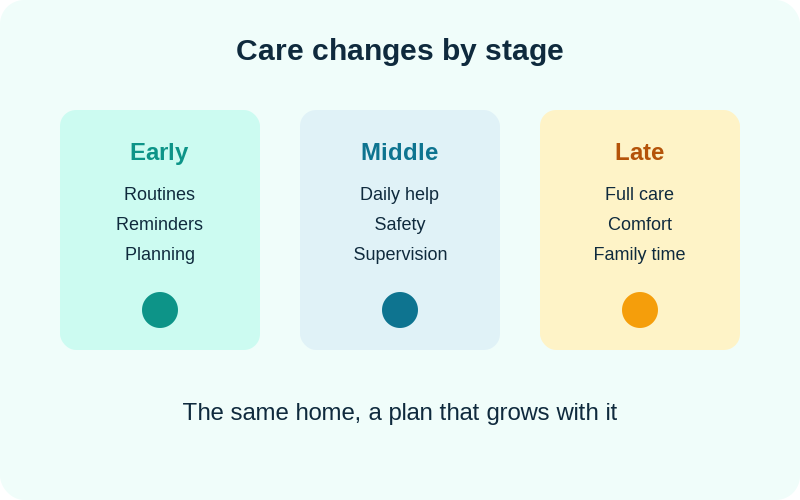
Dementia changes over time, and the home will need to change with it. A sign that helped last year may not be enough this year. A routine that worked in the early stage may need more support later. That does not mean you failed, or that the home is no longer suitable. It means the care needed has changed, and the home can change too. The best approach is to review the home regularly — once a month is a good rhythm for many families — and to ask three simple questions: what is working, what is confusing or risky now, and what is the smallest change that would help?
Make one change at a time, give it a week or two, and watch what happens before you make the next one. If a new sign helps your parent find the toilet, keep it. If a new lamp makes the hallway too bright at night, move it or dim it. If a piece of furniture has become a hazard, move it, even if it has been there for years. Keep a short note of what you changed and when, so the family can see the pattern, and so a new caregiver can understand the home quickly. A simple handover note — where things are, what the signs mean, what the routine is — is also useful for any professional caregiver who visits, and it helps the family relax when they are away.
When Home Still Feels Hard or Unsafe
Sometimes, despite your best efforts, home still feels hard. Your parent may be distressed most of the day, may try to leave at night, may fall repeatedly, or may need help around the clock that the family cannot safely provide. If that is happening, please do not blame yourself, and do not keep struggling alone. Talk to your parent's doctor, talk to your care provider, and talk honestly with the family about what is happening. A home that was safe last year may need more help now, and asking for that help is part of good care, not a failure of it.
If someone is in immediate danger — a fall with injury, sudden confusion, difficulty breathing, or a person who cannot be found — call your local emergency number straight away. Keep a list of emergency contacts by the phone, and keep a small bag ready with essentials, so a hospital visit does not become a frantic search. For non-urgent questions about care at home, you can contact our team by email. You can also read how we handle personal information and our terms and conditions before you get in touch. The home you have built, with its familiar chair, its photographs, and its quiet routines, is worth protecting — and so is the person who lives in it.
Frequently Asked Questions
Should I redecorate the whole house for dementia care? No. Small, gradual changes are usually better than a big redecoration. Start with the places where your parent gets confused or where safety is a concern, and make one change at a time. Keep familiar furniture, photographs, and objects where they are, and introduce new signs, lights, or labels slowly.
What is the most helpful first change to make? For many families, it is clearing paths and improving lighting, especially at night. A clear path from the bed to the bathroom, with a night light to guide the way, helps with safety and sleep, and it costs very little. A large, clear clock and a simple daily plan on a whiteboard are also good early steps.
Are signs and labels really helpful, or do they feel childish? Clear signs help many people with dementia find their way without having to remember or ask, and that protects independence rather than taking it away. Keep signs simple, respectful, and in the right place — one or two words, dark letters on a light background, with a picture where it helps — and ask your parent what they think of them.
Should I remove mirrors from the home? Some people with dementia are distressed by their own reflection, because they do not recognise the person in the mirror. If a mirror causes distress, cover it or move it, and see whether that helps. If a mirror causes no problem, there is no need to remove it. Watch your parent's reaction, and let that guide you.
How often should I review the home? Once a month is a good rhythm for most families, and more often if something has changed — a fall, a hospital stay, a new difficulty at night, or a change in routine. Ask what is working, what is confusing, and what is the smallest change that would help, and make one change at a time.
Sources and Further Reading
This guide draws on the following sources, all accessed 29 November 2026.
- Alzheimer's Association — Facts and Figures, and information on dementia care at home. alz.org/alzheimers-dementia/facts-figures
- National Institute on Aging (NIA) — information on Alzheimer's disease, dementia, and caregiving. nia.nih.gov/health/alzheimers-and-dementia
If this guide helped you, please share it with another family who needs it, and read our other guides on daily routines, sleep, and home safety. If you would like to talk about care for your parent, start on our homepage or contact us — a friendly advisor is ready to listen, with no obligation.
Last reviewed: 23 June 2026. This guide is general information and is reviewed regularly. It is not a substitute for medical advice. Always talk to a doctor about diagnosis, treatment, or any change to care or medication.
Tags: dementia home care, home safety, senior living