
Home Care for Memory Care: Questions to Ask When Choosing Care Support
Written by the HomeCare editorial team. Sources: Alzheimer's Association, National Institute on Aging (NIA).
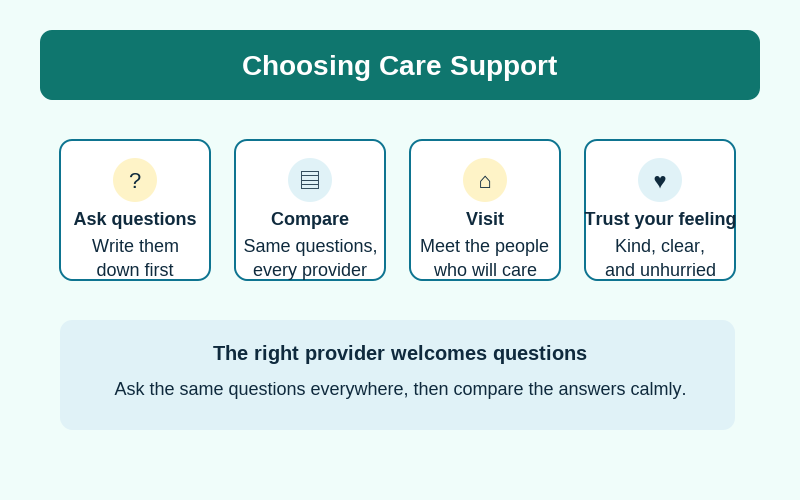
Choosing care support for a parent with dementia is one of the biggest decisions a family can make, and it can feel overwhelming. There are many providers, many options, and many promises, and it is hard to know what to ask, let alone how to compare the answers. The best protection is a list of questions, asked in the same way, to every provider, with the answers written down. This guide is written for adult children caring for a parent at home, and it gives you that list: the questions that matter, why they matter, and what a good answer sounds like. You do not need to ask them all at once, and you do not need to be an expert. You only need to ask, listen, and write down what you hear.
The right provider will welcome your questions. If a provider is impatient, vague, or unwilling to answer, that is itself an answer, and it tells you a great deal. Take your time, involve your parent as far as they can take part, and involve other family members too, so the decision is shared. If you would like the wider picture first, read our complete family guide to dementia care at home and our complete guide to home care, which explains how to choose support step by step.
Why Questions Matter
Questions matter because care is personal, and because the differences between providers are often hidden in the details. Two providers may both promise "dementia care at home", but one may send the same caregiver every time, while the other sends a different person each week. One may include a written care plan and regular reviews, while the other may not. One may answer the phone at night, while the other may not. These differences matter a great deal to your parent, and to you, and they only become visible when you ask. A provider that answers clearly, in plain language, and in writing, is showing you how they will care for your parent.
Questions also protect you from promises that sound good but mean little. "We specialise in dementia care" is a promise. "Our caregivers complete dementia training, and we review each care plan every month" is a fact you can check. "We are available around the clock" is a promise. "Here is the number to call at night, and here is what happens when you call it" is a fact you can check. Write the questions down before you meet a provider, ask them in the same words each time, and write the answers down. Then compare the answers calmly, side by side, when you are not under pressure. A good decision is a slow decision, made with clear information, not a rushed one made under pressure.
Before You Start: What Does Your Parent Need?
Before you talk to any provider, write down what your parent needs, in simple terms. What help is needed, and when? Help with washing and dressing in the morning? Help with meals? Help at night? Company during the day? How many hours a week, and at what times? What is most important to your parent: staying at home, keeping the same caregiver, or having help at night? What is most important to you: a written care plan, a phone number that is answered at night, or a provider that can increase hours quickly if needs change? A short, written list of needs is the best starting point, because it lets you ask providers whether they can meet those needs, rather than listening to what they would like to sell you.
Involve your parent in this list, as far as they can take part. Ask simple questions, one at a time, and listen to the answers. What matters most to them? What do they enjoy? What do they dislike? What would they like to keep doing? A list built around your parent's wishes is far more useful than one built around what a family thinks care should look like. And involve other family members too, so the list is shared, and so the decision is shared. If you are unsure what help is needed, talk to a doctor, who can advise on what care your parent needs now, and what they may need next. Our guide to when to ask for extra help at home explains the signs that more help is needed, and our guide to supporting independence safely explains how to balance help and independence.
Questions About the Care Itself
Start with the care itself. What help can the provider give, and how is it organised? Ask: "What help can you provide, and how is it organised?" A good answer describes the help in plain terms: help with washing, dressing, meals, medication reminders, and housework, with a written care plan that says what will happen, and when. Ask: "Will there be a written care plan, and how often is it reviewed?" A good answer is yes, with a review at least every month, or whenever needs change. Ask: "How do you assess what care is needed, and who does the assessment?" A good answer describes a visit, in your parent's home, with your parent and family present, by a trained assessor.
Ask about flexibility, because needs change. "What happens if my parent needs more hours, or help at night, or help on a weekend?" A good answer describes how hours can be increased, and how quickly. Ask about dementia specifically: "What experience do you have with dementia care, and what training do your caregivers receive?" A good answer describes specific training, and regular refreshers, not just a general promise. Ask about the first visit: "What happens on the first visit, and who will come?" A good answer describes a gentle introduction, with time to get to know your parent, rather than a rushed start. Write the answers down, and compare them, provider by provider.
Questions About the People Who Will Care
The people who will care for your parent matter more than anything else, because care is a relationship, not a service. Ask: "Will the same caregiver come each time, or will it be different people?" A good answer is the same caregiver, as far as possible, because familiarity matters a great deal to a person with dementia. Ask: "How are caregivers chosen, checked, and trained?" A good answer describes background checks, references, training, and supervision, in plain terms. Ask: "What happens if the usual caregiver is ill, or on holiday?" A good answer describes a named replacement, introduced in advance, not a stranger arriving without warning.
Ask, too, about how caregivers are supported. "How do you support your caregivers, and how long do they usually stay?" A good answer describes supervision, training, and fair conditions, because caregivers who are well supported stay longer, and care better. If you can, meet the caregiver who will come to your parent's home, before care starts, and let your parent meet them too. A short, relaxed meeting, over a cup of tea, can tell you more than any brochure. Trust your feeling: if the caregiver is kind, patient, and unhurried, and if your parent responds well to them, that matters a great deal. If something feels wrong, say so, and ask for a different caregiver. You are not being difficult. You are protecting your parent.
Questions About Cost
Cost matters, and it needs to be clear. Ask for a written quote, with no hidden charges, before care starts. Ask: "What is the hourly rate, and what is included?" A good answer gives a clear rate, and says what is included: help with personal care, meals, housework, and travel, or whether some of these cost extra. Ask: "Are there extra charges for evenings, weekends, or bank holidays, and how much are they?" Ask: "What is the minimum visit, and is there a charge for cancelling?" Ask: "How and when do we pay, and what happens if we need to change the hours?" A good answer is clear, in writing, with no surprises.
Be careful of quotes that seem too good to be true, because they often are. A very low rate may mean short visits, untrained caregivers, or hidden charges. Compare like with like: the same hours, the same help, the same days, from each provider, and ask for the total cost per week, in writing. If you are unsure what help is available, or what funding might be available, ask the provider, or ask your local council or support service. And remember that cost is only one part of the decision. The cheapest provider is not always the best, and the most expensive is not always the best either. The best provider is the one that meets your parent's needs, with kind, well-trained people, at a price you can afford, with no hidden charges. As a rough guide, CareScout reported a median cost of $35 per hour for home care in 2025, but prices vary widely by area and by provider, so always ask for a written quote for your own situation.
Questions About Safety and Emergencies
Safety questions are the ones families most often forget to ask, and they are among the most important. Ask: "What happens if my parent falls, or becomes unwell, while the caregiver is there?" A good answer describes a clear plan: the caregiver stays with your parent, calls for help, and contacts you, in that order. Ask: "Is there a phone number I can call at night, and who answers it?" A good answer gives a number, and says who answers it, and what happens when you call. Ask: "How do you handle medication reminders, and what happens if a dose is missed?" A good answer describes a clear system, with written records, and a plan for what to do if a dose is missed. Remember that caregivers should only remind and support; only a doctor can advise on medication itself.
Ask about emergencies more widely: "What is your plan for a fire, a flood, or a power cut?" "What happens if the caregiver cannot get to the house, because of snow or illness?" A good answer describes a plan, in writing, that has been thought through in advance. Ask about records: "What records do you keep, and can I see them?" A good answer describes a care log, kept in the home, that you can read at any time. And ask about complaints: "If I am unhappy with the care, who do I talk to, and what happens next?" A good answer gives a name, a number, and a clear process, without defensiveness. A provider that welcomes questions about safety and complaints is a provider that takes them seriously.
Visiting and Meeting the Team
Before you choose a provider, visit them, and meet the team, if you can. A visit tells you things a brochure cannot. Is the office welcoming, or chaotic? Are the staff kind and unhurried, or rushed and impatient? Do they listen to you, or do they talk over you? Ask to meet the manager, and the caregiver who would come to your parent's home, if possible. A short, relaxed meeting, over a cup of tea, can tell you a great deal about how the provider treats people.
If the provider offers care in a day centre or a residential setting as well as at home, ask to visit that too, and watch how the staff treat the people they care for. Are they kind, patient, and respectful? Do they use people's names? Do they listen? Trust your feeling. If something feels wrong — if the staff seem rushed, if the place feels cold, if your questions are dismissed — say so, and look elsewhere. You are not being difficult. You are protecting your parent. And involve your parent in the visit, as far as they can take part. Their response matters more than any brochure. If they respond well to the people they meet, that is a very good sign.

Comparing Options Side by Side
Once you have talked to two or three providers, compare them side by side, calmly, when you are not under pressure. Make a simple table, on paper, with the same questions down the side, and the providers across the top. Fill in each answer, in short words, from your notes. Then look at the table as a whole. Which provider answered most clearly? Which one offered the same caregiver each time? Which one had a written care plan, regular reviews, and a night-time number? Which one felt kindest, and most respectful, when you met them?
Compare cost in the same way: the same hours, the same help, the same days, from each provider, with the total cost per week, in writing. Be careful of a provider that is much cheaper than the others, because the difference may mean shorter visits, untrained caregivers, or hidden charges. And be careful of a provider that pressures you to decide quickly. A good provider will give you time to think, and will welcome a second meeting, or a second visit. If you feel pressured, step back, and talk to another family member, or a trusted friend, before deciding. A good decision is a slow decision, made with clear information, not a rushed one made under pressure.
Making the Decision Together
Make the decision together, as a family, with your parent as far as they can take part. Talk through the table you made, and listen to what each person thinks. Your parent's wishes matter most, even if they cannot express them as clearly as they once could. If your parent responds well to one provider, and not to another, that matters a great deal. If another family member has a strong feeling, listen to it. And if you disagree, take more time. There is rarely a need to decide today, and a decision made in haste is often regretted.
When you have chosen, tell the provider clearly, in writing, what you have agreed: the hours, the days, the caregiver, the cost, and the start date. Ask for a written agreement, and read it carefully before you sign it. Check the notice period, the cancellation terms, and what happens if needs change. Do not sign anything you do not understand, and do not be afraid to ask questions about the agreement itself. A good provider will explain it patiently, in plain language. If something in the agreement worries you, say so, and ask for it to be changed, or look elsewhere. You are not being difficult. You are protecting your parent, and yourself.
After You Choose: The First Weeks
The first weeks of care are a time to watch, listen, and adjust. Be present for the first visit, if you can, and introduce the caregiver to your parent, and to the home. Show them the calendar, the whiteboard, and the notebook, and explain the routine. Stay for a while, and then leave them to get to know each other. Check in regularly, in the first week, and ask your parent how it is going, in simple terms: "How was today? Did you like the visit?" Listen to the answer, and watch for signs: is your parent calmer, or more distressed? Are they eating, sleeping, and going out as before? Are the tasks being done as agreed?
If something is not working, say so early, kindly, and clearly. A small problem, raised early, is usually easy to fix: a different time, a different caregiver, a clearer instruction. A small problem, left alone, can become a big one. Ask for a review after the first week, and then after the first month, and make sure the care plan is updated as needs change. And remember that you can change provider, if the care is not right. You are not locked in forever, and a good provider will understand that. The right care is the care that meets your parent's needs, with kind, well-trained people, and it is worth taking the time to find it. If you would like help, you can contact our team to talk through a specific situation in confidence, or read more about who we are and how we work.
Frequently Asked Questions
How many providers should I talk to? Two or three is usually enough to compare. Ask the same questions, in the same words, to each one, and write the answers down. Then compare them calmly, side by side, when you are not under pressure.
What is the most important question to ask? "Will the same caregiver come each time?" Familiarity matters a great deal to a person with dementia, and a provider that can promise the same caregiver, as far as possible, is showing that they understand that.
Should I involve my parent in the decision? Yes, as far as they can take part. Their wishes matter most, even if they cannot express them as clearly as they once could. Let them meet the caregiver, and listen to how they respond.
What if I choose the wrong provider? You can change provider. Say so early, kindly, and clearly, and look elsewhere. A good provider will understand, and the right care is worth taking the time to find.
When should I ask a doctor about care? Before you choose a provider, if you are unsure what help your parent needs, and whenever memory, mood, or safety changes. Only a doctor can assess memory and advise on care.
Sources and Further Reading
This guide draws on the following sources, all accessed 29 November 2026.
- Alzheimer's Association — Facts and Figures, and information on dementia care at home. alz.org/alzheimers-dementia/facts-figures
- National Institute on Aging (NIA) — information on Alzheimer's disease, dementia, and caregiving. nia.nih.gov/health/alzheimers-and-dementia
If this guide helped you, please share it with another family who needs it, and read our other guides on dementia and memory care at home. If you would like to talk about care for your parent, start on our homepage or contact us — a friendly advisor is ready to listen, with no obligation. You can write to us at hello@homecare.biz.id.
Tags: memory care home care, senior care, family caregiver
Last reviewed: 29 June 2026. This guide is general information and is reviewed regularly. It is not a substitute for medical advice. Always talk to a doctor about diagnosis, treatment, or any change to care or medication.