
Home Care for Memory Care: How to Support Independence Safely
Written by the HomeCare editorial team. Sources: Alzheimer's Association, National Institute on Aging (NIA).
Independence is not only about doing things alone. It is about having a say in your own life: choosing what to wear, what to eat, when to go out, and how the day goes. For a person with dementia, that sense of choice can fade quickly, as family members, meaning well, begin to do everything for them. The result is often the opposite of what the family intends. A parent who is no longer allowed to do anything loses skills faster, feels less like themselves, and can become withdrawn, frustrated, or distressed. This guide is written for adult children caring for a parent at home, and it shows how to support independence safely, so your parent can keep doing as much as they can, for as long as they can.
The balance is not easy. Too little help, and your parent may be unsafe. Too much help, and they lose the very skills and confidence you are trying to protect. The answer is to offer the smallest help that works, and to let your parent do the rest. Do with, not for. Offer a choice, not a command. Break a task into small steps, and let your parent do the steps they can. And keep the home safe, so that independence does not mean danger. If you would like the wider picture first, read our complete family guide to dementia care at home and our guide to daily habits that support recall, which explains how steady routines support independence too.
Why Independence Matters
Independence matters because it is tied to who we are. Doing things for ourselves — making a cup of tea, choosing a shirt, walking to the shops — is how we feel capable, useful, and in control of our own lives. When those things are taken away, even with the best intentions, a person can feel helpless, and helplessness can lead to low mood, withdrawal, and a faster loss of skills. A parent who is allowed to do what they can, with a little help, keeps their skills alive for longer, and keeps their sense of self intact. That is not only kinder. It is also practical, because a parent who can do more needs less help, and the family has more energy for the things that really matter.
Independence also matters because it is what your parent would want, if they could choose. Most older people, asked what matters most to them, say the same thing: to stay at home, to make their own choices, and to be treated as an adult. Dementia does not take away that wish. It only makes it harder to achieve, and it makes the family's role more important. Your job is not to take over your parent's life. It is to make it possible for them to live as much of it as they can, safely, for as long as they can. That means offering help, not taking control, and it means listening to what your parent wants, even when what they want is not what you would choose.
Do With, Not For
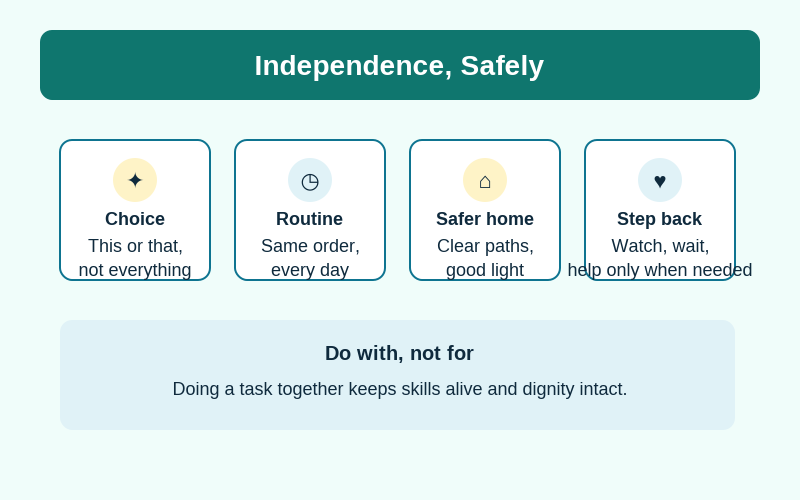
The simplest rule for supporting independence is this: do with, not for. If your parent can stir a pot, let them stir it, while you chop the vegetables. If they can fold laundry, let them fold it, while you carry the basket. If they can choose a shirt, let them choose, even if it takes longer, and even if the choice is not the one you would make. Doing a task together keeps the skill alive, and it gives your parent a sense of purpose. Doing it for them, however kindly, takes the skill away, a little at a time, until it is gone.
Doing with takes more time, and more patience, than doing for. It is often quicker to dress your parent yourself than to wait while they do it slowly, one step at a time. But the extra minutes are worth it, because they are minutes in which your parent is still doing something for themselves. Sit beside them, offer a gentle cue — "Now the blue shirt" — and wait. If they struggle, offer a little more help: hold the shirt open, guide an arm through the sleeve, and let them do the rest. If they become tired or frustrated, step in a little more, and try again tomorrow. The goal is not perfection. It is participation, however small, in the tasks of everyday life. Our guide to safe bathing and personal care has more ideas for keeping washing and dressing dignified and shared.
Choice, in Small Doses
Choice is one of the easiest ways to support independence, and one of the most often overlooked. A person with dementia may struggle with open questions — "What would you like to do today?" — because the question is too big, and the answer needs too much thinking. But a small, simple choice — "Tea or coffee?" "The blue shirt or the green one?" "A walk now, or after lunch?" — is easy to answer, and it gives your parent a real say in their own day. Offer two options, not ten, and let your parent choose. If they cannot choose, offer one option gently: "Let us have tea now." A choice offered kindly is better than no choice at all.
Offer choices throughout the day, not only at mealtimes. What to wear, what to watch, where to sit, what to do in the afternoon: each small choice is a reminder that your parent's wishes still matter. And respect the choice, even if it is not the one you would make. If your parent chooses the green shirt when you would have chosen blue, let them wear green. If they choose to stay in when you think a walk would be good, let them stay in, and try again tomorrow. The point of choice is not to get the right answer. It is to give your parent a voice in their own life. If choices become too hard, simplify further: hold up two shirts, and let your parent point. A pointed finger is still a choice, and it still matters.
Routine as a Support
Routine is one of the best supports for independence, because it removes the need to remember what comes next. When the day follows the same order — wake, wash, breakfast, walk, lunch, rest, tea, dinner, bedtime — your parent does not need to work out what to do. The day itself tells them. A steady routine means your parent can follow the day with less help, and can do more for themselves, because the pattern is familiar. It also means that everyone who helps with care follows the same day, so your parent does not have to adjust to a different plan every time a different person arrives.
Build the routine around your parent, not around a timetable. Notice when they are most alert, when they are most tired, and when they enjoy doing things, and shape the day around those times. Write the routine down where everyone can see it, on a whiteboard or a large-print sheet, and keep it the same, as far as you can, even on weekends. If the day slips — a late night, a visitor, a bad day — return to the usual order the next day. The routine is the pattern over weeks, not perfection on any single day. Our guide to building a calm daily routine walks through the whole day, hour by hour, and our guide to daily habits that support recall explains how habits help memory too.
Breaking Tasks Into Small Steps
Most everyday tasks are made of many small steps, and a person with dementia may struggle to hold all of them in mind at once. The answer is to break the task down, and offer one step at a time. Getting dressed becomes: "First, the shirt." Then: "Now, the trousers." Then: "Now, the socks." Making tea becomes: "Fill the kettle." Then: "Switch it on." Then: "Put a tea bag in the mug." One step, one cue, and time to respond, before the next step is offered. When the steps are small and steady, your parent can follow them, and the task gets done without a battle.
Use the same words for the same steps, so the words become familiar. Lay out what is needed in the order it will be used: clothes in the order they are put on, ingredients in the order they are used, tools in the order they are needed. If a task becomes too hard, break it into even smaller steps, or do the harder parts together. And if a task is no longer possible, change the task, not the person. A person who can no longer cook a full meal may still enjoy stirring a pot, or setting the table, or washing vegetables. A person who can no longer dress alone may still choose their clothes, or button a shirt. Find the part they can still do, and let them do it. Our guide to helping with appointments and daily tasks has more ideas for breaking tasks into small, steady steps.
A Safer Home, Without Taking Over
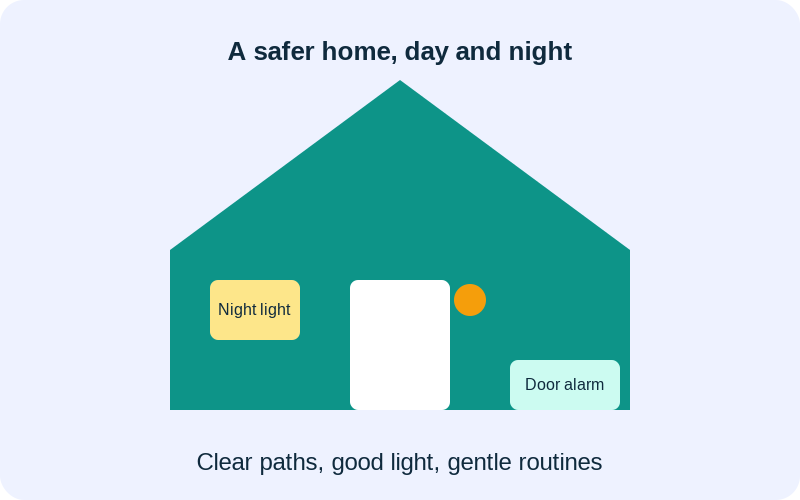
A safer home supports independence, because it lets your parent do more without help, and without danger. Keep the floor clear, the rug flat or removed, and the way to the kitchen and the toilet obvious. Use good lighting, especially at night, and keep a night light in the hallway and bathroom. Keep the most-used items at eye level, in the same place, so your parent does not need to reach, climb, or search. Label the cupboards, so your parent can find things without asking. These small changes make the home easier to live in, and they let your parent do more for themselves, safely.
Safety aids should be discreet, not intrusive. A grab bar in the bathroom, a raised toilet seat, or a non-slip mat in the shower can make a real difference, without making the home feel like a hospital. A door alarm that sounds when an outside door opens can keep your parent safe at night, without locking them in. If you are unsure what aids would help, talk to a doctor, or ask your local council or support service what is available. And remember that safety is not only about the home. It is also about the plan: a shared calendar, a written routine, and a note of who to call if something goes wrong. Our guide to preparing the home for changing needs has more ideas for a safer home, and our guide to creating a calm and familiar home covers lighting and clear paths.
When to Step In
Supporting independence does not mean never helping. There are times when you must step in, and knowing when is part of good care. Step in when your parent is unsafe: leaving the stove on, wandering at night, or getting lost. Step in when a task has become too hard, and your parent is distressed, frustrated, or exhausted. Step in when a medical problem needs attention: a fall, a sudden change in confusion, a fever, or pain. And step in when your parent asks for help, because asking for help is a sign of trust, not of failure.
When you step in, do it kindly, and explain what you are doing, in simple terms: "Let me help you with this step." "I will hold the pan while you stir." Do not take over without a word, because that feels like being pushed aside. And do not step in too early, either. If your parent is doing a task slowly, but safely, let them finish it. The extra minutes are worth it, because they are minutes in which your parent is still doing something for themselves. If you are unsure whether to step in, watch and wait for a moment. Often, your parent will manage, given a little more time, and a gentle cue. If they cannot, step in kindly, and try again tomorrow.
Dignity in Everyday Care
Dignity is not a luxury. It is the heart of good care, and it is shown in small, everyday ways. Knock before entering a bedroom or bathroom. Ask before helping with a personal task, and explain what you are doing. Use your parent's name, and speak to them as an adult, not as a child. Keep their body covered during washing, and give them privacy whenever you can. Let them choose their clothes, their food, and their activities, as far as they safely can. And listen to what they say, even if it is repeated, even if it does not make sense to you. Listening is a form of respect, and it costs nothing.
Dignity also means being honest. Do not lie to your parent, even kindly, because lies break trust, and trust is hard to rebuild. If you cannot do something they ask for, say so kindly, and offer an alternative: "We cannot go out today, because it is raining, but we can have tea in the garden tomorrow." If your parent is upset, acknowledge the feeling, rather than dismissing it: "I can see you are sad. I am here." Small kindnesses, repeated every day, are what make care feel like care, rather than control. Our guide to safe bathing and personal care has more ideas for keeping personal care dignified and calm.
Letting Go Gradually
As dementia progresses, your parent will need more help, and will be able to do less alone. That change is gradual, and it is often hard for families to accept, because each small loss — a task that can no longer be done, a choice that can no longer be made — feels like another piece of the person slipping away. Letting go gradually means accepting each change as it comes, and finding the new balance, rather than fighting it or pretending it has not happened. When a task becomes too hard, simplify it, or share it, or let it go, and find something else your parent can still do.
Letting go is not giving up. It is making room for what your parent can still do, and for the care they now need. It is also a time to talk as a family, about what matters most, and about what help is needed. If you are finding it hard to let go, talk to another family member, or a support group, because other families have faced the same feelings, and they can help. And remember that asking for extra help is not a failure. It is part of good care, and it is what your parent would want, if they could choose. Our guide to when to ask for extra help at home explains the signs, and our guide to questions to ask when choosing care support can help you compare options.
Asking for Help
You do not need to support your parent's independence alone. Other family members can help with daily tasks, or take your parent out, and a regular arrangement — a daughter on Tuesdays, a neighbour on Saturdays — is better than asking for help at the last minute. A professional caregiver can help with personal care, or with household tasks, and a written plan, shared with everyone who helps, means the same routine works whoever is there. If you are feeling exhausted, or if caring is taking a toll on your own health, talk to your own doctor, tell another family member, and ask for help before you reach breaking point.
There is also help available from local services. Some areas have support groups, day centres, or advice services that can help with planning, paperwork, and care. A support group can be a lifeline, because it reminds you that you are not alone, and that other families are facing the same challenges. If you would like to explore professional help, read our guide to questions to ask when choosing care support. You can also contact our team to talk through a specific situation in confidence, or read more about who we are and how we work.
Frequently Asked Questions
How do I balance safety and independence? Offer the smallest help that works, and let your parent do the rest. Do with, not for. Break tasks into small steps, offer choices in small doses, and keep the home safe, so independence does not mean danger. Step in when your parent is unsafe, distressed, or asks for help.
What if my parent insists on doing something unsafe? Acknowledge the wish kindly, and offer a safer alternative: "I know you would like to cook dinner. Let us cook it together." If the task is truly unsafe, talk to a doctor, and involve another family member or a trusted professional in the conversation.
Should I let my parent make their own choices? Yes, as far as they safely can. Offer two simple options, not ten, and respect the choice, even if it is not the one you would make. A choice offered kindly is better than no choice at all.
What if my parent can no longer do a task they used to do? Simplify the task, share it, or find the part they can still do. A person who can no longer cook a full meal may still enjoy stirring a pot, or setting the table. Find the part they can still do, and let them do it.
When should I ask a doctor about independence and safety? If memory problems are new, getting worse quickly, or affecting safety — getting lost, leaving the stove on, forgetting to eat or drink — talk to a doctor promptly. Only a doctor can assess memory and advise on care.
Sources and Further Reading
This guide draws on the following sources, all accessed 29 November 2026.
- Alzheimer's Association — Facts and Figures, and information on dementia care at home. alz.org/alzheimers-dementia/facts-figures
- National Institute on Aging (NIA) — information on Alzheimer's disease, dementia, and caregiving. nia.nih.gov/health/alzheimers-and-dementia
If this guide helped you, please share it with another family who needs it, and read our other guides on dementia and memory care at home. If you would like to talk about care for your parent, start on our homepage or contact us — a friendly advisor is ready to listen, with no obligation. You can write to us at hello@homecare.biz.id.
Tags: memory care home care, senior independence, home safety
Last reviewed: 29 June 2026. This guide is general information and is reviewed regularly. It is not a substitute for medical advice. Always talk to a doctor about diagnosis, treatment, or any change to care or medication.