
Home Care for Dementia: When to Ask for Extra Help at Home
Written by the HomeCare editorial team. Sources: Alzheimer's Association, National Institute on Aging (NIA), CareScout 2025 Cost of Care Survey.
Most families caring for a parent with dementia reach a point where they wonder whether they need extra help. It may come quietly, after a difficult night, a fall, or a week when everything felt harder than usual. It may come as a feeling of exhaustion that sleep does not fix, or as a worry that a parent is no longer safe alone, even for a short time. If you are reading this guide, you may already be at that point. This guide is here to help you recognise the signs, talk about them as a family, and plan the next step without panic or guilt.
This guide is for adult children caring for a parent at home. It explains the signs that more help may be needed, the kinds of help available, how to start small, how to plan respite, and how to choose a provider. For the wider picture, read our complete family guide to dementia care at home, our daily routine guide, and our complete guide to home care. If you would like to talk through your parent's situation, you can contact our team, and about how we work explains how professional care can fit alongside family care.
Asking for Help Is Part of Good Care
Many families feel guilty about asking for extra help, as if it means they have failed, or as if they are giving up on a parent they love. That feeling is understandable, and it is also wrong. Asking for help is part of good care, not a failure of it. Dementia care is a long journey, and no single person can do it alone, day and night, for months or years, without rest or support. A family that asks for help early is more likely to keep caring well for longer, and a parent who receives the right help at the right time is safer, calmer, and more comfortable.
Think of extra help as adding to the care your parent already receives, not replacing it. A few hours a week from a companion, a regular visit to help with personal care, or an overnight stay so you can sleep — these are all ways of making the care your family already gives sustainable. Your parent still has you, still has their home, and still has their routine. Extra help simply means there is another pair of hands, another pair of eyes, and another person who cares. That is a strength, not a weakness, and it is worth saying out loud, to yourself and to your family.
Signs Your Parent May Need More Help
There are signs that a parent's needs have grown beyond what the family can safely provide alone. Watch for frequent falls, weight loss, repeated infections, wounds that do not heal, or a parent who forgets to eat or drink. Watch for wandering at night despite safety measures, for a parent who tries to leave the house, or for a parent who becomes distressed, frightened, or aggressive in a way that puts family or caregivers at risk. Any one of these deserves a conversation with a doctor and with your care provider, not a silent decision to carry on regardless.
Other signs are quieter, but just as important. A parent who is lonely, bored, or distressed most of the day, who no longer enjoys the activities they once loved, or who seems anxious whenever they are alone may benefit from more company and more structured days. A parent who needs help with bathing, dressing, eating, or moving around the house, and who needs that help every day, may benefit from regular professional care. A parent whose needs change suddenly — after a fall, a hospital stay, or an infection — may need more help for a short time, and then less again. The pattern matters more than any single day, so keep a short note of what you notice, and share it with the doctor.
Signs the Family May Need More Help
Sometimes the sign is not in the parent, but in the family. Watch for exhaustion that sleep does not fix, irritability, poor sleep, headaches, skipping your own medical appointments, and feeling that nothing you do is enough. Watch for a family member who has stopped seeing friends, stopped working, or stopped looking after their own health because care takes all their time. Watch for arguments between brothers and sisters about who does what, or for a partner who is struggling to cope. These are signs that the family needs help, and they deserve to be taken as seriously as any sign in the parent.
If you notice those signs in yourself, please hear this clearly: feeling tired, resentful, or guilty does not make you a bad daughter or son. It makes you a human being doing a very hard job for a very long time. Talk to your own doctor, tell another family member, and ask for help before you reach breaking point. A support group — in person or online — can help enormously, because other caregivers understand in a way that well-meaning friends often cannot. Our guide to sleep support and nighttime routine also covers looking after the caregiver's sleep, and our guide to daily activities has ideas for sharing tasks.
Talking About It as a Family
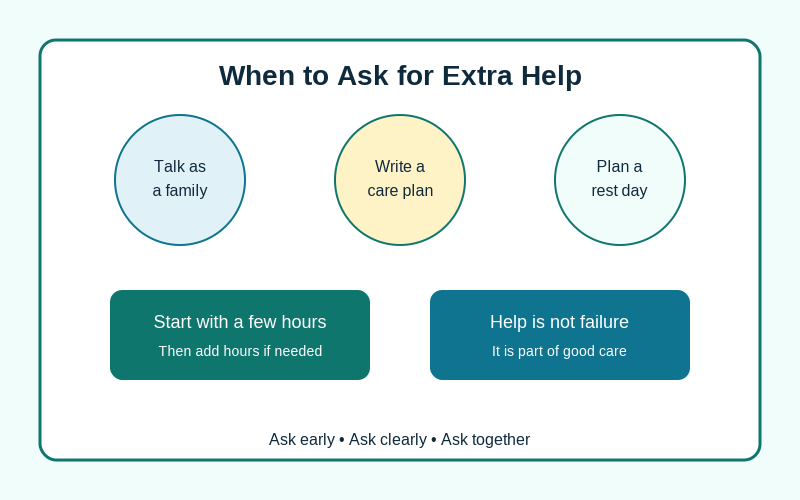
Talking about extra help can be difficult, especially if family members disagree, or if your parent does not want help. Choose a quiet moment, listen more than you speak, and focus on safety, comfort, and your parent's wishes, rather than on who is right or wrong. Share what you have noticed, using simple facts rather than blame: "Mum fell twice this month" is easier to hear than "you are not coping." Ask your parent what matters most to them — staying at home, seeing grandchildren, a favourite walk — and explain how extra help can protect those things, rather than take them away.
Involve brothers, sisters, partners, and other close relatives from the beginning. Share observations, agree on what matters most, and decide who will handle research, finances, and communication with providers. Clear roles prevent misunderstandings later. If family members disagree, focus on your parent's wishes and safety first, and consider asking a doctor, social worker, or care coordinator to help guide the discussion. It can also help to talk to your parent more than once, in short conversations, rather than trying to settle everything in one long talk. A decision made together, slowly, is more likely to last than a decision made in a crisis.
Kinds of Extra Help Available
Extra help can take many forms, and it does not have to mean a big change all at once. Companion care — a friendly visit, help with meals, a walk, or company — is often the first step, and it can lift mood and give the family a break. Personal care — help with bathing, dressing, grooming, and moving around the house — is often the next step, when daily tasks need more support. Overnight care, or live-in care, can help when nights are unsafe or when the family needs sleep. Skilled care, provided by trained nurses under a doctor's direction, can help when medical needs are part of the picture.
Other kinds of help are worth knowing about too. Day care, or a day centre, can give your parent company and structured activities during the day, while you work or rest. A meal delivery service, a transport service, or help with housework can all reduce the daily load. A care coordinator, a social worker, or a local support group can help you find what is available in your area, and can help you plan. You do not need to choose everything at once. Start with the help that matches the need you have today, and add more as needs change.
Starting Small: A Few Hours a Week
Starting small is often the best way to begin. A few hours a week, at a regular time, with the same caregiver, gives your parent time to get used to a new person, and gives the family time to see whether the help works. Arrange an introduction before care begins, so your parent can meet the caregiver in a familiar room, with a family member present. Watch how the caregiver speaks to your parent, and trust your instincts — if your parent seems relaxed and respected, that is a good sign.
Write a short handover note for the caregiver — routines, likes and dislikes, what calms your parent, and who to call — so they can start well, and so you can actually relax while you are away, rather than worrying the whole time. Agree a written care plan together, covering routines, meals, appointments, safety measures, and emergency contacts, and review it regularly as needs change. Keep a simple daily log — sleep, appetite, mood, any incidents — and share it with the care team, because patterns only become visible over time. If the first few hours go well, you can add more hours, or try a different kind of help, when you are ready.
Respite: Planned Rest for Family Caregivers
Respite — planned, trusted cover so a family caregiver can rest — is not a luxury, it is part of the care plan. Even a few hours a week can give you time to sleep, see a doctor, work, or simply sit quietly. Start small if the idea feels hard: a companion visit while you go for a walk, a day of care while you attend an appointment, a weekend of cover while you visit friends. Plan respite before you reach breaking point, not after it, because a rested caregiver can care better, and for longer.
Talk about respite openly, as a family, and include your parent in the conversation where you can. Explain that respite is for the caregiver, not a punishment for the parent, and that the same caregiver, the same routine, and the same home will be there when you return. Write a handover note, as above, so the respite caregiver has everything they need, and so you can rest without worrying. If guilt makes respite hard, remember that looking after yourself is part of looking after your parent. A family that rests is a family that can keep caring.

Choosing a Provider and a Caregiver
A good provider does more than send a caregiver. It listens carefully, assesses needs properly, creates a written care plan, supervises its staff, and stays in touch with the family. Start by checking how long the provider has operated, whether its caregivers are trained and background-checked, and how it handles emergencies, holidays, and staff sickness. Ask whether caregivers have training in dementia care, how they are supervised, whether the same caregiver will visit regularly, and what happens if they are ill or on holiday. Continuity matters: a familiar face notices small changes, and your parent will settle more quickly with someone they know.
Ask how care is organised in practice. Will the same caregiver visit regularly, or will faces change every week? How are visits scheduled, and what happens if a caregiver is late or unavailable? Ask what services are included, how care plans are written and reviewed, and how quickly care can start. Ask who you should call if something goes wrong, day or night. A provider that values continuity will try to keep the same caregiver, because familiarity builds trust. To learn more about how we work, see About Us, and when you are ready, contact us for a free, no-obligation conversation about your parent's situation.
Planning Ahead: Costs and Questions to Ask
Cost is one of the first questions families ask, and it is worth planning for honestly. As a starting point for planning, the CareScout 2025 Cost of Care Survey gives a United States national median of $35 an hour (2025) for a non-medical caregiver at home. That is a median — half of rates are above it, half below — and it is a United States figure, so treat it as a starting point for planning, not as a quote for your area. Always ask for a written quote before you commit, and ask what is included in the price.
Ask for a clear written breakdown, and ask about minimum visit lengths, evenings, weekends, and cancellation fees. Ask what happens if a visit is cancelled, and whether there are any extra fees for travel, assessments, or care-plan reviews. Keep a simple record of hours and spending, and review the budget every few months, because dementia care is a long journey and costs change as needs change. Funding may come from several sources, and eligibility rules differ, so check with your insurer, local authority, or a benefits adviser before you assume what is covered. Clear answers now prevent painful surprises later, and our Terms & Conditions explain how fees are agreed in writing before care begins.
When Home Care May No Longer Be Enough
There are signs that home care is reaching its limits, and recognising them early gives your family more choices. Watch for frequent falls, weight loss, repeated infections, wounds that do not heal, a parent who wanders at night despite safety measures, aggression that puts family or caregivers at risk, or a family caregiver who is exhausted, ill, or unable to cope. Any one of these deserves a conversation with a doctor and with your care provider, not a silent decision to carry on regardless. A good provider will tell you honestly when more help is needed, even if that means recommending a different setting.
If someone is in immediate danger — a fall with injury, confusion that came on suddenly, chest pain, difficulty breathing, or a person who cannot be found — call your local emergency number straight away. Sudden confusion can have a medical cause, and it needs urgent medical attention. Keep a list of emergency contacts by the phone, and keep a small bag ready with essentials, so a hospital visit does not become a frantic search. Do not decide alone, and do not decide in a crisis if you can avoid it. Visit other options in advance, talk to your parent's doctor, and remember that choosing safety is an act of care, not abandonment. Whatever you decide, the goal is the same — safety, comfort, and dignity — and that goal does not change when the setting changes.
Frequently Asked Questions
How do I know it is time to ask for extra help? If your parent is unsafe, distressed, or lonely most of the day, or if you are exhausted, ill, or unable to cope, it is time to ask. Asking early gives your family more choices than asking in a crisis.
Will my parent accept a stranger in the house? Many parents do, especially if the introduction is gentle, the caregiver is the same person each time, and the first visits are short. Start small, meet the caregiver together, and give your parent time to get used to the idea.
What is respite care? Respite is planned, trusted cover so a family caregiver can rest. It can be a few hours a week, a day, or a weekend. It is part of the care plan, not a luxury, and it helps families keep caring well for longer.
How much does extra help cost? It depends on hours, location, and the type of care. The CareScout 2025 survey gives a United States national median of $35 an hour (2025) for non-medical care at home, as a starting point for planning. Always ask for a written quote for your area.
What if home care is no longer enough? Talk to your parent's doctor and your care provider, and do not decide alone or in a crisis if you can avoid it. Choosing safety is an act of care, not abandonment, and the goal — safety, comfort, and dignity — does not change when the setting changes.
Sources and Further Reading
This guide draws on the following sources, all accessed 29 November 2026.
- Alzheimer's Association — Facts and Figures, and information on dementia care at home. alz.org/alzheimers-dementia/facts-figures
- National Institute on Aging (NIA) — information on Alzheimer's disease, dementia, and caregiving. nia.nih.gov/health/alzheimers-and-dementia
- CareScout 2025 Cost of Care Survey, released 2 March 2026 — national median $35 an hour for a non-medical caregiver at home, based on more than 25,000 rates. investor.genworth.com
If this guide helped you, please share it with another family who needs it, and read our other guides on daily routines, sleep, and home safety. If you would like to talk about care for your parent, start on our homepage or contact us — a friendly advisor is ready to listen, with no obligation.
Last reviewed: 24 June 2026. This guide is general information and is reviewed regularly. It is not a substitute for medical advice. Always talk to a doctor about diagnosis, treatment, or any change to care or medication.
Tags: dementia home care, respite care, family caregiver