
Home Care for Dementia: Daily Routine Guide for Families
Written by the HomeCare editorial team. Sources: Alzheimer's Association, National Institute on Aging (NIA).
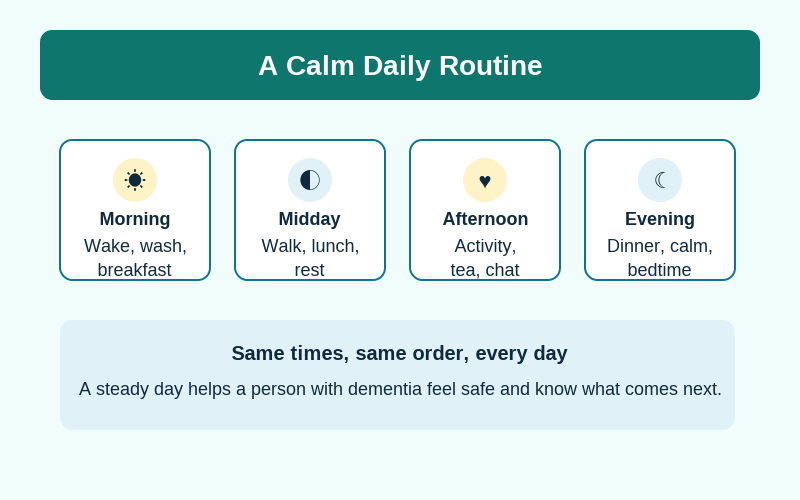
If you are caring for a parent with dementia at home, your days may feel unpredictable. One morning goes smoothly, the next brings confusion, repeated questions, or a refusal to get dressed. A steady daily routine cannot remove dementia, but it can make the day easier to read, for your parent and for you. When the same things happen at the same times, in the same order, your parent does not have to work out what comes next. The day itself tells them.
This guide is written for adult children caring for a parent at home. It walks through the whole day, from waking to bedtime, and shows how to build a routine that fits your parent, your home, and your family. You do not need to change everything at once. Start with one part of the day, make it steady, and then add the next. Small, repeated steps are far more helpful than a perfect plan that nobody can keep. If you would like the wider picture first, read our complete family guide to dementia care at home and our complete guide to home care.
Why a Routine Helps
Memory is one of the first things dementia affects, and that makes new situations hard. Your parent may forget what day it is, what they have already done, or what is supposed to happen next. A routine replaces that missing memory with habit. When breakfast always follows washing, and a walk always follows lunch, the body remembers the pattern even when the mind cannot name it. That is why a parent who is confused in a new place can be surprisingly settled at home, where the rooms, the sounds, and the order of the day are familiar.
A routine also reduces the number of decisions in a day, and decisions are tiring for a person with dementia. Choosing what to wear, what to eat, and what to do next can feel overwhelming when every choice needs to be worked out from scratch. A routine answers many of those questions in advance. Clothes are laid out the night before. Breakfast is the same simple meal most days. Fewer decisions mean less confusion, less frustration, and fewer moments when your parent feels lost or pressed. For the caregiver, a routine protects energy too: it lets you prepare in advance, share tasks with other family members, and know when you will have a break. When the routine is written down, everyone follows the same day, and your parent does not have to adjust to a different plan every time a different person arrives.
None of this means the day must be rigid. A routine is a rhythm, not a timetable enforced to the minute. Some days your parent will be tired, unwell, or simply not in the mood, and the routine should bend. The point is that the usual order stays recognisable, so that even on a difficult day your parent knows roughly what is happening. If you miss the walk, have a shorter one. If lunch is late, keep the rest of the day in its usual order. Flexibility inside a familiar shape is the goal, not perfection.
Start Where You Are
Before you build a new routine, spend a few days noticing the one you already have. Write down what actually happens: what time your parent wakes, when they eat, when they are most alert, when they become tired or restless, and when they sleep. Notice the good moments too. Is there a time of day when your parent is calmer, more talkative, or more willing to do things? That pattern is your starting point, and it is more useful than any routine copied from a book.
Next, talk to your parent, if you can, about what matters to them in a day. Ask simple questions, one at a time, and listen to the answers. What do they enjoy most? A walk, a garden, music, a particular meal, a visit from a grandchild? What do they dislike? Being rushed in the morning, a noisy afternoon? A routine built around likes and dislikes is far more likely to work than one built around what a family thinks a day should look like. Then choose one change to make first, not ten. Pick the part of the day that causes the most stress, and make only that part steadier for a week. When it feels settled, add the next. Write the routine down where everyone can see it, on a whiteboard or a large-print sheet, and give a copy to everyone who helps with care.
A Calm Morning Routine
Mornings are often the best time of day for a person with dementia. Sleep has cleared some of the tiredness, the house is quiet, and the light is bright. That makes the morning a good time for the tasks that need the most cooperation, such as washing, dressing, and eating breakfast. Try to protect the morning from rushing. If you need to be somewhere, allow extra time, and prepare what you can the night before, so the morning itself is calm.
Start the day in the same way each morning. Open the curtains, let in the daylight, and greet your parent by name, in a warm voice. Say what day it is and what is happening today, in one or two short sentences. A whiteboard with the day's plan can help, especially if your parent asks the same question again later. Break the morning into small steps, one at a time. Lay clothes out in the order they are put on, and offer a choice where you can: "the blue shirt or the green one?" If your parent resists a task, do not push it into a battle. Try again a little later. Breakfast deserves a calm place too: sit together, eat at the same table, and allow plenty of time. Our guide to safe bathing and personal care has more ideas for mornings when washing is hard, and our guide to mealtime help and nutrition covers food in detail.
Midday: Food, Movement, and Rest
By midday, energy often starts to dip, and that is normal. A short walk in the morning, followed by lunch, is a rhythm that works for many families. The walk does not need to be long. A slow walk around the garden, to the end of the street and back, or around a local park can be enough. Fresh air and daylight help the body clock, and gentle movement can improve mood and appetite. Walk at your parent's pace, not yours, and choose a familiar route. If walking is difficult, sitting in the garden or by an open window can give some of the same benefit.
Lunch should be at the same time each day, at the same table. Keep the meal simple and familiar, and offer one course at a time. After lunch, many people with dementia benefit from a short rest in a comfortable chair, with a book or music. Midday is also a good time for small household tasks that give your parent a role in the home: folding laundry, watering a plant, or sorting photographs. Offer one task at a time, keep it short, and praise the effort rather than the result.
Afternoon: Activity and Connection
The afternoon is often the best time for an activity your parent enjoys. Music, looking through photographs, a simple puzzle, gardening, listening to the radio, or a gentle craft can all work, as long as the activity is matched to what your parent can still do. The goal is engagement, not achievement. Choose activities your parent liked before dementia, and simplify them, rather than introducing something entirely new. Keep activities short: twenty or thirty minutes, followed by a rest, is often better than an hour that ends in frustration.
Connection matters more than activity. A phone call from a grandchild, a visit from a neighbour, a shared cup of tea, or a conversation about an old photograph can lift the whole afternoon. Ask about the past, which is often easier to remember than the present, and listen to the answer, even if you have heard the story before. As the afternoon goes on, start to slow the house down. Turn off the television if it is only background noise, and avoid starting anything new or demanding. A calm afternoon makes a calm evening far more likely. Our guide to communicating with calm and patience has more ideas for keeping conversation kind and easy.
Evening: Winding Down Well
Evenings are often the hardest part of the day. Confusion, restlessness, and distress can grow worse in the late afternoon and evening, a pattern often called sundowning. Your parent may pace, repeat questions, try to leave the house, or say they want to go home, even when they are already home. A steady evening routine is one of the best tools you have, because it gives the evening a shape before the difficulty starts. Begin winding down an hour or two before sunset: turn the lights on before it gets dark, close the curtains, put on familiar music, and offer a warm drink and a light snack.
Dinner should be at the same time, at the same table, and kept simple. After dinner, a quiet activity — a photograph album, a familiar song, or simply sitting together — can help the evening feel settled. Avoid visitors, outings, and difficult conversations late in the day. When restlessness happens, stay calm. Do not argue or raise your voice. Acknowledge the feeling, offer a simple reassurance, and gently redirect: "I can see you are worried. I am here with you. Let us sit in the kitchen and have some tea." Our guide to managing sundowning at home covers this in detail, and it is worth reading if evenings are difficult.
Night: Sleep and Safety
Sleep is often broken, both for the person with dementia and for the family. A regular bedtime, a dark, quiet bedroom, and daylight in the morning help the body's clock, while long daytime naps can make nights harder. Keep bedtime at the same time each night, and follow the same steps: a warm drink, a wash, night clothes, a short, calm conversation, and lights out. A familiar object by the bed — a photograph, a blanket, a favourite book — can help your parent feel safe in the dark.
If your parent wakes at night, keep the response calm and brief: a toilet visit, a drink of water, a reassuring word, and then back to bed. Use a night light in the hallway and bathroom, so your parent can find the toilet without waking the whole house. Keep a clear path from the bed to the bathroom, with nothing to trip over. Consider a door alarm that sounds when an outside door opens, so you know if your parent leaves the house at night. If nights become unsafe or exhausting, talk to a doctor and consider overnight help, even for a few nights a week. Our guide to sleep support and nighttime routine has more ideas for safer, calmer nights.
When the Day Goes Wrong
Even the best routine will have bad days. Your parent may wake confused, refuse to eat, or be restless all evening. On those days, it is easy to feel that the routine has failed. It has not. Dementia is unpredictable, and a bad day is often caused by tiredness, pain, hunger, needing the toilet, a cold, or a change you did not notice. The routine is still there, underneath the difficult day, and it will help again tomorrow.
On a bad day, simplify. Drop the activity, shorten the walk, offer a simpler meal, and keep only the most important parts: waking, eating, drinking, a little fresh air, and bedtime. Do not try to force the full day through. If a change is sudden — your parent is much more confused than usual, cannot be woken, has a fever, has fallen, or is in pain — talk to a doctor promptly, not as a bad day to wait out. Keep a short daily note — sleep, appetite, mood, any incidents — so you can tell a doctor what has changed, and when. After a bad day, be kind to yourself. Talk to another family member or a support group, write down what helped, and then let the day go.
A Routine for the Caregiver Too
A routine for your parent works best when you have a routine for yourself as well. Even small regular habits can help: a short walk alone in the morning, a cup of tea at the same time each afternoon, a phone call with a friend in the evening, or a few minutes of quiet before bed. These are not luxuries. They are the small breaks that keep you going, and they are easier to keep when they happen at the same time each day.
Plan your breaks in advance, not when you are already exhausted. Write them into the week's plan, and ask another family member to cover a specific time, or arrange a professional caregiver for a few hours a week. Watch for burnout in yourself: exhaustion that sleep does not fix, irritability, poor sleep, skipping your own medical appointments, and feeling that nothing you do is enough. If you notice those signs, talk to your own doctor, tell another family member, and ask for help before you reach breaking point. Looking after yourself is part of the same care. You can read more in our guide to when to ask for extra help at home.
A Sample Day You Can Adapt
The following sample day is a starting point, not a rule. Adapt it to your parent, your home, and your family, and change it as needs change. Keep the order steady, keep the times roughly the same, and keep the day calm.
- Morning: Wake at the same time, open the curtains, greet your parent by name, wash and dress one step at a time, then breakfast together at the same table.
- Late morning: A short walk or time in the garden, followed by a simple household task, such as folding laundry or watering a plant.
- Midday: Lunch at the same time, then a short rest in a comfortable chair, with water within reach.
- Afternoon: A favourite activity, such as music or photographs, followed by a cup of tea and a quiet conversation.
- Evening: Lights on before dark, curtains closed, dinner at the same time, then a calm activity, a warm drink, and the same bedtime steps each night.
- Night: A dark, quiet bedroom, a night light in the hallway and bathroom, a clear path to the toilet, and a calm, brief response if your parent wakes.
Try this shape for a week, and keep a short note each day: what went well, what was hard, and what time of day felt best. At the end of the week, adjust one thing. Perhaps the walk works better before lunch, or dinner needs to be earlier. Small adjustments, made one at a time, are how a routine becomes yours. Share the updated routine with everyone who helps with care, so the day looks the same whoever is there. If you would like help building a routine, you can contact our team or read more about who we are and how we work.
Frequently Asked Questions
How strict should a daily routine be? A routine should be a familiar rhythm, not a timetable enforced to the minute. Keep the order and the rough times steady, and allow the day to bend when your parent is tired or unwell. Flexibility inside a familiar shape is the goal.
What if my parent refuses to follow the routine? Do not turn it into a battle. Offer a choice, try again a little later, or try a different approach. A wash at the sink on a difficult morning is better than a long argument about a shower. If refusal becomes frequent, talk to a doctor, because pain, fear, or discomfort may be part of the problem.
How long does it take for a routine to work? Give a new routine at least a week, and change only one part of the day at a time. Small, repeated steps, kept steady for a week or two, are far more likely to settle into a habit.
What if different family members follow different routines? Write the routine down where everyone can see it, and give a copy to everyone who helps with care. A shared, written routine means your parent does not have to adjust to a different plan every time a different person arrives.
When should I ask for extra help with the routine? Ask before you reach breaking point. If nights are unsafe, if evenings are regularly difficult, or if you are exhausted, talk to a doctor and to your care provider about more hours, overnight cover, or respite. Asking for help is part of good care, not a failure of it.
Sources and Further Reading
This guide draws on the following sources, all accessed 29 November 2026.
- Alzheimer's Association — Facts and Figures, and information on dementia care at home. alz.org/alzheimers-dementia/facts-figures
- National Institute on Aging (NIA) — information on Alzheimer's disease, dementia, and caregiving. nia.nih.gov/health/alzheimers-and-dementia
If this guide helped you, please share it with another family who needs it, and read our other guides on dementia care at home. If you would like to talk about care for your parent, start on our homepage or contact us — a friendly advisor is ready to listen, with no obligation. You can write to us at hello@homecare.biz.id.
Tags: dementia home care, senior home care, family caregiver
Last reviewed: 23 June 2026. This guide is general information and is reviewed regularly. It is not a substitute for medical advice. Always talk to a doctor about diagnosis, treatment, or any change to care or medication.