
Home Care for Dementia: Activities That Support Daily Engagement
Written by the HomeCare editorial team. Sources: Alzheimer's Association, National Institute on Aging (NIA).
A good day with dementia is rarely a busy day. It is a day with a few familiar pleasures, a little fresh air, and no unnecessary hurry. Gentle activities — a song, a walk, a photograph, a simple task done together — can give the day shape, lift mood, and help a parent feel useful and connected. They are not lessons or tests, and they do not need to be clever or new. The best activities are often the simplest ones, drawn from a life your parent has already lived: the music they loved, the garden they tended, the food they cooked, the stories they told.
This guide is for adult children caring for a parent at home. It offers practical ideas you can try one at a time, and advice on how to choose, time, and adapt them. You will find ideas for music, photos, hands-on tasks, gardening, creative work, and social time, as well as guidance on what to do when an activity does not work. For the wider picture, read our complete family guide to dementia care at home, our daily routine guide, and our guide to creating a calm and familiar home. If you would like to talk through your parent's situation, you can contact our team.
Why Gentle Activities Matter
Activity gives a day purpose. Without it, hours can feel long and empty, and boredom can make confusion, restlessness, and low mood worse. A short walk, a song, or a task with the hands can break up the day, use up restless energy, and give your parent something pleasant to look forward to. Activity also supports sleep: a day with daylight, movement, and company usually leads to a better night than a day spent sitting indoors alone. Our guide to sleep support and nighttime routine explains how daytime activity and a steady bedtime work together.
Activities also protect dignity. Many people with dementia can still do a great deal, even when they cannot do everything they once did. Folding laundry, watering a plant, stirring a pot, sorting photographs, or singing a familiar song are all real contributions to the household. When a parent is given a task they can do, and praised for the effort rather than the result, they feel useful rather than helpless. That feeling matters enormously. It is also worth remembering that doing things for someone too early can take away confidence faster than the illness itself. Offer help, but let your parent do what they safely can.
What Makes a Good Activity
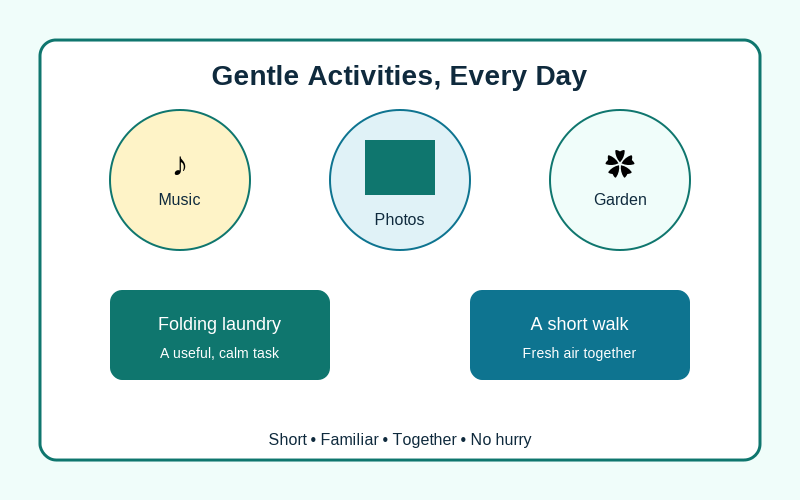
A good activity is short, familiar, and matched to the day. Short means ten to thirty minutes is often enough, especially at first. Familiar means it draws on something your parent already knows and enjoys, rather than something entirely new that has to be learned. Matched to the day means it fits the time, the energy, and the mood: a walk in the morning when energy is highest, a quiet activity in the afternoon, and something calm in the evening. If your parent is tired, unwell, or distressed, a shorter, gentler activity — or a rest — is the right choice.
Keep the steps simple, and offer one step at a time. "Here is the cloth, let us wipe the table" is easier than "please clean the kitchen." Give plenty of time, and do not correct mistakes. If the laundry is folded differently than you would fold it, it is still folded. If a song is sung in the wrong order, it is still sung. Praise the effort, join in yourself, and stop while the activity is still enjoyable, rather than carrying on until it becomes tiring or frustrating. A good activity leaves your parent feeling calm and pleased, not tested or exhausted.
Think about safety as you choose. Activities should not involve sharp tools, hot water, heavy lifting, or climbing, unless you are there to help and the risk is low. Choose a calm, well-lit place, with a clear table or a comfortable chair, and remove distractions such as a loud television. If an activity involves food, keep portions small and check for any eating difficulties with a doctor first. The aim is pleasure and connection, not a finished product, so choose safety and comfort first, every time.
Fitting Activities into the Daily Routine
Activities work best when they are part of a steady routine, not an extra job squeezed in at random. A predictable day helps a person with dementia know what comes next, and that reduces anxiety. Try building the day around a few fixed points: breakfast at the same time, a walk after breakfast, a quiet activity after lunch, a rest in the afternoon, and a calm evening. Write the plan on a whiteboard where it can be seen, and cross items off as they happen. Our daily routine guide gives a full example of a day built this way.
Do not fill every hour. Rest is part of the routine too, and many people with dementia tire quickly. A morning activity, a rest, and an afternoon activity is plenty for most days. Watch for signs of tiredness — yawning, irritability, wandering attention, or restlessness — and take a break before the activity becomes a struggle. It is better to do one activity well than three activities badly. If a planned activity does not suit the day, swap it for something simpler, or skip it altogether. The routine is there to help, not to control the day.
Music, Singing, and Listening Together
Music is one of the most powerful activities in dementia care, because songs learned long ago often remain in memory even when recent events fade. A familiar hymn, a song from a wedding, a tune from childhood, or a favourite singer can spark recognition, singing, tapping, and even conversation where words alone have failed. Play music your parent loved in younger years, and watch for the response: a smile, a hum, a foot tapping, a story about where the song was first heard. Those responses are the activity working.
Keep music simple and calm. Play one song at a time, at a comfortable volume, and sit together while it plays. Sing along if your parent enjoys it, and do not worry about getting the words right. A small playlist of ten or twelve favourite songs, kept ready on a simple player or phone, is more useful than a large collection that is hard to choose from. Avoid loud or unfamiliar music, and avoid music with a fast beat late in the evening, when calm is what is needed. If music causes distress — for example, a song linked to a sad memory — stop it gently and try a different song, without making a fuss.
Photos, Stories, and Reminiscence
Looking at photographs together is a gentle way to share time and spark conversation. Choose a small album, or a few framed pictures, from times your parent remembers well. Sit together, look at one photograph at a time, and talk about what you can see: who is in the picture, where it was taken, what happened that day. Ask open questions — "tell me about this day" — rather than testing memory with questions that have a right answer. If your parent remembers, enjoy the story. If they do not, enjoy the picture itself, and move on without correcting them.
Reminiscence is not about getting the facts right. It is about connection, and about the feelings a memory brings. A photograph of a childhood home, a wedding, a holiday, or a favourite pet can bring comfort even when the details are hazy. Keep a few photographs in places where your parent sits, and keep a photo album within easy reach. Label photographs simply with names and dates if that helps. If a photograph causes sadness, acknowledge the feeling — "you miss him, don't you?" — and offer comfort, or gently move to a different photograph. You can also read more about memory aids in our guide to a calm and familiar home.
Hands-On Tasks Around the Home
Hands-on tasks are among the most useful activities, because they are real, familiar, and part of daily life. Folding laundry, sorting socks, wiping a table, watering a plant, peeling vegetables, setting the table, or dusting a shelf are all tasks many people have done for decades. They use the hands, they have a clear beginning and end, and they end with something useful done. Offer one task at a time, with the materials ready and the steps simple, and work alongside your parent rather than watching them.
Choose tasks that match ability and interest, and that are safe to do together. A person who loved cooking may enjoy stirring a pot or tearing lettuce, while a person who loved gardening may enjoy potting a plant indoors. Avoid tasks that involve sharp knives, hot water, or heavy objects, and avoid tasks that are really chores in disguise — the point is enjoyment and usefulness, not getting the housework done. If a task becomes frustrating, switch to something easier without making a fuss. A good day is not measured by how much was done, but by how your parent felt while doing it.
Sorting and organising tasks can also be calming. Sorting buttons by colour, sorting photographs by person, folding napkins, or arranging flowers are all gentle, repetitive tasks that many people find soothing. Keep the materials simple, the instructions short, and the pace unhurried. If your parent loses interest, let the task go. There will be another day, and another task, and the relationship matters more than the finished job.
Gardening, Walking, and Being Outdoors
Being outdoors is good for body and mood. Daylight helps the body's sense of time, fresh air lifts spirits, and a short walk uses energy that might otherwise become restlessness at night. A walk in the morning, in a familiar place, with a companion, is one of the simplest and most helpful activities you can offer. Keep the walk short, the route familiar, and the pace comfortable. Bring water, wear suitable shoes, and choose a time of day when the weather is kind and your parent has energy.
Gardening can be adapted to almost any ability. Watering a plant, deadheading flowers, planting seeds in a pot, or simply sitting in the garden and watching birds are all worthwhile. Keep tools light and safe, and avoid anything sharp or heavy. If your parent cannot go outside, bring the garden indoors: a pot of herbs on the windowsill, a vase of flowers to arrange, or a tray of soil to touch and smell. The point is not a perfect garden. It is fresh air, daylight, and the pleasure of something living and growing. For safety outdoors, see our guide to a calm and familiar home and our guide to managing sundowning.
Creative Activities: Drawing, Crafts, and Puzzles
Creative activities can be enjoyable even when words are hard. Drawing, colouring, painting with large brushes, making a simple collage, or working with clay all use the hands and the senses, and they do not depend on memory or correct answers. Keep materials simple and safe: large crayons or pencils, thick paper, washable paints, and a clear table. Offer a simple starting point — a picture to colour, a flower to draw, a shape to cut — and let your parent work in their own way, for as long as they enjoy it.
Puzzles and games can also help, if they are matched to ability. A large-piece jigsaw, a simple matching game, a pack of large-print cards, or a game of dominoes can all be enjoyable, especially when played together. Avoid games that are competitive, timed, or complicated, and avoid correcting mistakes. The aim is shared time, not winning. If a puzzle becomes frustrating, put it away and try something else. Some days a creative activity will work well, and other days it will not, and both are normal. Keep the materials within easy reach, so your parent can choose an activity when they feel like it, rather than waiting to be offered one.
Social Time, Visitors, and Connection
People need people, and dementia does not change that. Regular company — a family visit, a phone call, a neighbour dropping in, a companion visit — can lift mood, reduce loneliness, and give the day a social shape. Keep visits short and calm, especially at first: one or two visitors at a time, in a familiar room, with a clear beginning and end. Introduce visitors by name, and give your parent time to recognise them. A short, warm visit is far better than a long, tiring one.
Help visitors know how to be helpful. Suggest they bring a photograph, a song, or a simple activity, rather than asking lots of questions. Suggest they speak slowly, one idea at a time, and listen patiently. Suggest they sit with your parent, rather than talking over them. If a visit becomes tiring, help your parent rest afterwards, without guilt. Social time is an activity like any other: it should leave your parent feeling pleased, not exhausted. If you are caring for a parent while also working or caring for children, a companion visit can also give you a break, and our guide to asking for extra help explains how to arrange that.
When an Activity Does Not Work
Some days, nothing works. Your parent may refuse an activity, become distressed, walk away, or fall asleep. That is normal, and it is not a failure. It may mean your parent is tired, unwell, in pain, hungry, or simply not in the mood. It may mean the activity was too hard, too long, too noisy, or too new. It may mean the time of day was wrong. Do not push, argue, or insist. Offer something simpler, offer a rest, or try again later. A quiet sit together, a cup of tea, and a familiar song are often enough on a difficult day.
Keep a short note of what worked and what did not, so you can learn the pattern. You may notice that mornings are better than afternoons, that music works better than puzzles, or that gardening works better than drawing. That knowledge is valuable, and it helps the whole family — and any professional caregiver — choose well. If your parent becomes distressed often, or if a change is sudden, talk to a doctor, because a change in mood or behaviour can have a medical cause. For communication tips, see our guide to communicating with calm and patience, and for evening difficulties, see our guide to managing sundowning.
Frequently Asked Questions
How long should an activity last? Ten to thirty minutes is often enough, especially at first. Watch for signs of tiredness, and stop while the activity is still enjoyable. A short, pleasant activity is far better than a long one that ends in frustration.
What if my parent refuses every activity? Do not force it. Try a simpler activity, try a different time of day, or simply sit together quietly. Refusal often means tiredness, pain, or fear, not laziness. If refusal is new or sudden, talk to a doctor.
Are puzzles and games helpful? They can be, if they are simple and played together, without competition or correction. Large-piece jigsaws, matching games, and dominoes are good choices. Avoid complicated or timed games, and stop if the activity becomes frustrating.
Should I plan activities every day? A few gentle activities each day, built into a steady routine, are usually enough. Rest is part of the routine too. One morning activity and one afternoon activity, with rests in between, is plenty for most days.
What is the best activity to start with? Start with something your parent already loved: a favourite song, a walk, a photograph, or a simple household task. Familiar activities are easier to join in with, and they are more likely to bring pleasure.
Sources and Further Reading
This guide draws on the following sources, all accessed 29 November 2026.
- Alzheimer's Association — Facts and Figures, and information on dementia care at home. alz.org/alzheimers-dementia/facts-figures
- National Institute on Aging (NIA) — information on Alzheimer's disease, dementia, and caregiving. nia.nih.gov/health/alzheimers-and-dementia
If this guide helped you, please share it with another family who needs it, and read our other guides on daily routines, sleep, and home safety. If you would like to talk about care for your parent, start on our homepage or contact us — a friendly advisor is ready to listen, with no obligation.
Last reviewed: 23 June 2026. This guide is general information and is reviewed regularly. It is not a substitute for medical advice. Always talk to a doctor about diagnosis, treatment, or any change to care or medication.
Tags: dementia home care, senior activities, memory care