
Home Care for Alzheimer Support: Meaningful Activities at Home
Written by the HomeCare editorial team. Sources: Alzheimer's Association, National Institute on Aging (NIA).
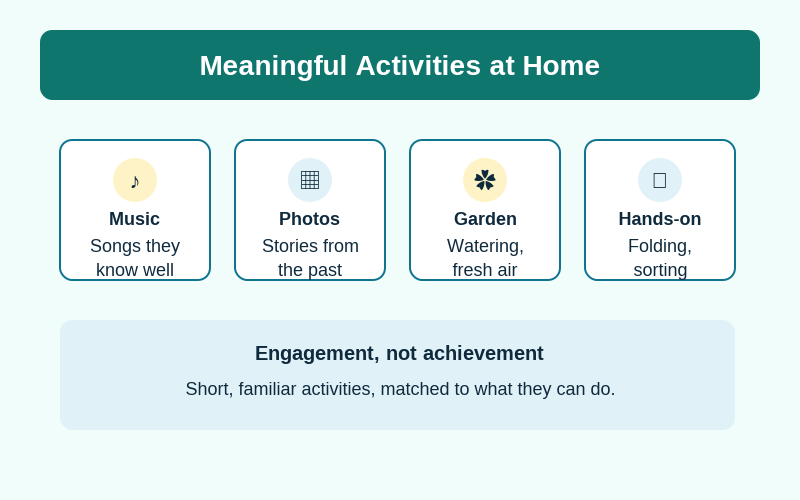
A day without anything to do is a long day, for anyone. For a person with Alzheimer disease, it can be longer still. Without activity, time stretches, boredom grows, and restlessness often follows. But activity does not have to mean outings, classes, or complicated projects. The most meaningful activities are often the simplest ones, done at home: a favourite song, an old photograph, a walk in the garden, or folding laundry together. What matters is not what the activity is, but that it is familiar, enjoyable, and matched to what your parent can still do.
This guide offers meaningful activities at home for Alzheimer home care. It is written for adult children caring for a parent at home, and it focuses on simple, everyday ideas: music, photographs, gardening, hands-on tasks, movement, and social time. The goal is engagement, not achievement. There is no test to pass, and no right way to do an activity. If your parent enjoys it, even for a few minutes, it has worked. If you would like the wider picture first, read our complete family guide to dementia care at home and our guide to activities that support daily engagement.
Why Activities Matter
Activities matter for several reasons, and none of them is about keeping busy for its own sake. First, activities give the day a shape. A morning walk, an afternoon of music, and an evening photograph album give the day a rhythm, and rhythm supports memory and orientation. Second, activities give your parent a role. Folding laundry, watering a plant, or helping to prepare lunch are not just tasks. They are ways of saying "you are still part of this home, and what you do matters". Third, activities support mood. A favourite song, a walk in the garden, or a conversation about the past can lift a low mood in a way that words alone cannot.
Activities also reduce restlessness and distress. A person who is bored, understimulated, or sitting alone for hours is more likely to become restless, anxious, or agitated. A short, enjoyable activity, offered at the right time, can prevent that. It does not have to be long. Twenty or thirty minutes, followed by a rest, is often better than an hour that ends in frustration. The best time for activities is usually the morning or early afternoon, when your parent is most alert. Evenings are better kept calm and quiet. Our guide to building a daily care plan shows how to build activities into the day.
Music: Songs They Know Well
Music is one of the most powerful activities in Alzheimer home care, because it reaches parts of memory that words cannot. A song from your parent's youth can bring back a memory, a feeling, or a smile, even when recent memories have faded. Play music your parent knows well: songs from their teens and twenties, hymns, folk songs, or the music they danced to. Sing along, even if you sing badly. Your parent does not care about the quality. They care about the connection.
Keep music simple and calm. A radio tuned to a familiar station, a playlist of favourite songs, or a simple instrument such as a harmonica can all work. Avoid music that is loud, fast, or unfamiliar, because it can cause distress rather than pleasure. Watch your parent's response. If a song brings a smile, play it again. If it brings tears, do not be frightened. Tears can be a release, and they are not necessarily a sign of distress. Sit with your parent, hold their hand, and let the music do its work. If music causes agitation, turn it off and try again another day, with a different song. Music is personal, and what works for one person may not work for another.
Photographs and Reminiscence
Looking at old photographs together is a simple, powerful activity. Choose a small album, with one photograph per page and a short caption beneath it: a name, a place, a date. Sit together, look at each photograph, and talk about it. Ask simple questions: "Who is this?", "Where was this taken?", "What do you remember about this day?" Listen to the answer, even if you have heard the story before. The point is connection, not accuracy. Do not correct your parent if they remember a detail differently. The story matters more than the facts.
Reminiscence is talking about the past, and it is often easier than talking about the present, because older memories are often stronger. Ask about childhood, about a first job, about a wedding, or about a favourite holiday. Use objects as well as photographs: an old tool, a piece of jewellery, a letter, or a familiar smell, such as a favourite food or a flower from the garden. These can trigger memories that words alone cannot reach. Keep reminiscence short and pleasant, and watch for tiredness. If your parent becomes upset, change the subject gently, or stop and try again another day. Our guide to helping with memory and orientation has more on photographs and memory books.
Gardening and Nature
Gardening is a wonderful activity for a person with Alzheimer disease, because it is familiar, physical, and outdoors. Watering plants, picking flowers, pulling weeds, or simply sitting in the garden can all work. Choose simple tasks, one at a time, and keep them short. A small pot of herbs on a windowsill, a few flowers in a raised bed, or a vegetable patch that is easy to reach can give your parent a reason to go outside every day. Fresh air and daylight help mood and sleep, and gentle movement is good for the body.
If your parent cannot garden, bring nature inside. A vase of flowers on the table, a bird feeder outside the window, or a walk to look at the trees can all give the same benefit. Go for a short walk together, at your parent's pace, on a familiar route. Talk about what you see: the weather, the birds, the flowers, the seasons. Nature is calming, and it gives you something to talk about that is not about illness or care. If the weather is bad, look out of the window together, or watch a nature programme on television. The point is to stay connected with the world outside the house, even in small ways.
Hands-On Tasks Around the Home
Hands-on tasks are simple jobs around the home that give your parent a role and a sense of purpose. Folding laundry, sorting photographs, polishing shoes, dusting a shelf, or helping to prepare a meal are all useful, familiar tasks. Choose one task at a time, keep it short, and praise the effort rather than the result. The laundry does not need to be folded perfectly. What matters is that your parent helped, and that they felt useful.
Match the task to what your parent can still do, and simplify it if needed. If sorting photographs is too hard, try sorting them by colour, or by size. If cooking is too hard, try stirring a pot, or tearing lettuce for a salad. If a task causes frustration, stop and try something else. Do not take over the task, and do not correct your parent's way of doing it, unless safety is at risk. The task is not the point. The point is that your parent is doing something, with you, and feeling part of the home. Our guide to a safe home setup has more on keeping the home safe for hands-on tasks.
Movement and Gentle Exercise
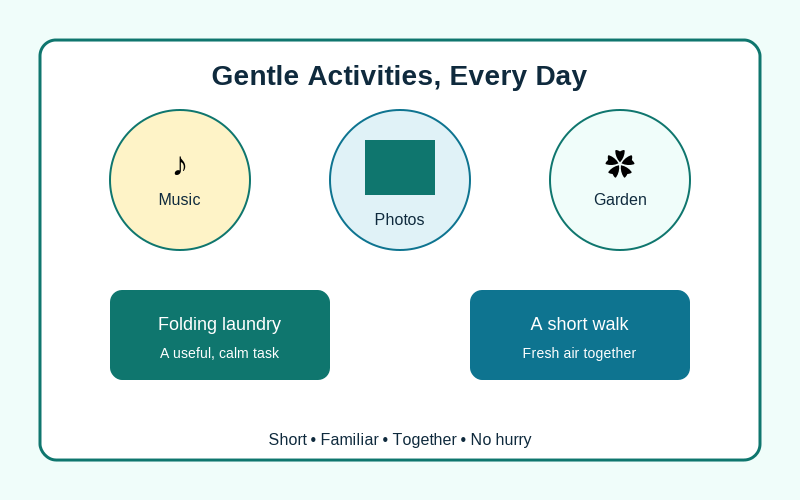
Movement is important for everyone, and it is especially important for a person with Alzheimer disease. Gentle movement can improve mood, appetite, and sleep, and it can reduce restlessness. It does not have to be formal exercise. A short walk, a slow dance to a favourite song, or some gentle stretching in a chair can all work. Keep it simple, keep it short, and do it together, so it feels like a shared pleasure rather than a task.
Walk at your parent's pace, not yours, and choose a familiar route. If walking is difficult, try sitting exercises: lifting arms, turning shoulders, or tapping feet to music. If your parent enjoys it, try a simple group activity, such as a gentle exercise class for older people, but keep it short and familiar. Avoid anything that is tiring, painful, or frightening. If your parent has difficulty walking, or has fallen, talk to a doctor before starting any new exercise. Safety comes first, and a doctor can advise on what is right for your parent. Our guide to a calm daily routine shows how to build movement into the day.
Reading, Puzzles, and Games
Reading, puzzles, and games can be enjoyable, as long as they are matched to what your parent can still do. A large-print book, a newspaper, or a magazine with photographs can be a pleasure, even if your parent only looks at the pictures. A simple jigsaw puzzle with large pieces, a game of dominoes, or a card game with simple rules can all work. Choose activities your parent enjoyed before, and simplify them, rather than introducing something entirely new.
Keep it short, and do not worry about finishing. A puzzle that is half done is still a pleasure, and a game that is not finished is still a game. If your parent becomes frustrated, stop and try something else. Do not correct mistakes, and do not keep score. The point is to enjoy time together, not to test memory or ability. If reading has become hard, try reading aloud to your parent, or listening to an audiobook together. A familiar story, read slowly, can be a comfort, even if your parent does not follow every word.
Visitors and Social Time
Social time is important, but it needs to be managed carefully. A visit from a grandchild, a neighbour, or an old friend can lift the whole day, but a large, noisy gathering can be overwhelming. Keep visits short, and keep the number of visitors small. One or two people at a time is enough. Prepare visitors in advance: tell them what to expect, and give them simple things to do, such as looking at photographs, listening to music, or going for a short walk.
Encourage visitors to come, even for a short time, and to keep coming regularly. A short visit every week is better than a long visit once a month. If your parent becomes tired or distressed during a visit, end it gently, and try again another day. Do not force social time, and do not feel guilty if your parent prefers a quiet day. Some days, a cup of tea with one familiar person is enough. Our guide to gentle communication tips has more on keeping conversation kind and easy, and our guide to planning respite shows how to arrange time for yourself as well.
Matching the Activity to the Day
Not every activity works every day. Your parent's energy, mood, and ability change from day to day, and even from hour to hour. Mornings are often the best time for activities, when your parent is most alert. Afternoons are good for quieter activities, such as music or photographs. Evenings are better kept calm and quiet. Watch your parent's signals: if they are alert and engaged, continue. If they are tired, restless, or upset, stop and try something else, or try again later.
Keep a short list of activities that work, and note when they work best. A favourite song in the morning, a walk after lunch, and photographs in the afternoon may be a good shape for the day. If an activity stops working, do not force it. Try a different one, or try the same one at a different time. Flexibility is more important than a fixed schedule. The aim is a day with moments of pleasure and connection, not a day filled with activities. If you would like help building activities into the day, you can contact our team or read more about who we are and how we work.
When Activities No Longer Work
There may come a time when activities that once worked no longer work. Your parent may lose interest, become distressed, or be unable to follow even a simple task. That is not a failure, and it is not your fault. It is a sign that needs have changed, and that the plan needs to change too. Simplify further. A walk becomes sitting in the garden. A puzzle becomes holding a familiar object. A conversation becomes sitting together in silence, holding a hand.
Even when activities stop working, connection does not have to stop. Touch, tone, music, and presence can still reach your parent, even when words and tasks cannot. Sit with your parent, hold their hand, play familiar music, or simply be there. That is enough. Talk to a doctor about what is happening, and about what help is available, including more hours of care. Our complete family guide to dementia care at home describes how care changes through the stages, and our guide to paying for care and planning ahead can help you plan for more support.
Frequently Asked Questions
What if my parent refuses to do any activity? Do not force it. Offer a choice, try again later, or try a different activity. A short walk, a favourite song, or simply sitting together may work better than a planned activity. If refusal is frequent, talk to a doctor, because pain, low mood, or discomfort may be part of the problem.
How long should an activity last? Twenty or thirty minutes is often enough, followed by a rest. Short, enjoyable activities are better than long ones that end in frustration. Watch your parent's signals, and stop when they are tired.
What if an activity makes my parent upset? Stop, stay calm, and try something else. An activity that causes distress is not the right activity, or not the right time. Try again another day, with a different activity, or at a different time of day.
Should I keep doing activities my parent used to enjoy, even if they cannot do them well any more? Yes, in a simpler form. A favourite activity, simplified, is often more enjoyable than a new activity. The point is engagement and pleasure, not achievement.
What if I have no time for activities? Activities do not need extra time. They can be part of the day you already have: folding laundry together, listening to music while you cook, or looking at photographs over tea. Small moments, built into the day, are enough.
Sources and Further Reading
This guide draws on the following sources, all accessed 29 November 2026.
- Alzheimer's Association — Facts and Figures, and information on Alzheimer disease and meaningful activities. alz.org/alzheimers-dementia/facts-figures
- National Institute on Aging (NIA) — information on Alzheimer's disease, dementia, and caregiving. nia.nih.gov/health/alzheimers-and-dementia
If this guide helped you, please share it with another family who needs it, and read our other guides on Alzheimer support at home. If you would like to talk about care for your parent, start on our homepage or contact us — a friendly advisor is ready to listen, with no obligation. You can write to us at hello@homecare.biz.id.
Tags: alzheimer home care, senior activities, memory care
Last reviewed: 25 June 2026. This guide is general information and is reviewed regularly. It is not a substitute for medical advice. Always talk to a doctor about diagnosis, treatment, or any change to care or medication.