
Home Care for Alzheimer Support: Early Signs Families Notice at Home
Written by the HomeCare editorial team. Sources: Alzheimer's Association, National Institute on Aging (NIA).
Most families do not notice Alzheimer disease in a single moment. They notice it in small pieces, spread across months: a parent who asks the same question three times in an hour, a familiar recipe that suddenly goes wrong, a bill paid twice, a loved one who seems quieter than before. Each moment on its own can be explained away. A bad night's sleep, a stressful week, a cold. It is the pattern that matters, and families are often the first people to see it, because they see the everyday life that a short doctor's visit cannot show.
This guide is written for adult children and family members who have started to notice changes at home and want to understand them. It describes the early signs families most often report, explains how they differ from ordinary forgetfulness, and shows how to keep simple notes that make a conversation with a doctor far more useful. It does not diagnose anyone. Only a doctor can do that, and this guide will help you prepare for that conversation, not replace it. If you would like the wider picture first, read our complete family guide to dementia care at home and our complete guide to home care.
What Early Signs Can Look Like
Early signs of Alzheimer disease usually appear in everyday life, not in dramatic moments. They show up in the kitchen, in conversation, in the diary, and in the way a person handles money or plans a day. The changes are often gradual. Your parent may still manage most things well, and on a good day you may wonder if you imagined it. That uncertainty is normal, and it is one reason families wait. Many families tell us they noticed changes for a year or more before they talked to a doctor, because each change seemed small on its own.
It helps to think in terms of change from how your parent used to be, rather than comparing them with other people of the same age. A parent who always kept a careful diary and now misses appointments is showing a change. A parent who always cooked with confidence and now struggles with a familiar recipe is showing a change. A parent who always loved conversation and now avoids it may be showing a change too. The question is not whether your parent is perfect, but whether something has shifted from their own normal, and whether that shift is growing. Our guide to building a daily care plan shows how a steady routine can support a parent while you work out what is happening.
Memory Changes That Stand Out
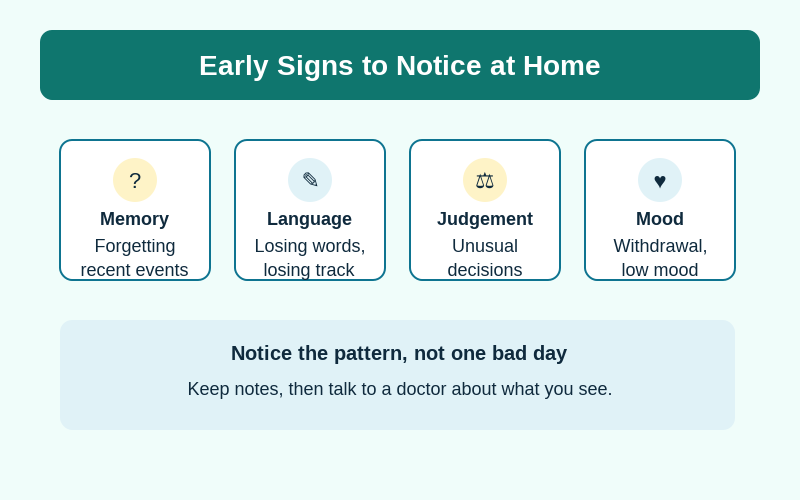
Memory change is the sign families notice first, most often. It is not the ordinary forgetting of where you left your keys. It is forgetting things that were only just said or done, and not remembering them even with a reminder. Your parent may ask the same question again and again within a short time, forget a conversation you had that morning, or repeat the same story several times in one visit. They may forget appointments they wrote down, lose track of whether they have eaten, or be unable to remember a visit from a grandchild the day before.
Another common pattern is losing things and being unable to retrace steps. Everyone misplaces things, but a person with early Alzheimer disease may put something in an unusual place — a wallet in the fridge, keys in a shoe — and then be unable to work backwards to find it. They may also forget the names of people they know well, or mix up the names of family members. At first, these lapses may be covered up. Your parent may laugh it off, change the subject, or blame tiredness. That is understandable. Forgetting is frightening, and many people work hard to hide it, even from themselves. Be patient with that. Noticing is your job; arguing about it is not helpful.
Language and Finding Words
Language changes are often subtle at first. Your parent may pause more often in the middle of a sentence, searching for a word that will not come. They may use a general word, like "thing" or "that one", instead of the name of the object they mean. They may call a kettle a "hot water thing" or describe a grandchild as "the young one" rather than using a name. They may stop in the middle of a story and lose the thread, or repeat themselves because they have forgotten what they already said.
Writing can change too. A parent who used to write clear notes or letters may start to write shorter, simpler sentences, or may struggle to spell words they once knew easily. Following a conversation can become harder, especially in a group, on the telephone, or when there is background noise. Your parent may nod and smile while understanding very little, because it is easier than admitting they have lost the thread. If you notice this, slow down. Use short sentences, one idea at a time, and give your parent time to answer. Our guide to gentle communication tips for families has more ideas for keeping conversation kind and easy.
Planning, Judgement, and Everyday Tasks
Planning and judgement are often affected early, and this is where families first notice practical problems. A parent who always managed the household bills may start to pay the same bill twice, forget a payment, or struggle to follow a bank statement. They may find a recipe difficult, even one they have cooked for years, because the steps no longer stay in order. They may struggle to plan a simple outing, such as working out what time to leave, what to take, and how to get there.
Everyday tasks that used to be automatic can take longer and need more effort. Dressing may become confusing, especially choosing clothes for the weather or putting them on in the right order. Using a remote control, a washing machine, or a mobile phone may become difficult, even though your parent used these things easily for years. Some families notice poor judgement, such as giving away large sums of money, falling for a scam, or making an unusual purchase. This is a serious sign, and it is worth acting on quickly, because it can put your parent's money and safety at risk. Talk to your parent's bank about protections if you are worried, and talk to a doctor about what you have noticed.
Getting Lost and Losing Track of Time
Losing track of time is another early sign. Your parent may forget what day it is, what month it is, or what season it is. They may turn up for an appointment on the wrong day, or be confused about whether something happened yesterday or last week. They may lose track of time during the day, eating lunch at ten in the morning or getting ready for bed in the afternoon. A large-print calendar and a clock that shows the day and date can help, and our guide to helping with memory and orientation has more ideas.
Getting lost is more worrying, and it can happen in places your parent knows well. They may take a wrong turn on a familiar walk, be unable to find their way home from a local shop, or become confused in a place they have visited many times. At first, this may happen only occasionally, and your parent may cover it up by following someone else or by saying they wanted to take a different route. If your parent gets lost, do not treat it as a small matter. Make sure they carry identification and a phone, agree on a plan for what to do if they cannot find their way, and talk to a doctor promptly. Safety comes first, and getting lost can be dangerous.
Mood, Personality, and Withdrawal
Changes in mood and personality are common, and families sometimes notice these before they notice memory problems. Your parent may become more anxious, more easily upset, or quicker to anger than before. They may seem low in mood, lose interest in hobbies they once loved, or withdraw from friends and family. Some people become suspicious, accusing others of moving things or stealing, when the real problem is that they cannot remember where they put something.
Withdrawal is often a way of coping. If conversation is hard, if memory is unreliable, and if everyday tasks feel confusing, it is easier to stay at home and avoid people. But withdrawal can also make things worse, because it reduces stimulation, movement, and social contact, all of which help a person feel better. Encourage your parent to keep doing the things they enjoy, in simpler forms, and to keep seeing people, even for short visits. If low mood, anxiety, or suspiciousness is strong or persistent, talk to a doctor. These feelings may be part of the illness, and they may also be something a doctor can help with. You do not have to manage them alone.
Normal Ageing, or Something More?
It is natural to wonder whether what you see is simply normal ageing. Normal ageing does bring some changes: we all forget a name now and then, walk into a room and forget why, or need a moment to find a word. The difference is usually in how often it happens, how much it interferes with daily life, and whether it is getting worse. Ordinary forgetfulness is occasional, and a reminder usually brings the memory back. The memory changes in early Alzheimer disease are more frequent, they affect everyday life, and they do not improve with a reminder.
Another difference is the range of changes. Normal ageing does not usually affect judgement, planning, language, and mood all at once. If you are seeing changes in several areas, and they are growing over weeks and months, that is worth a conversation with a doctor. It is also worth remembering that many things can cause memory problems, including low mood, poor sleep, some medicines, low vitamin levels, thyroid problems, and other medical conditions. A doctor can check for these, and some of them can be treated. That is another reason not to wait: the cause may not be what you fear, and it may be something that can be helped. Only a doctor can work out what is happening, and only a doctor can advise on what to do next.
How to Keep Notes That Help a Doctor
Notes are one of the most useful things a family can bring to a doctor's appointment. Doctors have limited time, and a clear, short record of what you have noticed is far more useful than a general worry. Start a simple notebook, or a note on your phone, and write down what you see, when it happened, and how often. Keep it factual and specific. "Mum asked the same question four times in one hour on Tuesday" is far more useful than "Mum is forgetful". "Dad paid the electricity bill twice in March" is more useful than "Dad is bad with money".
Include the date, the situation, and what happened. Note changes in memory, language, planning, mood, sleep, appetite, and safety. Note anything that has become unsafe: getting lost, leaving the stove on, falling, or driving badly. Also note what is still going well, because that helps a doctor understand your parent as a whole person, not just a list of problems. Bring your notes to the appointment, and if your parent agrees, go with them, or ask to speak to the doctor separately. Many families find it helpful to write a short summary on one page: the main changes, when they started, and how they affect daily life. Keep your notes private and respectful. They are for a doctor, not for sharing with others.
Talking with Your Parent About What You Notice
Talking about memory problems is one of the hardest conversations a family can have. Your parent may be frightened, embarrassed, or angry. They may deny there is a problem, or say you are making a fuss. That is understandable. Nobody wants to hear that their memory is failing, and many people protect themselves by denying it. Choose a calm moment, in private, when neither of you is tired or rushed. Start with care, not with a list of mistakes. "I have noticed you seem tired lately, and I am worried about you" is kinder than "You keep forgetting things".
Use "I" statements, and keep it simple. "I noticed you seemed confused at the shop yesterday, and I want to make sure you are safe" is easier to hear than "You got lost again". Offer to go to the doctor together, as a check-up, not as an accusation. Some families find it helps to frame it as a general health check, or to mention another symptom, such as poor sleep, as a reason to go. If your parent refuses, do not force it. Plant the seed, and try again later. You can also talk to your own doctor about your worries, and ask for advice on how to approach the conversation. If safety is at risk — getting lost, leaving the stove on, driving unsafely — act sooner, and involve other family members. Safety is more important than keeping the peace.
What to Do Next
If you have noticed a pattern of changes, the next step is to talk to a doctor. Start with your parent's own doctor, who knows their history. Take your notes, and if possible, go with your parent. The doctor will ask questions, may do a short memory test, and may arrange blood tests or a referral to a specialist. This process can take time, and it can feel slow, but it is the only way to find out what is happening and what help is available. Do not try to diagnose your parent yourself, and do not start or stop any medicine without a doctor's advice.
While you wait for appointments, there are practical things you can do. Keep a steady daily routine, because routine supports memory and reduces confusion. Our guides to a calm daily routine and a safe home setup are good places to start. Make the home safer: clear paths, good lighting, a calendar and clock that show the day and date. Talk to other family members, so everyone knows what is happening and can share the load. And look after yourself. Watching a parent change is hard, and you will need support too. You can read more about who we are and how we work, and if you would like to talk about care, contact our team.
Frequently Asked Questions
How do I know if it is Alzheimer disease or just normal ageing? You cannot tell on your own, and neither can a family member. Normal forgetfulness is occasional and does not interfere much with daily life. If changes are frequent, affect everyday tasks, and are growing over weeks and months, talk to a doctor. Only a doctor can work out what is happening.
My parent denies there is a problem. What should I do? Denial is common and understandable. Do not argue. Keep notes, choose a calm moment, and try again. Offer to go to the doctor together for a general check-up. If safety is at risk, act sooner and involve other family members.
How long should I wait before talking to a doctor? Do not wait for things to become serious. If you have noticed a pattern of changes over weeks or months, talk to a doctor now. Some causes of memory problems can be treated, and the sooner you know, the more help is available.
Should I tell my parent I am worried? Yes, gently and privately, in a calm moment. Start with care, use "I" statements, and keep it simple. "I am worried about you" is kinder than a list of mistakes. Offer to go to the doctor together.
What if the doctor finds nothing wrong? That is good news, and it is still useful. The doctor may find another cause for the symptoms, or may suggest watching and coming back. Keep your notes, and go back if things change. Trust what you see at home.
Sources and Further Reading
This guide draws on the following sources, all accessed 29 November 2026.
- Alzheimer's Association — Facts and Figures, and information on Alzheimer disease and early signs. alz.org/alzheimers-dementia/facts-figures
- National Institute on Aging (NIA) — information on Alzheimer's disease, dementia, and caregiving. nia.nih.gov/health/alzheimers-and-dementia
If this guide helped you, please share it with another family who needs it, and read our other guides on Alzheimer support at home. If you would like to talk about care for your parent, start on our homepage or contact us — a friendly advisor is ready to listen, with no obligation. You can write to us at hello@homecare.biz.id.
Tags: alzheimer home care, dementia home care, senior care
Last reviewed: 24 June 2026. This guide is general information and is reviewed regularly. It is not a substitute for medical advice. Always talk to a doctor about diagnosis, treatment, or any change to care or medication.