
Home Care for Alzheimer Support: Helping with Memory and Orientation
Written by the HomeCare editorial team. Sources: Alzheimer's Association, National Institute on Aging (NIA).
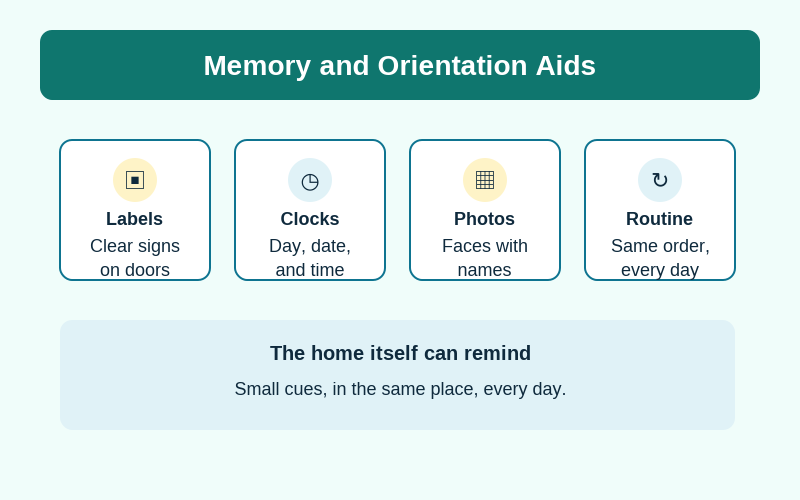
Memory is one of the first things Alzheimer disease affects, and it changes the way a person finds their way through the day. Your parent may forget what they did this morning, where they put their glasses, or what day it is. They may walk into a room and not know why they went there, or look for the bathroom in their own home. These moments are confusing and frightening, for your parent and for you. But there are simple, practical ways to help: labels, clocks, photographs, routines, and keeping things in the same place. The home itself can become a memory aid.
This guide shows everyday ways to help with memory and orientation in Alzheimer home care. It is written for adult children caring for a parent at home, and it focuses on small changes that make a big difference: clear signs, gentle cues, and a steady routine. None of these ideas will stop Alzheimer disease, and none of them replaces medical advice. They simply make the day easier to read, so your parent can stay independent for longer, and feel safer at home. If you would like the wider picture first, read our complete family guide to dementia care at home and our guide to early signs families notice at home.
How Memory Changes in Alzheimer Disease
Memory does not fail all at once, and it does not fail in the same way for everyone. In Alzheimer disease, recent memories are usually affected first. Your parent may forget a conversation from this morning, a meal they just ate, or a visit from a grandchild yesterday, while still remembering details from twenty years ago quite clearly. That is because older memories, especially those tied to strong feelings, are often stored more deeply. A song from their youth, a childhood home, or a wedding day may be vivid, while today is blurred.
Orientation is closely tied to memory. To know where you are, what day it is, and what you are doing, you need to remember what happened just before. When recent memory fades, orientation fades with it. Your parent may wake up and not know whether it is morning or night, or may think they are in a different house. They may ask the same question again and again, not because they did not hear the answer, but because the answer did not stay. Understanding this helps you respond with patience rather than frustration. Your parent is not being difficult. They are trying to find their way in a day that keeps slipping away. Our guide to gentle communication tips has more on responding with calm and patience.
Labels and Signs Around the Home
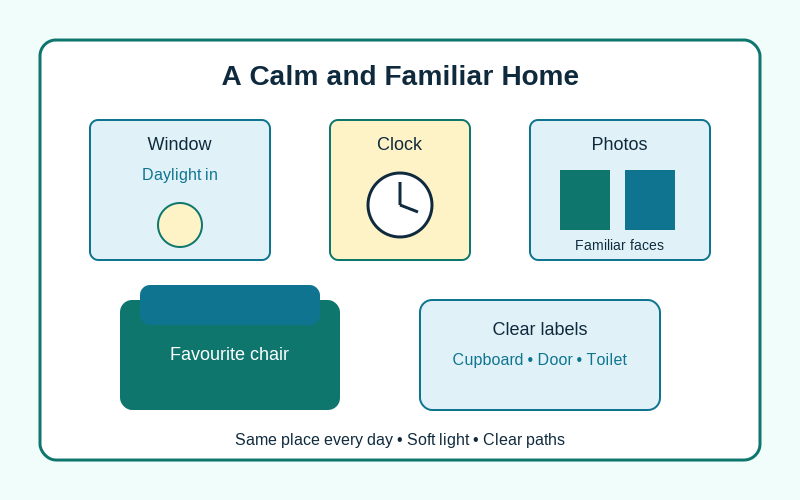
Labels are one of the simplest and most effective memory aids. A clear label on a door tells your parent what is behind it, without them having to remember. Label the bathroom, the bedroom, the kitchen, and the toilet, using large, clear words, and a simple picture if that helps. Label cupboards and drawers too: "plates", "cups", "towels", "socks". Use the same words your parent uses, and keep the labels in the same place, at eye level, where they can be seen easily.
Keep labels simple and consistent. One or two words are enough. Use a dark colour on a light background, in large print, and avoid fancy lettering. If your parent reads better with pictures, add a simple drawing or a photograph of the object inside. Review the labels every few weeks, and add new ones as needs change. Remove labels that are no longer needed, so the home does not become cluttered with signs. The aim is a home that explains itself, so your parent can find their way without having to ask. Our guide to a safe home setup has more ideas for making each room easier to read.
Clocks, Calendars, and the Day
Losing track of time is one of the most common problems in Alzheimer disease. Your parent may not know what day it is, what month it is, or whether it is morning or night. A clock that shows the day, the date, and the time in words — "Tuesday, 29 November, morning" — can help more than a normal clock, because it answers all three questions at once. Put one in the bedroom and one in the living room, where your parent can see them easily.
A large-print calendar is just as useful. Mark the day clearly, cross off each day as it passes, and write appointments and visits on it in large letters. A whiteboard with today's plan — the day, the weather, what is happening, and who is visiting — can help your parent know what to expect. Keep it in the same place, and update it each morning. Say the day and date out loud when you greet your parent in the morning, in one or two short sentences. Repetition is not nagging. It is a gentle cue that helps your parent stay oriented, and it costs nothing. Our guide to building a daily care plan shows how a written plan supports orientation through the whole day.
Photographs and Memory Books
Photographs are powerful memory aids, because they connect a face with a name and a story. Put photographs of family members where your parent can see them, with names written underneath in large print. A photograph of a grandchild with their name beneath it is far more helpful than a photograph alone. Keep the photographs current, and change them as the family grows, so your parent is not trying to recognise a child who is now an adult.
A memory book is a simple album that tells the story of your parent's life in photographs and short captions: where they grew up, their wedding, their children, their work, their holidays. Looking through it together can be a pleasure, and it can help your parent remember who they are and who the people around them are. Keep the book simple, with one photograph per page and a few words beneath it. Do not correct your parent if they remember a detail differently. The point is connection, not accuracy. Our guide to meaningful activities at home has more ideas for using photographs and reminiscence.
The Same Place for the Same Things
When memory is unreliable, place becomes memory. If your parent's glasses are always in the same dish by the bed, they can find them without remembering where they put them. If keys are always on the same hook by the door, they are always there. The rule is simple: everything has a place, and everything goes back to its place. This sounds obvious, but it requires the whole family to follow it, every time, without exception.
Choose the places together, and make them easy. A dish for glasses, a hook for keys, a tray for the wallet, a single drawer for medicines, a single shelf for the phone charger. Keep the places visible and within reach, not hidden in a cupboard. Reduce clutter, because clutter makes it harder to find anything, and it makes the home harder to read. If something is lost, retrace the steps calmly with your parent, and check the usual places first. If an object keeps getting lost, change its place to somewhere more obvious, and tell everyone who helps. Our guide to creating a calm and familiar home has more on keeping the home simple and easy to read.
Routines as Reminders
A routine is the most powerful orientation aid of all, because it replaces memory with habit. When the same things happen at the same times, in the same order, your parent does not have to remember what comes next. The day itself tells them. Breakfast follows washing, a walk follows lunch, dinner is followed by a quiet evening and then bed. The body remembers the pattern even when the mind cannot name it.
Keep the routine steady, and keep it written down where everyone can see it. A whiteboard with the day's order, or a large-print sheet on the fridge, helps everyone follow the same day. Do not change the routine without reason, and if you must change it, explain the change simply, in advance. If your parent asks what is happening next, the answer is always the same, because the day is always the same. That predictability is calming, and it reduces the number of times your parent has to ask. Our guide to a calm daily routine shows how to build a routine that fits your parent and your family.
Appointments, Dates, and Events
Appointments and events are hard to remember when recent memory is fading. Your parent may forget a doctor's appointment, a family visit, or a birthday, even if it was written down. The solution is to make appointments visible and to repeat them gently. Write each appointment on the large-print calendar, in large letters, with the time and the place. Say it out loud in the morning, and again an hour before. Do not rely on your parent to remember it from yesterday.
Keep the number of appointments small, and spread them out. One appointment in a day is enough. Allow extra time to get ready, and explain what is happening in simple terms: "Today we are going to see the doctor at ten o'clock. It will take about an hour, and I will be with you." If your parent becomes anxious about an appointment, keep the explanation short and calm, and do not add new information at the last minute. After the appointment, write down what was said, so you have a record, and tell your parent what happens next, in simple words. If you would like help with planning, you can contact our team.
When Your Parent Is Confused About Where They Are
There may be times when your parent is confused about where they are, even at home. They may say they want to go home, when they are already home. They may think they are in a different house, or a different town, or that they are a child again. This is frightening for them, and it can be frightening for you too. The most important thing is to stay calm. Do not argue, and do not try to prove them wrong. Arguing will only increase distress, and it will not help your parent remember.
Instead, acknowledge the feeling, and gently redirect. "I can see you are worried. I am here with you. This is your home, and you are safe here. Let us sit in the kitchen and have some tea." Use your parent's name, speak slowly and warmly, and offer something familiar: a photograph, a favourite blanket, a cup of tea, a song. If the confusion is new or sudden, or if your parent is much more confused than usual, talk to a doctor promptly. Sudden confusion can have many causes, and a doctor should know about it. If confusion happens often, talk to a doctor about what is happening, and about how to keep your parent safe.
When Orientation Aids Stop Working
Orientation aids work best in the early stages, when your parent can still read a label, follow a clock, or recognise a photograph. As Alzheimer disease progresses, these aids may stop working. Your parent may no longer be able to read, or may not understand what a label means, or may not recognise the people in photographs. That is not a failure of the aids, or of you. It is a sign that needs have changed, and that the plan needs to change too.
When aids stop working, simplify further. Reduce the number of signs, keep only the most important ones, and rely more on routine, on familiar voices, and on your presence. Guide your parent gently by the arm, rather than giving directions. Use touch, tone, and a calm voice to orient them, rather than words alone. Talk to a doctor about what is happening, and about what help is available, including more hours of care. Our complete family guide to dementia care at home describes how care changes through the stages, and our guide to paying for care and planning ahead can help you plan for more support. If you would like to talk about care for your parent, read more about who we are or contact us.
Frequently Asked Questions
Do labels really help, or do they just remind my parent that they are forgetting? Labels help, and most families find they reduce frustration rather than increase it. A label answers a question before it is asked, so your parent does not have to struggle to remember. Keep labels simple, respectful, and in the same place.
What if my parent removes the labels or the calendar? That can happen, especially if labels feel like a sign of illness. Try again later, use fewer labels, or try a different style, such as pictures instead of words. If your parent strongly dislikes them, rely more on routine and on keeping things in the same place.
How do I help my parent remember appointments? Write them on a large-print calendar, say them out loud in the morning and again an hour before, and keep the number of appointments small. One appointment a day is enough. Allow extra time, and explain simply what is happening.
My parent says they want to go home when they are already home. What should I do? Stay calm, do not argue, and acknowledge the feeling. Offer something familiar — a photograph, a cup of tea, a song — and gently redirect. If confusion is sudden or much worse than usual, talk to a doctor promptly.
When should I ask a doctor about memory problems? If you have noticed a pattern of changes over weeks or months, talk to a doctor now. Only a doctor can work out what is happening, and some causes of memory problems can be treated.
Sources and Further Reading
This guide draws on the following sources, all accessed 29 November 2026.
- Alzheimer's Association — Facts and Figures, and information on Alzheimer disease and caregiving. alz.org/alzheimers-dementia/facts-figures
- National Institute on Aging (NIA) — information on Alzheimer's disease, dementia, and caregiving. nia.nih.gov/health/alzheimers-and-dementia
If this guide helped you, please share it with another family who needs it, and read our other guides on Alzheimer support at home. If you would like to talk about care for your parent, start on our homepage or contact us — a friendly advisor is ready to listen, with no obligation. You can write to us at hello@homecare.biz.id.
Tags: alzheimer home care, memory care, senior home care
Last reviewed: 24 June 2026. This guide is general information and is reviewed regularly. It is not a substitute for medical advice. Always talk to a doctor about diagnosis, treatment, or any change to care or medication.