
Home Care for Alzheimer Support: Safe Home Setup for Daily Living
Written by the HomeCare editorial team. Sources: Alzheimer's Association, National Institute on Aging (NIA).
Home is where most people with Alzheimer disease want to stay, and with the right setup, home can be safe for a long time. The aim is not to turn the home into a hospital, or to remove everything that makes it feel like home. It is to make small, practical changes, room by room, that reduce the risk of falls, burns, and confusion, and that make daily life easier. A safer home is also a calmer home, because when the home is easy to read, your parent feels less lost and less anxious.
This guide walks through the home room by room, and shows how to set it up for daily living with Alzheimer disease. It is written for adult children caring for a parent at home, and it focuses on changes you can make yourself, without major building work. Start with the rooms your parent uses most, and change one thing at a time. If you would like the wider picture first, read our complete family guide to dementia care at home and our guide to helping with memory and orientation.
Walk Through the Home First
Before you change anything, walk through the home slowly, as your parent would, from the front door to the bedroom, the bathroom, the kitchen, and the living room. Look for trip hazards: loose rugs, trailing cables, clutter on the floor, low furniture, and poor lighting. Look for confusion: rooms that look alike, doors without signs, cupboards that are hard to open, and switches that are hard to find. Look for danger: a stove that can be left on, hot water that is too hot, medicines within easy reach, and cleaning products stored where they could be mistaken for food or drink.
Make a simple list, room by room, of what you find. Do not try to fix everything at once. Choose the most dangerous problems first — falls, burns, and wandering — and then work through the rest, one room at a time. Talk to your parent about the changes, if you can, and explain them simply. "We are putting a rail in the bathroom so it is easier to stand up" is better than changing things without explanation. If your parent resists a change, try a smaller version first, or try it in a different way. A home that feels imposed will be resisted; a home that feels cared for will be accepted. Our guide to creating a calm and familiar home has more on keeping the home feeling like home.
Kitchen: Safe Cooking and Eating
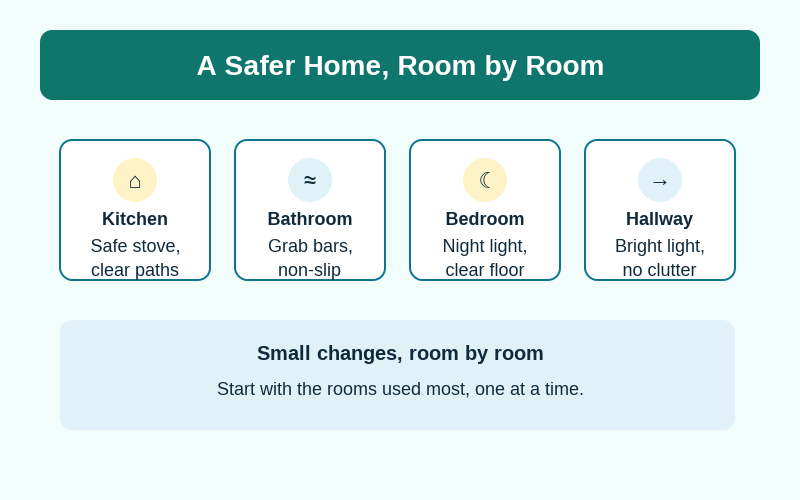
The kitchen is one of the most useful rooms in the home, and one of the most dangerous. The stove is the main risk. If your parent forgets that the stove is on, or leaves it on and walks away, there is a risk of fire or burns. Consider a stove with an automatic shut-off, or a simple timer that turns the stove off. If cooking has become unsafe, do the cooking yourself, or arrange for meals to be prepared, and keep the stove off when you are not there. Keep sharp knives, cleaning products, and medicines out of easy reach, in a locked cupboard if needed.
Make the kitchen easy to use. Label cupboards and drawers in large, clear words: "plates", "cups", "cutlery". Keep everyday things within easy reach, so your parent does not have to climb or stretch. Keep the floor clear and dry, and wipe up spills straight away. Use a kettle with an automatic shut-off, and keep hot drinks in a safe place. Eat together at the same table, at the same times, because a shared meal is safer and more pleasant than eating alone. Our guide to nutrition and hydration has more on meals, and our guide to mealtime help and nutrition covers food in detail.
Bathroom: Grab Bars and Non-Slip Surfaces
The bathroom is where most falls at home happen, because the floor is often wet and the surfaces are hard. The most useful change is a grab bar, fitted securely to the wall beside the toilet and in the shower or bath. A grab bar gives your parent something to hold on to when standing up or stepping in and out, and it can prevent a fall. Fit the bars properly, with the help of a professional if needed, because a loose bar is worse than no bar at all.
Use a non-slip mat in the shower or bath, and on the bathroom floor. A shower chair can help if standing is difficult, and a hand-held shower head makes washing easier and safer. Keep the water temperature safe: if the hot water is very hot, ask a plumber to fit a thermostatic valve, or turn the water heater down. Keep the bathroom warm, well lit, and free of clutter. Label the toilet clearly, and keep the door easy to open. If your parent needs help with washing, read our guide to safe bathing and personal care, which covers dignity and comfort as well as safety.
Bedroom: Sleep, Night Lights, and Clear Paths
The bedroom should be a calm, safe place for sleep, and it should be easy to find the way to the toilet at night. Keep the path from the bed to the bathroom clear, with nothing to trip over, and use a night light in the bedroom, the hallway, and the bathroom, so your parent can see where they are going without turning on bright lights. Keep a glass of water and a familiar object by the bed, such as a photograph or a blanket, so your parent feels safe in the dark.
Keep the bedroom at a comfortable temperature, and keep the bed at a height that makes it easy to get in and out. If your parent gets up at night and wanders, consider a door alarm that sounds when an outside door opens, so you know if they leave the house. Keep a clear, written note by the bed with the day and date, so your parent can orient themselves if they wake confused. If nights become unsafe or exhausting, talk to a doctor and consider overnight help. Our guide to supporting sleep and rest has more ideas for safer, calmer nights.
Living Room: Comfort and Clarity
The living room is where most of the day is spent, so it should be the most comfortable and the easiest to understand. Keep your parent's favourite chair in the same place, with a small table nearby for a drink, a book, or glasses. Keep the television and radio simple to use, with a remote control that has large, clear buttons. Keep the floor clear, the rug flat or removed, and the way to the kitchen and the toilet obvious. A familiar blanket, a cushion, and a few photographs make the room feel like home, while a tidy surface makes it feel calm.
Avoid moving furniture around, because a familiar layout is a memory aid in itself. If your parent sits in the same chair every day, they know where they are. If the furniture changes, they have to learn the room again. Keep the room well lit during the day, with curtains open to let in daylight, and keep the temperature comfortable. If your parent likes to look out of the window, make sure the chair faces it, and that the curtains can be opened easily in the morning. A calm, familiar living room is the heart of the home, and it is worth keeping it that way.
Hallway and Stairs: Light and Clear Paths
Hallways and stairs are often overlooked, but they are where many falls happen. Keep hallways clear of clutter, shoes, bags, and cables, and make sure there is nothing to trip over. Fit a handrail on both sides of the stairs if you can, and make sure the stairs are well lit, with a light switch at the top and the bottom. Mark the edge of each step clearly, with a contrasting strip, so your parent can see where each step ends.
If stairs have become difficult or unsafe, talk to a doctor and to your care provider about alternatives, such as moving the bedroom downstairs, or arranging more help. Do not let your parent use the stairs alone if they are unsteady, and do not carry things up and down the stairs at the same time as helping your parent. Keep a clear path from the front door to the living room, and from the living room to the bathroom, so your parent can move around the home without obstacles. Our guide to creating a calm and familiar home has more on clear paths and familiar layouts.
Lighting Through the Day
Good lighting helps with safety, mood, and sleep. During the day, open the curtains and let in as much daylight as possible. Daylight helps the body clock, improves mood, and makes it easier to see. In the evening, turn the lights on before it gets dark, so the house does not grow dim and confusing. Shadows can be frightening for a person with Alzheimer disease, and a dark corner can look like a person standing there. Bright, even lighting reduces shadows and makes the home easier to read.
Use lights that are easy to turn on and off, with large, clear switches. Consider lights that turn on automatically when someone enters a room, especially in the hallway and bathroom at night. Avoid very bright, glaring lights, and avoid lamps that cast strong shadows. If your parent is restless in the evening, check the lighting first: a house that is too dark, or too bright, can make confusion worse. A steady, warm light through the evening, followed by a dark, quiet bedroom at night, supports the body's natural rhythm. Our guide to managing sundowning at home has more on light and evening confusion.
Doors, Exits, and Wandering Safety
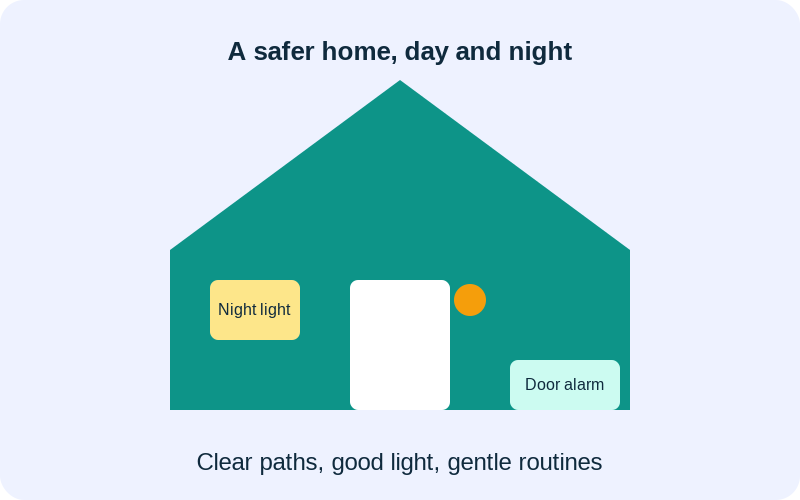
Wandering is a common concern in Alzheimer disease. Your parent may try to leave the house, often because they are looking for something, or someone, or because they feel they need to go somewhere. It is important to keep the home safe without making it feel like a prison. Make sure outside doors are secure, with locks that your parent cannot easily open, or with a door alarm that sounds when a door opens. Keep the front door locked at night, and consider a simple latch high up, out of easy reach.
Make sure your parent carries identification and a phone when they go out, and agree on a plan for what to do if they cannot find their way. Tell neighbours what is happening, so they can help if they see your parent outside alone. If wandering happens often, talk to a doctor, and consider more supervision, or a safe, enclosed garden where your parent can walk freely. Do not use locks or barriers that could trap your parent in a fire, and always make sure there is a safe way out in an emergency. Safety and freedom need to be balanced, and a doctor can help you work out what is right for your parent.
Daily Living Aids That Help
Daily living aids are simple tools that make everyday tasks easier and safer. They are not medical devices, and they do not need a prescription. A clock that shows the day and date in words, a large-print calendar, a whiteboard with today's plan, and labels on doors and cupboards are all daily living aids, and they cost very little. Other useful aids include a kettle with an automatic shut-off, a remote control with large buttons, a phone with large numbers and a few pre-set contacts, and a pill organiser that is filled by a family member or pharmacist.
Choose aids that fit your parent, not aids that look impressive. The best aid is the one your parent will actually use. Introduce one aid at a time, show your parent how to use it, and give them time to get used to it. If an aid is not used, take it away and try something else. Do not fill the home with gadgets that confuse more than they help. A few simple aids, well chosen and well placed, are worth more than a drawer full of devices nobody uses. If you are unsure what might help, talk to a doctor or to an occupational therapist, who can assess your parent's needs and suggest aids that fit.
Keeping the Home Calm and Familiar
Safety is not only about rails and locks. A calm, familiar home is a safe home, because it reduces confusion and anxiety. Keep the home tidy, but not bare. A few familiar objects — a photograph, a favourite blanket, a well-loved chair — make the home feel like home. Avoid major changes, such as redecorating or moving furniture, unless they are needed for safety. If you must change something, explain it simply, and give your parent time to adjust.
Keep noise down. Turn off the television if it is only background noise, and avoid loud music or sudden sounds. Keep visitors to a few at a time, and avoid large, noisy gatherings at home. A calm home is easier to read, and easier to feel safe in. If your parent becomes agitated, check the home first: is it too hot, too cold, too dark, too noisy, or too cluttered? Often, a small change — opening a curtain, turning off a television, or offering a cup of tea — can make a large difference. Our guide to gentle communication tips has more on staying calm when your parent is distressed.
Reviewing the Setup as Needs Change
Alzheimer disease changes over time, and the home must change with it. Review the setup once a month, and sooner if something changes: a fall, a burn, a night of wandering, or a change in mobility or confusion. Walk through the home again, as your parent would, and look for new risks. Remove anything that has become dangerous, and add anything that would help. Keep a short list of changes, with dates, so everyone who helps knows what has changed.
If the home can no longer be made safe, or if your parent needs more supervision than the family can provide, talk to a doctor and to your care provider about more hours of care, or about other options. That is not a failure. It is a sign that needs have changed, and that the plan needs to change too. Our complete family guide to dementia care at home describes how care changes through the stages, and our guide to paying for care and planning ahead can help you plan for more support. If you would like to talk about care, read more about who we are or contact us.
Frequently Asked Questions
Where should I start with making the home safer? Start with the rooms your parent uses most, and with the most dangerous problems first: falls, burns, and wandering. Walk through the home as your parent would, make a list room by room, and change one thing at a time.
Do I need to make major changes, such as a new bathroom? Usually not. Most safety comes from small changes: grab bars, non-slip mats, good lighting, clear paths, and labels. Major changes are only needed if the home cannot be made safe in other ways. Talk to a doctor or an occupational therapist if you are unsure.
How do I stop my parent wandering without locking them in? Use door alarms, secure locks that are hard to open from the inside, and a safe, enclosed garden. Make sure your parent carries identification and a phone. Never use locks that could trap your parent in a fire. Talk to a doctor if wandering happens often.
What if my parent resists changes to the home? Explain each change simply, try a smaller version first, and give your parent time to adjust. A home that feels imposed will be resisted. Involve your parent in the changes as much as possible, and keep the home feeling like home.
How often should I review the home setup? Once a month, and sooner if something changes: a fall, a burn, a night of wandering, or a change in mobility or confusion. Walk through the home again, update your list, and share changes with everyone who helps.
Sources and Further Reading
This guide draws on the following sources, all accessed 29 November 2026.
- Alzheimer's Association — Facts and Figures, and information on Alzheimer disease and home safety. alz.org/alzheimers-dementia/facts-figures
- National Institute on Aging (NIA) — information on Alzheimer's disease, dementia, and caregiving. nia.nih.gov/health/alzheimers-and-dementia
If this guide helped you, please share it with another family who needs it, and read our other guides on Alzheimer support at home. If you would like to talk about care for your parent, start on our homepage or contact us — a friendly advisor is ready to listen, with no obligation. You can write to us at hello@homecare.biz.id.
Tags: alzheimer home care, home safety, senior living
Last reviewed: 25 June 2026. This guide is general information and is reviewed regularly. It is not a substitute for medical advice. Always talk to a doctor about diagnosis, treatment, or any change to care or medication.