
Home Care for Alzheimer Support: Gentle Communication Tips for Families
Written by the HomeCare editorial team. Sources: Alzheimer's Association, National Institute on Aging (NIA).
Conversation is how families stay close. It is how you share news, remember the past, and show love. When Alzheimer disease affects language and memory, conversation becomes harder, for your parent and for you. Words go missing, stories lose their thread, and a simple question can lead to confusion. It is easy to feel that you are losing your parent, one conversation at a time. But communication does not have to stop. It changes, and families can learn new ways to keep it going: shorter sentences, a calm tone, patient listening, and attention to feelings as well as words.
This guide offers gentle communication tips for families caring for a parent with Alzheimer disease at home. It is written for adult children and family members, and it focuses on practical ideas you can use today, in the kitchen, in the car, or on the telephone. It does not replace medical advice. It simply helps you stay connected with your parent, even as words become harder. If you would like the wider picture first, read our complete family guide to dementia care at home and our guide to early signs families notice at home.
Why Communication Changes
Communication changes in Alzheimer disease for several reasons, and understanding them helps you respond with patience. Memory changes mean your parent may forget what was just said, or lose the thread of a conversation. Language changes mean they may struggle to find words, or use a general word instead of a specific one. Attention changes mean they may find it hard to follow a conversation in a noisy room, or to listen to more than one person at a time. And understanding changes mean they may take words literally, or miss the meaning behind a joke or a hint.
These changes are not a choice, and they are not a sign that your parent is not listening or does not care. Your parent is working harder than you can see to follow what is happening, and that effort is tiring. When communication breaks down, your parent may become frustrated, anxious, or withdrawn, and you may feel the same. The aim of gentle communication is to reduce that effort: to make it easier for your parent to understand, and easier for you to be understood. Small changes — shorter sentences, a slower pace, a quiet room — can make a large difference. Our guide to helping with memory and orientation shows how the home itself can support understanding.
Short Sentences, One Idea at a Time
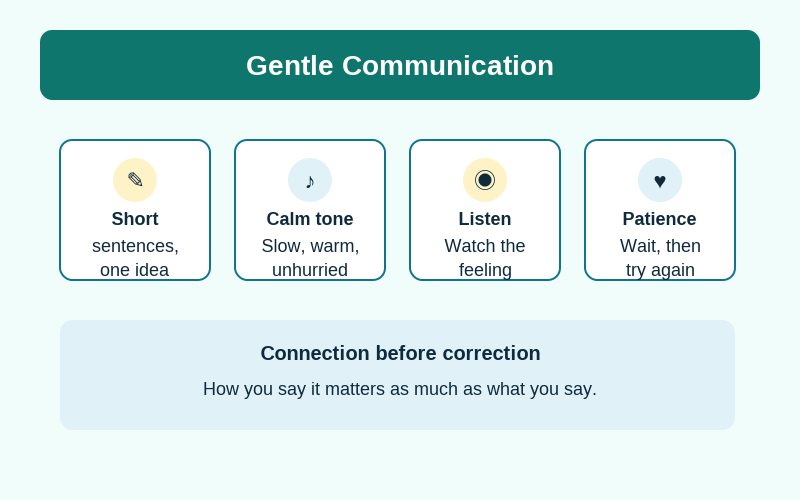
The most useful rule in Alzheimer communication is also the simplest: one idea at a time, in short sentences. "It is time for lunch" is easier to follow than "It is time for lunch, and then we need to go to the shop, and your sister is coming later, and don't forget your coat". Long sentences with several ideas are hard to hold in memory, and your parent may remember only the last part, or none of it. Break instructions into one step at a time. "Put on your coat" is enough. Wait for your parent to do it, then say the next step.
Use simple, familiar words, and say the name of the person or thing you mean, rather than "he", "she", or "it". "Mum, it is time for lunch" is easier to follow than "It is time for lunch", because it tells your parent who you are talking to. Avoid questions that need a long answer, and offer choices instead. "Would you like tea or coffee?" is easier than "What would you like to drink?" If your parent does not understand, do not repeat the same sentence louder. Rephrase it, more simply, or show what you mean. Point to the coat, hold up the cup, or gently guide your parent towards the room. Words are only part of communication, and showing can be clearer than telling.
Tone, Pace, and Body Language
How you say something matters as much as what you say. A calm, warm tone tells your parent that they are safe, even if they do not understand every word. A hurried, sharp, or frustrated tone tells them the opposite, even if your words are kind. Slow down. Speak a little more slowly than usual, with a pause between sentences, so your parent has time to take in what you said. Do not rush the answer. Wait, count silently to ten if you need to, and give your parent time to find their words.
Body language matters too. Sit where your parent can see you, at the same level, and make gentle eye contact. Face your parent when you speak, and do not talk from another room. Touch can help: a hand on the arm, a gentle squeeze, or sitting close together can say more than words. Smile, even when the conversation is hard, because a smile is easy to read. Avoid standing over your parent, crossing your arms, or looking at your phone while you talk. Your parent reads your face and your body before your words, and they will know how you feel. If you are frustrated, take a breath, step away for a moment if you can, and come back calm. Your parent deserves your patience, and you deserve a moment to find it.
Listening and Watching Feelings
Listening is as important as speaking, and it means more than waiting for your turn to talk. When your parent speaks, give them your full attention. Turn off the television, put down what you are doing, and face them. Listen to the feeling behind the words, not just the words themselves. If your parent says "I want to go home" when they are already home, the feeling may be fear, or a wish for safety, or a memory of a childhood home. The words are not literally true, but the feeling is real, and that is what needs a response.
Watch for non-verbal signs too. A furrowed brow, a restless hand, a change in breathing, or a look away can tell you that your parent is confused, tired, or upset, even if they say they are fine. Respond to the feeling, not the words. "I can see you are worried. I am here with you" is more helpful than "There is nothing to worry about". Do not correct every mistake, and do not argue about facts. If your parent says something that is not true, ask yourself whether it matters. If it does not affect safety, let it go, and respond to the feeling instead. Our guide to communicating with calm and patience has more ideas for keeping conversation kind.
When Your Parent Repeats Questions
Repeated questions are one of the most tiring parts of caring for a parent with Alzheimer disease. Your parent may ask the same question five times in ten minutes, and each time it feels as if they have not heard your answer. They have heard it, but the answer did not stay. Remembering that can help you respond with patience, even when you are tired. Answer the question again, in the same short, calm words, as if it were the first time. Do not say "I already told you", because that tells your parent they have failed, and it will not help them remember.
There are practical ways to reduce repeated questions. Write the answer down where your parent can see it: a whiteboard with today's plan, a note by the chair, a calendar with the day's events. If your parent asks when lunch is, point to the whiteboard. If they ask when a visitor is coming, show them the calendar. A written answer stays, even when a spoken answer does not. If the same question comes from anxiety, respond to the anxiety, not the question. "You are safe, and I am here" may help more than another answer. And if you are exhausted by repetition, step away for a moment, ask another family member to take over, or take a short break. You cannot answer the same question with patience if you have none left. Our guide to planning respite for family caregivers shows how to arrange a break.
When Your Parent Says Things That Are Not True
Your parent may say things that are not true: that someone stole their money, that a family member has not visited, that they need to go to work, or that they are a child again. These statements can be upsetting, especially if they accuse you or another family member. It is important to remember that your parent is not lying. They are trying to make sense of a confusing world, using the memories and feelings they still have. Arguing will not help, and it will only increase distress, for both of you.
Do not correct, and do not argue. Acknowledge the feeling, and gently redirect. If your parent says someone stole their money, try "That must be worrying. Let us look for it together." Then help them look, and if you find it, say so kindly. If your parent says they need to go to work, try "You worked hard for many years. Today is a day to rest. Let us have some tea." If your parent talks about a person who has died as if they are alive, do not correct them harshly. Respond to the feeling — the love, the missing — and gently move the conversation on. If accusations or false beliefs are frequent, distressing, or unsafe, talk to a doctor. There may be help available, and you do not have to manage this alone.
Difficult Conversations
Some conversations are hard for every family: driving, money, safety, and care. Your parent may need to stop driving, or may need help with money, or may need more care than the family can provide. These conversations are difficult because they touch on independence, dignity, and control. Choose a calm moment, in private, when neither of you is tired or rushed. Start with care, not with a decision. "I am worried about your safety, and I want to talk about it" is kinder than "You cannot drive any more".
Keep the conversation short, and do not try to settle everything at once. One topic, one conversation. Use "I" statements, and keep it simple. Offer choices where you can, and involve your parent in the decision as much as possible. If your parent becomes upset, pause, acknowledge the feeling, and try again later. If a conversation is too difficult to have alone, ask another family member to join, or ask a doctor to raise the topic. A doctor's words can carry weight that a family member's cannot. And remember that some conversations, such as driving, may need a doctor's advice or a formal assessment. Talk to a doctor about what is needed, and follow their advice. Our guide to paying for care and planning ahead can help with conversations about money and care.
Talking With Children and Grandchildren
Children and grandchildren need help to understand what is happening to a grandparent with Alzheimer disease. Explain it simply, in words they can understand, and be honest. "Grandma's memory is not working as well as it used to, so she may forget things, or ask the same question again. She still loves you, and she still likes it when you visit." Encourage children to visit, even for short times, and to do simple things together: looking at photographs, listening to music, or going for a walk.
Prepare children for changes they may notice. Their grandparent may not remember their name, may repeat themselves, or may become upset for no clear reason. Tell them in advance, so they are not frightened, and give them simple things to do: "Show Grandma your drawing", "Sing her favourite song", "Hold her hand". If a child is upset, listen to them, and reassure them. It is all right to feel sad, confused, or angry. Children who are included, and who are told the truth in simple words, cope better than children who are kept away or told nothing. If you would like more ideas, our guide to meaningful activities at home has ideas for activities that work across generations.
Keeping a Conversation Going
Conversation does not have to be about the present, or about facts. The past is often easier to remember than the present, and talking about the past can be a pleasure for your parent. Ask about their childhood, their first job, their wedding, or a favourite holiday. Look at old photographs together, and listen to the stories, even if you have heard them before. Play music from their youth, and sing along. Read a familiar poem or a passage from a favourite book. These are all conversations, even if they do not look like one.
Keep conversations short, and watch for tiredness. If your parent becomes quiet, restless, or upset, it may be time to stop. A short, happy conversation is better than a long one that ends in frustration. End on a good note, with something warm: a cup of tea, a favourite song, or a simple "I love you". And remember that conversation is not only words. Sitting together, holding a hand, or sharing a meal in silence can be just as much a connection as a long talk. Our guide to activities that support daily engagement has more ideas for staying connected, and if you would like to talk about care, contact our team or read more about who we are and how we work.
Frequently Asked Questions
Should I correct my parent when they say something wrong? Not usually. If it does not affect safety, let it go and respond to the feeling instead. Correcting every mistake causes distress and does not help memory. Save corrections for safety: if your parent is about to do something dangerous, intervene calmly and clearly.
What should I do when my parent asks the same question again and again? Answer again, in the same short, calm words, as if it were the first time. Write the answer down where your parent can see it, and respond to the anxiety behind the question. If you are exhausted, take a break or ask another family member to take over.
How can I talk to my parent about driving or money? Choose a calm moment, in private. Start with care, use "I" statements, and keep it short. One topic, one conversation. If it is too difficult, ask another family member or a doctor to help. Some decisions, such as driving, may need a doctor's advice.
My parent has stopped talking much. What can I do? Keep talking to them, even if they do not answer much. Use short sentences, a calm tone, and familiar topics from the past. Music, photographs, and touch can help. If withdrawal is sudden or severe, talk to a doctor.
Is it all right to feel frustrated when communication is hard? Yes. Communication problems are tiring and upsetting, and frustration is normal. Take a breath, step away if you can, and be kind to yourself. Talk to another family member or a support group. You cannot communicate with patience if you have none left.
Sources and Further Reading
This guide draws on the following sources, all accessed 29 November 2026.
- Alzheimer's Association — Facts and Figures, and information on Alzheimer disease and communication. alz.org/alzheimers-dementia/facts-figures
- National Institute on Aging (NIA) — information on Alzheimer's disease, dementia, and caregiving. nia.nih.gov/health/alzheimers-and-dementia
If this guide helped you, please share it with another family who needs it, and read our other guides on Alzheimer support at home. If you would like to talk about care for your parent, start on our homepage or contact us — a friendly advisor is ready to listen, with no obligation. You can write to us at hello@homecare.biz.id.
Tags: alzheimer home care, dementia home care, senior communication
Last reviewed: 24 June 2026. This guide is general information and is reviewed regularly. It is not a substitute for medical advice. Always talk to a doctor about diagnosis, treatment, or any change to care or medication.