
Home Care and Caregiver Support: How to Ask for Help Without Guilt
Written by the HomeCare editorial team. Sources: Alzheimer's Association, National Institute on Aging (NIA).
Most family caregivers can describe the moment they realised they needed help, and the moment they decided not to ask for it. Perhaps you were exhausted after a broken night, and a sibling rang to chat, and you said everything was fine. Perhaps a friend offered to sit with your parent for an afternoon, and you said no, because it felt wrong to hand over your own parent to someone else. Perhaps you have never asked at all, because asking feels like admitting that you cannot cope, and you are the one the family relies on.
This guide is written for adult children caring for a parent at home, and it starts from a simple idea: asking for help is part of good care, not a failure of it. No one person can do this work alone, day after day, without rest, and the care your parent receives is better when the person giving it is rested, supported, and able to keep going. This guide explains why asking feels so hard, what guilt is really telling you, and how to ask in clear, practical words that make it easy for other people to say yes. If you would like the wider picture first, read our complete guide to home care and our guide to avoiding caregiver burnout.
Why Asking for Help Feels So Hard
Asking for help is hard for reasons that have little to do with how strong you are. The first reason is love. Your parent cared for you, and now you want to return that care properly. Handing part of it to someone else can feel like stepping back from a promise you made to yourself, even when no one asked you to make that promise alone. The second reason is habit. If you have always been the reliable one in the family, the one who sorts things out, it can feel strange to be the one who needs something. The third reason is worry: worry that others will not do it properly, worry that your parent will be upset, worry that you are being a burden.
There is also a practical reason, and it is worth naming: asking for help is work in itself. You have to explain what needs doing, when, and how, and that takes time and energy you may not have. It can feel easier to do it yourself than to explain it to someone else, especially the first time. That is true, and it is also a trap, because the work only grows as your parent's needs change. The first time you ask is the hardest. The second time is easier, because the other person already knows the routine. The goal of this guide is to make that first ask as small and as easy as possible, so that you can get through it and reach the easier times that follow.
Guilt Is Not the Truth
Guilt is the feeling most caregivers mention first, and it deserves a careful look, because guilt is a feeling, not a fact. Guilt says: if you were a better son or daughter, you would do this all yourself. It says: your parent deserves your time, not a stranger's. It says: other people have their own lives, and you should not trouble them. Each of these thoughts sounds reasonable, and each of them falls apart when you look at it closely. A better son or daughter is not one who collapses from exhaustion; it is one who makes sure care keeps going, safely and kindly, for a long time. Your parent deserves care from a rested person, not from someone running on empty.
It helps to ask yourself a simple question: if your sibling were in your position, doing everything you do, what would you tell them? Most caregivers answer at once: I would tell them to ask for help, to take a break, to let the family share the load. You would not call them selfish. You would not think less of them. Hold yourself to the same standard you would hold them to. Guilt may not disappear the first time you ask, and that is normal. Many caregivers feel guilty and ask anyway, and find that the guilt fades once they see that their parent is well cared for and that they themselves can breathe again. Our guide to self-care tips for family caregivers has more on living with these feelings, and our guide on managing stress and sleep as a caregiver looks at what happens when the load stays unshared for too long.
What Help Can Look Like
When people hear "help", they often picture one big thing: someone moving in, or a full-time carer arriving. In practice, help is usually a collection of small things, and small things are easier to ask for. Help can be a sibling sitting with your parent for two hours on a Saturday so you can go out. It can be a neighbour doing the weekly shop. It can be a friend cooking an extra meal and leaving it at the door. It can be a family member taking over the paperwork, the appointments, or the phone calls to the care provider, so that you have fewer jobs to carry in your head.
Help can also be practical in a different way: someone who listens. A weekly phone call with a friend, a support group where other caregivers understand exactly what your days are like, or a short chat with a care advisor can make the load feel lighter, even when nothing practical changes. Before you ask anyone for anything, make a list of the jobs you do in a week, and mark the ones that someone else could do. Cooking, shopping, laundry, driving to appointments, sitting with your parent, handling paperwork, and making phone calls are all jobs that can be shared. When you can see the list, you can see that you are not asking for everything. You are asking for one or two jobs, from one or two people, at a time that suits them.
Who to Ask, and When
Start with the people closest to the situation: your siblings, your parent's other children, and your own partner or adult children. They know your parent, and they have the strongest reason to share the care. If family cannot help, or cannot help enough, look wider: neighbours, friends, members of a local faith group or community group, and the volunteers and services in your area. Our guide to local help and community resources can help you find what exists near you, and it is worth reading before you decide that there is no one to ask.
Timing matters. Ask when the other person is calm and has time to listen, not in the middle of a crisis or at the end of a difficult day. A quiet phone call, a cup of tea together, or a short message asking for a time to talk all work better than a request made in a rush. Ask early, before you are exhausted, because it is much harder to ask well when you are already at breaking point. And ask one person at a time, about one specific thing, rather than asking a whole group at once. When a request goes to a group, everyone assumes someone else will answer. When it goes to one person, with a clear job and a clear time, it is much easier to say yes.
Clear Words That Make It Easy to Say Yes
The way you ask matters as much as what you ask for. A vague request — "I need some help" — is hard to answer, because the other person does not know what you need, when, or for how long. A clear request is easy to answer, because the person can see exactly what is being asked and can say yes or no honestly. A clear request has four parts: what you need, when you need it, how long it will take, and what it will involve. For example: "Could you sit with Mum on Saturday from two until four, so I can go to my own appointment? She will be in the living room, she likes tea at three, and my number is on the fridge if you need me."
It also helps to say why it matters, in one short sentence, without making the other person feel guilty. "I have not had a break this week, and two hours would make a real difference" is honest and kind, and it lets the other person see that their help has a real effect. Avoid apologising too much, because long apologies make a simple request sound like a burden. A short, warm request, with a thank you at the end, is enough. If the person says yes, write down what was agreed — the day, the time, and the job — and send a short message to confirm it. That way nobody has to remember, and nobody has to ask twice. Keep a few ready-made requests for different people: a sibling might take a Saturday afternoon, a neighbour might do a weekly shop, and a friend might cook a meal. Having the words ready makes asking feel less daunting when the moment comes.
Holding a Short Family Meeting
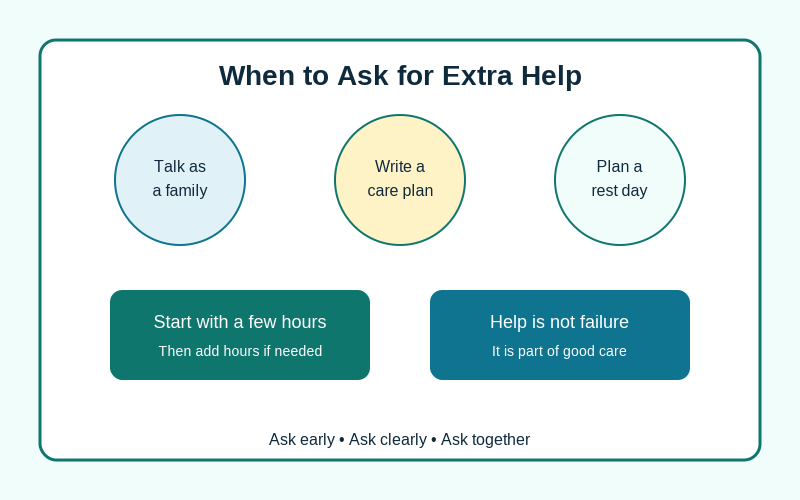
When several family members are involved, a short family meeting can share the load more fairly than a series of separate requests. Keep it short — thirty minutes is enough — and keep it practical. Choose a time when everyone can join, in person or by video call, and send a short note beforehand: what you want to talk about, and what you hope to agree. Start with the facts: what your parent needs now, what you are currently doing, and what is becoming too much. Then ask each person what they could do, regularly, rather than telling them what they should do. People are far more willing to take on a job they have chosen than a job they have been given.
Write down what is agreed, who is doing what, and when it starts, and share the note with everyone afterwards. A shared note prevents the most common family problem in caregiving: everyone thinking someone else is handling it. If your parent can take part, include them too, and let them say what matters to them. If a family member cannot help in person, they may be able to help in another way: paying for a few hours of professional care, handling paperwork, or doing the weekly shop online. Fair does not always mean equal, and it does not always mean the same job. It means everyone contributes something, regularly, and no one person carries it all. Our guide to talking with family about care needs has more ideas for these conversations, and our guide to building a weekly care schedule shows how to turn the agreement into a plan everyone can see.
When the Answer Is No
Sometimes the answer is no, and that is painful, especially when you have worked up the courage to ask. It helps to remember that a no is usually about the other person's life, not about you. They may be ill, exhausted, busy with their own family, or afraid of doing it wrong. A no to one request is not a no to every request, and it is not a judgement on you or on your parent. Thank them for listening, and ask whether there is a different job, or a different time, that would work better. "Could you do the shopping instead, on a Friday?" is a smaller ask, and it may be one they can say yes to.
If the same person says no every time, do not keep asking the same question in the same way. Look elsewhere: another family member, a neighbour, a community service, or a professional caregiver. It is also worth asking yourself whether the request was clear enough. Sometimes a no means "I do not know what you want me to do" rather than "I will not help". A clearer, smaller request, with a fixed time and a fixed job, can turn a no into a yes. And if family help truly is not available, that is not your failure. It is a fact about your family's situation, and it is a good reason to look at professional help and community resources, which exist precisely for families in that position.
Asking for Professional Help
Asking a professional for help is different from asking family, and for many caregivers it is harder, because it feels like a bigger step. It is not. Professional help is a normal part of home care, and most families use it at some point. It can be a professional caregiver visiting for a few hours a week, help with personal care or meals, overnight cover, or respite care that gives you a longer break. Start small: a few hours a week, at a regular time, is easier to arrange and easier to get used to than a large change made in a crisis. Our guide to respite care options for family caregivers explains the choices in detail.
When you talk to a care provider, be clear about what you need, and ask what they can offer, what it costs, and how it works. If cost is a worry, it helps to know the figures: the CareScout median cost of home care in the United States was $35 per hour in 2025, according to CareScout's cost of care survey, so a few hours a week has a clear, plannable cost that you can discuss with your family. Ask the provider how they choose and train their caregivers, what happens if a caregiver is ill, and how you can give feedback. A good provider will welcome those questions. You can also write to us at hello@homecare.biz.id, or read more about who we are and how we work, if you would like to talk about care for your parent. And if you are caring for a parent with dementia, our guide to when to ask for extra help at home covers the signs that more support is needed.
A Simple Plan for the Next Two Weeks
A plan makes asking easier, because it turns a vague feeling — "I need help" — into a short list of small, clear requests. The plan below is a starting point. Work through it over the next two weeks, one step at a time.
- Day one: Write down the jobs you do in a week, and mark three that someone else could do.
- Day two: Choose one person to ask first, and one small, specific job with a day and a time.
- Day three: Ask them, using clear words: what, when, how long, and what it involves. Write down what was agreed.
- Week one: Let the help happen. Do not hover, and do not redo the job afterwards. Use the time for yourself.
- Week two: Ask a second person, or ask the first person for a regular slot, such as every Saturday afternoon.
- End of week two: Hold a short family meeting, share the weekly schedule, and agree who does what next month.
Keep the note of what was agreed where everyone can see it, and update it when things change. If a request is turned down, try a smaller request or a different person, and do not take it as a reason to stop asking. If you would like more ideas for sharing the load, read our guide to planning long term care together and our guide to balancing work and family caregiving.
Frequently Asked Questions
Is it selfish to ask for help with caring for my own parent? No. Asking for help is how care keeps going safely and kindly over months and years. A rested caregiver gives better care than an exhausted one, and sharing the load means your parent has more people who know and care about them.
What if my siblings think I should manage alone? Start with facts, not blame: what your parent needs, what you are doing now, and what is becoming too much. Ask each person what they could do regularly, and write down what is agreed. If a sibling cannot help in person, they may be able to help in another way, such as paying for a few hours of professional care or handling paperwork.
How do I ask without sounding like I am complaining? Keep the request short, specific, and warm: what you need, when, how long, and what it involves, plus one short sentence about why it matters. Avoid long apologies, and thank the person at the end. A clear request is easier to hear than a vague one, and it does not sound like a complaint.
What if I ask and the person does it differently from me? Let it go, unless safety is involved. Different is not wrong. Your parent will adjust, and the other person will get better with practice. Redoing the job afterwards, or correcting every detail, makes people reluctant to help again.
When should I ask for professional help instead of family help? Ask for professional help when the care your parent needs is more than family can safely give, when nights are broken most nights, or when you are exhausted despite family help. Start with a few hours a week at a regular time, and talk to the provider about what they offer and what it costs.
Sources and Further Reading
This guide draws on the following sources, all accessed 29 November 2026.
- Alzheimer's Association — Facts and Figures, and information on dementia care at home. alz.org/alzheimers-dementia/facts-figures
- National Institute on Aging (NIA) — information on Alzheimer's disease, dementia, and caregiving. nia.nih.gov/health/alzheimers-and-dementia
If this guide helped you, please share it with another family who needs it, and read our other guides on home care and caregiver support. If you would like to talk about care for your parent, start on our homepage or contact us — a friendly advisor is ready to listen, with no obligation. You can write to us at hello@homecare.biz.id.
Tags: home care caregiver, family support, respite care
Last reviewed: 28 June 2026. This guide is general information and is reviewed regularly. It is not a substitute for medical advice. Always talk to a doctor about diagnosis, treatment, or any change to care or medication.