
Home Care and Caregiver Support: Planning Long Term Care Together
Written by the HomeCare editorial team. Sources: Alzheimer's Association, National Institute on Aging (NIA).
Most families do not plan long term care. They cope with today, and then with tomorrow, and then a crisis arrives — a fall, a hospital stay, a sudden change — and suddenly decisions have to be made in a hurry, with no plan, no agreement, and no clear idea of what your parent would have wanted. Planning long term care together is the opposite of that. It is a slow, calm conversation, held while there is still time, about what your parent wants, what the family can do, what care might be needed, and how it will be paid for. It is one of the kindest things a family can do for each other.
This guide is written for adult children caring for a parent at home, and for the families around them. It walks through the whole plan, step by step: starting the conversation, listening to what your parent wants, looking honestly at care needs now and what may change, comparing the care options, working out the costs, sorting the practical papers, and agreeing who does what. You do not need to do it all at once. Work through one section at a time, over a few weeks, and write down what you agree. If you would like the wider picture first, read our complete guide to home care and our complete family guide to dementia care at home.
Why Plan Early, While There Is Time
Planning early matters for three reasons. The first is choice. When you plan early, you can compare options calmly, visit services, talk to care providers, and choose what fits your parent best. When you plan in a crisis, you take whatever is available, and that is rarely the best fit. The second reason is your parent's voice. Early planning means your parent can say what they want, while they can still say it clearly. That matters more than anything else in the plan, because care that follows a person's own wishes is kinder, and it is easier for the family to carry out, because they know it is what their parent wanted. The third reason is money. Care costs money, and knowing the costs early means the family can plan, save, share the cost, and avoid the shock of a large bill arriving with no warning.
Planning early also protects the family. Caregiving can strain even close families, especially when siblings disagree about what should happen. A written plan, agreed together, prevents most of those arguments, because everyone has seen the same facts and agreed the same next steps. It also protects the person doing most of the caring, because the plan makes the load visible, and shows who is doing what. If your parent has dementia, planning early matters even more, because needs will change over time, and the plan will need to change with them. Our guide to a calm daily routine for dementia care can help with the day-to-day side of that, while this guide covers the longer view.

Starting the Conversation
Starting the conversation is often the hardest part, because it means talking about ageing, illness, and the future, and no one enjoys that. It helps to start small, and to start with your parent's life, not with their problems. A walk together, a cup of tea, a quiet afternoon — these are better settings than a formal meeting. You might begin with a simple question: "What matters most to you about living at home?" Or: "If you needed more help one day, what would you want it to look like?" Listen to the answer, and do not rush to fix anything. The first conversation is about listening, not deciding.
It also helps to be honest about why you are asking. "I want to make sure we do this the way you would want it, and I want us to be ready, so that no one has to decide in a hurry" is a kind and honest reason, and most parents understand it. If your parent finds the conversation hard, leave it for another day, and try again. If one sibling finds it hard, let another start the conversation. You do not need everyone in the room at once for the first talk. What you need is a beginning, and a promise to talk again. Our guide to talking with family about care needs has more ideas for these conversations, and our guide on how to ask for help without guilt can help when the conversation turns to sharing the load.
What Your Parent Wants
Your parent's wishes are the centre of the plan, and they deserve to be written down in their own words, as far as possible. Ask about the things that matter most to daily life: staying at home, or moving somewhere with more support; who they would like to help them, and who they would not; what a good day looks like to them; what they would find hardest to lose. Ask about the small things too, because the small things are often what make a day feel like their own: a favourite meal, a morning walk, music in the afternoon, a garden, a pet, a regular visit from a grandchild. A plan that protects those things is a plan your parent will recognise as theirs.
It is also worth asking, gently, about the things that are harder to talk about: what your parent would want if they became very ill, who they would trust to make decisions for them, and what they would not want. These are difficult questions, and your parent may not want to answer them all at once. That is fine. Write down what they do say, and come back to the rest later. If your parent can no longer tell you what they want, look for what they have said before — in conversations, in letters, in the way they have lived — and use that as your guide. And talk to a doctor if you are unsure about what care your parent may need, because a doctor can help you understand what is likely to change, and when.
Care Needs Now, and What May Change
A good plan starts with an honest look at what your parent needs now. Write down the daily tasks: washing, dressing, eating, moving around the house, taking the right things at the right time, keeping the house safe, and getting out and about. For each one, note whether your parent manages alone, manages with a little help, or needs a lot of help. Then write down the weekly tasks: shopping, cooking, laundry, cleaning, appointments, and paperwork. This simple list is the heart of the plan, because it shows exactly what care is needed, and it shows what will change if any one task becomes harder.
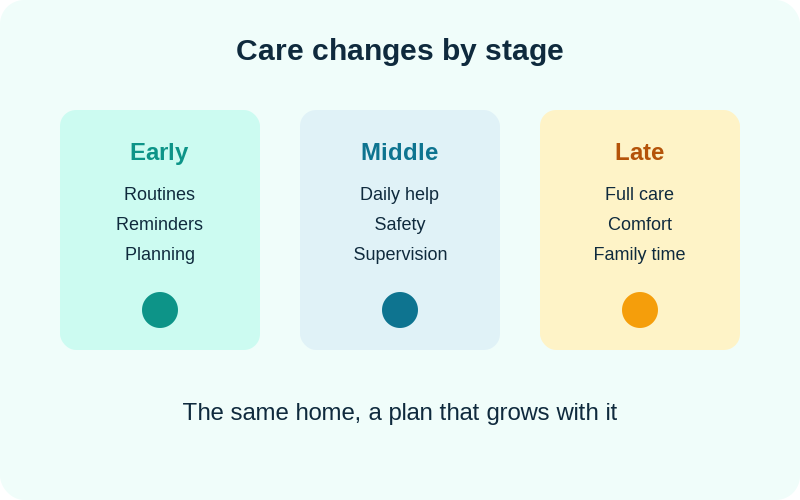
Next, think about what may change. Needs rarely stay the same. A parent who needs a little help with shopping today may need help with washing next year, and help through the night the year after. That does not mean the plan has to cover everything at once. It means the plan should have stages: what happens now, what happens if more help is needed, and what happens if staying at home is no longer safe. For each stage, write down who will help, what it will cost, and how the family will decide when to move to the next stage. A plan with stages is a plan that can grow, and it stops the family from having to start from scratch every time something changes. Our guide to building a weekly care schedule can help you turn the list of needs into a week that works.
The Care Options, Side by Side
There are more care options than most families realise, and they are not all or nothing. At one end is care at home, with family help and a professional caregiver visiting for a few hours a week. At the other end is a care home with round-the-clock support. In between, there are many steps: more hours at home, overnight cover, respite care for a break, day centres where your parent can spend time with others, and supported living where help is nearby. Each option has its own strengths, and the right one depends on your parent's needs, their wishes, and what the family can sustain.
Compare the options side by side, on paper, before you decide anything. For each option, write down what it offers, what it costs, who provides it, and what would have to change at home to make it work. Talk to more than one provider, visit if you can, and ask the same questions each time: who will come, how are they chosen and trained, what happens if someone is ill, and how can the family give feedback. A good provider will welcome those questions. And remember that the plan can mix options: care at home during the week, a day centre twice a week, and respite for a longer break can work together, and the mix can change as needs change. Our guide to respite care options for family caregivers explains one of those options in detail, and our guide to local help and community resources can help you find what exists near you.
Costs and Money, Without Surprises
Money is the part of the plan that families avoid most, and the part that causes most worry later. It is worth facing it early, calmly, and together. Start by listing what care costs now, and what it might cost at each stage of the plan. The clearest figure to work with is the hourly cost of home care: the CareScout median cost of home care in the United States was $35 per hour in 2025, according to CareScout's cost of care survey. From that figure, you can work out what a few hours a week costs, what daily help costs, and what round-the-clock help would cost, and you can compare those figures with the other options on your list.
Next, list what money is available: your parent's income, savings, and any support they may be entitled to, and what the family can contribute. Be honest about what each person can give, regularly, without harming their own household. If the numbers do not add up, that is useful information, not a failure. It tells you which options are realistic, and where the family needs to look for other support, or to change the plan. Keep the figures in one place, update them when they change, and review them together at least once a year. If the money is complicated, consider talking to a qualified financial adviser who understands care costs, and bring the written plan to that conversation. You can also write to us at hello@homecare.biz.id, or read more about who we are and how we work, if you would like to talk about care for your parent.
Legal and Practical Papers to Sort
Alongside the care plan, there are practical papers that make everything easier when they are sorted early. The most important is a clear record of who can make decisions for your parent if they cannot make them themselves, and what your parent would want those decisions to be. The rules for this vary by place, so it is worth getting proper legal advice in your own area, rather than guessing. A solicitor or legal adviser can explain the options, help your parent put their wishes in writing, and make sure the papers are valid. Do this while your parent can still say what they want, and keep the papers where the family can find them.
Other papers are simpler, but just as useful: a list of your parent's doctors and health details, a list of regular appointments, a list of important contacts, and a note of where key papers are kept. Keep a copy of the care plan with these papers, and give a copy to everyone in the family who is involved. If your parent has a will, make sure the family knows where it is, and when it was last reviewed. Sorting these papers is not morbid, and it is not rushing anything. It is a practical kindness, because it means that when a decision has to be made, the family is not searching for papers in the middle of a crisis. If you are unsure where to start, ask your parent's doctor or a local advice service, and work through the list one paper at a time.
Agreeing Family Roles
A plan only works if everyone knows their part in it. Sit down together — in person or by video call — and agree, in writing, who does what. One person may be the main caregiver. Another may handle the money and the paperwork. Another may do the weekly shop, or cover weekends, or take your parent to appointments. Fair does not mean equal, and it does not mean the same job. It means everyone contributes something, regularly, and no one person carries it all. Write down the roles, the days, and the times, and share the note with everyone, including your parent, so that the plan is visible to all.
It also helps to agree how decisions will be made. Who is the main contact for the care provider? Who decides when to move to the next stage of the plan? How will the family handle a disagreement? Agreeing this in advance, while everyone is calm, prevents arguments later, when the stakes are higher. And agree how the main caregiver will be supported, because a plan that protects the caregiver protects the care itself. Regular breaks, shared nights, and a say in the big decisions are not extras. They are part of the plan. Our guides to managing stress and sleep as a caregiver and balancing work and family caregiving look at what happens when that support is missing, and how to put it back.
Reviewing the Plan as Things Change
A long term care plan is not a document you write once and forget. It is a living plan, and it needs reviewing as things change. Put a review date in the calendar — every six months is a good rhythm, or sooner if something changes — and sit down together to look at the plan. What has changed? What is working, and what is not? Has your parent's health changed, has the family's situation changed, have costs changed? Update the list of needs, the schedule, the roles, and the figures, and write down what was agreed. Keep the old versions, so that you can see how the plan has grown, and so that no one has to remember what was decided a year ago.
The review is also a good time to ask your parent, again, what matters to them, because wishes can change too. A parent who wanted to stay at home at all costs may, one day, feel safer somewhere with more support, and a plan that listens to that change is a plan that is working. If a review shows that staying at home is no longer safe, or that the main caregiver is exhausted, do not treat that as a failure. Treat it as the plan doing its job: telling you, in time, that it is time for the next stage. If you would like to talk about the next stage, contact us — a friendly advisor is ready to listen, with no obligation. You can write to us at hello@homecare.biz.id.
Frequently Asked Questions
When is the right time to start planning long term care? The right time is now, while your parent can still say what they want and while there is no crisis forcing a decision. Planning early gives you choice, time to compare options, and a plan the whole family has agreed. It is never too early, and it is only too late when a crisis has already arrived.
What if my parent does not want to talk about it? Do not force the conversation. Start small, start with what matters to them about daily life, and come back to it another day. A short, calm conversation, repeated over weeks, will get further than one long, difficult talk. If one family member finds it easier to talk to your parent, let them start.
How much does home care cost? The CareScout median cost of home care in the United States was $35 per hour in 2025, according to CareScout's cost of care survey. From that figure, you can work out what a few hours a week costs, and compare it with other options. Costs vary by place and by provider, so ask for a written quote before you decide.
What if the family disagrees about the plan? Start with the facts, and with your parent's wishes, which come first. Write down what is agreed and what is not, and agree to review the disputed points at the next meeting. If the disagreement is about money or about who does what, a written plan, with clear roles and clear figures, usually helps more than another argument.
How often should we review the plan? Every six months is a good rhythm, or sooner if something changes — a fall, a hospital stay, a change in health, or a change in the family's situation. Update the list of needs, the schedule, the roles, and the figures, and keep the old versions so you can see how the plan has grown.
Sources and Further Reading
This guide draws on the following sources, all accessed 29 November 2026.
- Alzheimer's Association — Facts and Figures, and information on dementia care at home. alz.org/alzheimers-dementia/facts-figures
- National Institute on Aging (NIA) — information on Alzheimer's disease, dementia, and caregiving. nia.nih.gov/health/alzheimers-and-dementia
If this guide helped you, please share it with another family who needs it, and read our other guides on home care and caregiver support. If you would like to talk about care for your parent, start on our homepage or contact us — a friendly advisor is ready to listen, with no obligation. You can write to us at hello@homecare.biz.id.
Tags: home care caregiver, long term care, senior care planning
Last reviewed: 28 June 2026. This guide is general information and is reviewed regularly. It is not a substitute for medical advice. Always talk to a doctor about diagnosis, treatment, or any change to care or medication.