
Home Care for Dementia: How to Communicate with Calm and Patience
Written by the HomeCare editorial team. Sources: Alzheimer's Association, National Institute on Aging (NIA).
Talking with a parent who has dementia can be one of the hardest parts of caring at home. The person you have known all your life may struggle to find a word, lose the thread of a conversation, repeat the same question, or say something that is not true. You may feel frustrated, sad, or guilty for feeling frustrated. You may find yourself correcting your parent, raising your voice, or walking away — and then wishing you had done it differently. This guide is here to help you communicate in a way that is calmer, kinder, and easier for both of you.
Good communication with dementia is not about perfect sentences. It is about patience, simplicity, and respect. It is about listening to the feeling behind the words, giving your parent time to answer, and choosing connection over correction. The ideas in this guide are practical, and you can use them today, in ordinary moments: at breakfast, on a walk, in the evening, or when your parent is upset. If you would like the wider picture first, read our complete family guide to dementia care at home and our daily routine guide for families, because a steady day makes conversation easier too.
How Dementia Changes Communication
Dementia affects the brain in ways that make communication harder. Finding the right word takes longer. Following a long sentence, or a conversation with several people, becomes difficult. Remembering what was just said, or what happened earlier in the day, is often hard. Your parent may use the wrong word, describe something instead of naming it, or stop in the middle of a sentence. They may also find it harder to understand what others mean, especially if people speak quickly, use long sentences, or ask several questions at once.
These changes are not your parent's fault, and they are not something your parent can simply try harder to overcome. A person with dementia is not being difficult when they repeat a question or forget an answer. They are coping with a brain that no longer works in the way it used to. Keeping that in mind changes everything: the goal is not to test memory, or to prove that something is wrong, but to make the conversation feel safe and kind. When your parent feels safe, they are more likely to relax, to listen, and to try to speak. When they feel rushed or corrected, they are more likely to withdraw, or to become upset.
Communication is more than words. A calm voice, a gentle touch, eye contact, a smile, and an unhurried manner all tell your parent that they are safe and respected, even when words are hard to follow. A familiar song, a photograph, or simply sitting together in silence can be a form of communication too. Your parent is still an adult, and they deserve to be spoken to as you would want to be spoken to.
Before You Speak
Before you say anything important, take a moment to prepare the moment. Choose a quiet place, with as little background noise as possible. Turn off the television or radio if it is only background noise, because it can make it harder for your parent to hear and follow you. Make sure you have your parent's attention before you speak. Sit where they can see you, make gentle eye contact, and use their name. "Mum, I would like to talk about lunch" is easier to follow than a sentence spoken from another room.
Check your own state too. If you are rushed, tired, or upset, your parent will often sense it, even if you try to hide it. A hurried voice, a tense face, or a hand on the door can make your parent feel anxious before you have said a word. If you can, take a slow breath, lower your shoulders, and give yourself a moment. If the conversation can wait until you are calmer, let it wait. A kind conversation at a calm time is far better than a rushed one now. This is especially true in the evening, when tiredness can make everything harder, as explained in our guide to managing sundowning at home.
Think about what you need to say, and keep it to one idea. If you need to talk about lunch, a visit, and a doctor's appointment, do not put them all in one conversation. Choose the most important one, say it simply, and leave the rest for later. Write important things down, so your parent can look at them again, and so you do not have to repeat the same information many times. A whiteboard, a large-print note, or a simple calendar can carry the message when words alone are not enough.
Simple, Clear Language
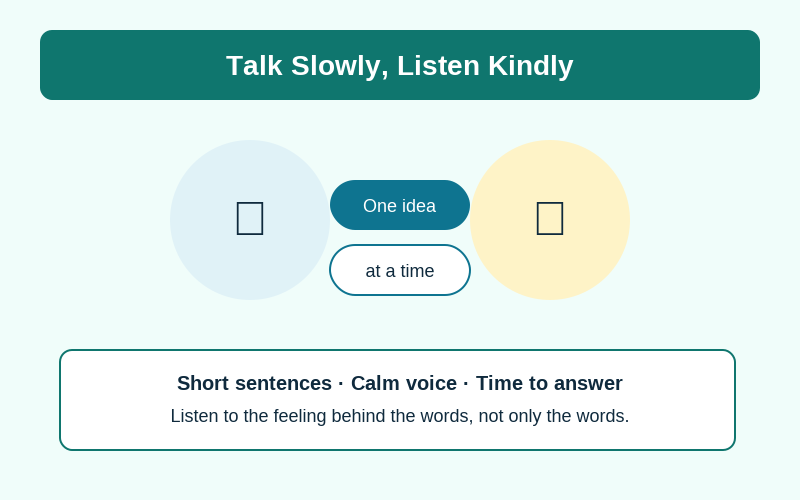
Use short sentences, one idea at a time. "It is time for lunch" is easier to follow than "It is time for lunch, and then we need to go to the shops, and your sister is coming later, so we need to hurry." If a sentence has more than one idea, break it into two. Pause between sentences, and give your parent time to take in what you have said. Silence can feel awkward, but it is often exactly what your parent needs in order to understand and to answer.
Use simple, familiar words, and say them clearly, in a calm, unhurried voice. Do not shout, and do not speak as if your parent is a child. Speak as an adult to an adult, slowly and respectfully. Use your parent's name often, because it helps them know that you are speaking to them. Avoid questions that test memory, such as "Do you remember what we did yesterday?" or "What is my name?" Those questions can cause distress, and they rarely help. Instead, offer information gently: "It is Tuesday. I am Sarah, your daughter. We are going to have lunch together."
When you ask a question, make it a simple one, with a clear choice. "Would you like tea or water?" is easier than "What would you like to drink?" A choice between two things is a real choice, and it is small enough not to overwhelm. If your parent does not answer, wait. Count slowly to ten in your head before you repeat the question. Repeating a question too quickly can feel like pressure, and it can make your parent more confused, not less. If your parent still does not answer, try saying the same thing in a slightly different way, or offer the choice again later.
Tone and Body Language
Your tone of voice often matters more than your words. A calm, warm, unhurried voice tells your parent that they are safe, even when the words are hard to follow. A sharp, loud, or impatient voice tells them the opposite, even if the words themselves are kind. Try to keep your voice low and steady, especially when your parent is upset. If you notice your own voice rising, pause, take a breath, and start again more slowly.
Your body language matters too. Sit at the same level as your parent, rather than standing over them. Face them, make gentle eye contact, and keep your hands relaxed. A gentle touch on the arm or hand can be reassuring, if your parent welcomes it, but do not touch without warning, and respect it if your parent pulls away. Keep your face open and friendly, and smile when you can. If your parent is looking for reassurance, your face and your manner will often give it before your words do.
Be aware of the room as well. A noisy room, a bright light, or a crowded space can make communication harder. Move to a quieter place if you can, and make sure your parent can see your face clearly. If your parent wears glasses or a hearing aid, check that they are in place and working. Our guide to creating a calm and familiar home has more ideas for a home that is easier to talk in.
Listening Well
Listening is at least as important as speaking, and it is often harder. When your parent speaks slowly, pauses, or struggles for a word, it is tempting to finish the sentence for them, or to guess what they mean. Try not to. Give them time, and listen with your whole attention. Put down your phone, turn towards them, and show that you are listening. If you guess the wrong word, it can be frustrating for both of you. A patient silence, followed by a gentle prompt, is often better than a quick guess.
If you do not understand what your parent is saying, say so kindly, and try another way. "I am not sure I understood. Can you tell me again, in a different way?" is kinder than pretending to understand, or saying "I do not know what you mean." You can also try using photographs, objects, or gestures to help. Pointing to a photograph, holding up a cup, or miming an action can sometimes explain what words cannot. If your parent is trying to tell you about a feeling, rather than a fact, listen to the feeling. "You sound worried" is often more helpful than trying to work out the exact details.
Listening also means accepting that your parent may want to talk about the past, rather than the present. Memories from long ago are often easier to recall than what happened this morning, and talking about them can be comforting. Listen to the story, even if you have heard it before, and ask a gentle question about it. "Tell me more about that house" or "What was your mother like?" can open a conversation that a question about today cannot. You can read more about using memories in conversation in our guide to activities that support daily engagement.
Repeated Questions
Repeated questions are one of the most tiring parts of dementia care. Your parent may ask the same question many times in an hour: "When are we going out?" "Where is my mother?" "What time is lunch?" It is natural to feel frustrated, and it is natural to want to say, "You already asked that." Try not to. Your parent is not asking to annoy you. They have forgotten the answer, or they are worried, and the question is the only way they know to ask for reassurance.
Answer briefly and calmly, in the same words each time, and then gently redirect. "Lunch is at twelve. Let us look at the photographs while we wait." A whiteboard with the day's plan can help, because you can point to it instead of repeating the answer from scratch. If the question is about a person who has died, or an event that will not happen, answer the feeling behind the question, rather than correcting the fact. "You miss your mother, don't you? Tell me about her" is kinder than a blunt correction that forces the grief to be relived. Our complete family guide has more on this, and it is worth reading if repeated questions are a daily strain.
When Words Are Not True
Your parent may say things that are not true: that someone has stolen something, that they need to go to work, that a person who died long ago is coming to visit. The instinct is to correct them — "That is not true", "Nobody stole anything" — but correction usually increases distress without improving memory. Your parent believes what they are saying, and being told they are wrong can feel like being called a liar, or being told they are losing their mind.
Instead, try to understand what the words might mean. A parent who says something has been stolen may be frightened, or may have misplaced something and feel confused. A parent who says they need to go to work may be looking for a sense of purpose, or a familiar routine. Acknowledge the feeling first: "That sounds worrying. Let us look together." Then offer a simple reassurance, and gently redirect to something calm: a cup of tea, a photograph, a walk around the house. If the belief is causing distress, or if it involves safety, talk to a doctor. Do not try to argue your parent out of a belief that feels real to them.

When Your Parent Is Upset
When your parent becomes upset, angry, or frightened, the first step is to stay calm yourself, even if you are tired. Do not argue, do not raise your voice, and do not try to reason your parent out of a fear that feels real to them. Move to a quieter place if you can, lower your voice, and acknowledge the feeling: "I can see you are upset. I am here with you. You are safe." That simple reassurance, repeated calmly, can be more helpful than any explanation.
Check for simple causes. Is your parent tired, hungry, thirsty, in pain, or needing the toilet? Is the room too noisy, too dark, or too crowded? Has something changed in the routine? A short walk, a familiar photograph, a favourite song, or a task with the hands can sometimes break the loop. If the distress continues, or if your parent becomes unsafe, talk to a doctor promptly. Keep a note of what happened, when, and what seemed to help, so the doctor can see the pattern. You can also read our guide to managing sundowning at home, because evenings are often when distress is hardest.
Everyday Conversations That Help
Not every conversation needs a purpose. Small, everyday talk — about the weather, the garden, a meal, a song on the radio — can be a pleasure in itself, and it keeps your parent connected to the world. Talk about what is happening now, in simple terms, and use the senses: what you can see, hear, smell, and touch. "The sun is shining. Shall we sit in the garden for a while?" is easier to follow than a conversation about plans for next week.
Use photographs, music, and objects to start conversations when words fail. A photograph album, a favourite song, a familiar smell, or an object from your parent's past can reach a person when a question cannot. Ask about the past, which is often easier to remember, and listen to the answer. Sing together, if your parent enjoys music, even if the words are not perfect. Read aloud, if your parent enjoys being read to. These shared moments are not a waste of time. They are the heart of care at home, and they are what your parent will remember, in feeling if not in detail.
Talking About Care and Difficult Decisions
Some conversations are harder than others: talking about needing more help, about safety, about driving, or about future care. Start these conversations early, before a crisis forces a rushed decision, and choose a quiet moment when your parent is calm. Listen more than you speak, and acknowledge feelings honestly. Your parent may worry about cost, privacy, strangers in the house, or becoming a burden. Those fears are understandable, and naming them openly makes it easier to find solutions together.
Keep the conversation simple, and focus on safety and comfort, not on what your parent cannot do. "I want you to be safe at home, and I would like some help so we can both rest" is kinder than a list of problems. Involve other family members early, and agree on what matters most. If family members disagree, focus on your parent's wishes and safety first, and consider asking a doctor or care coordinator to help guide the discussion. You can learn more about planning care in our complete guide to home care and in our guide to when to ask for extra help at home.
Frequently Asked Questions
Should I correct my parent when they say something wrong? Usually, no. Correction often increases distress without helping memory. Acknowledge the feeling behind the words, offer a simple reassurance, and gently redirect. If the belief involves safety, talk to a doctor.
What should I do when my parent keeps asking the same question? Answer briefly and calmly, in the same words each time, and then gently redirect. A whiteboard with the day's plan can help, because you can point to it instead of repeating the answer from scratch.
How can I help my parent find a word? Give them time, and do not finish the sentence for them. A patient silence, followed by a gentle prompt, is often better than a quick guess. If the word does not come, move on kindly, and try again later.
What if my parent does not want to talk? Respect that. Sit together quietly, offer a drink, play familiar music, or look at photographs. Company without conversation is also valuable, and a quiet time together can be just as good as a talk.
When should I ask for help with communication? If conversations are regularly distressing, if your parent becomes unsafe, or if you feel exhausted by the effort of communicating, talk to a doctor and to your care provider. A professional caregiver with experience in dementia care can help, and so can a support group for family caregivers.
Sources and Further Reading
This guide draws on the following sources, all accessed 29 November 2026.
- Alzheimer's Association — Facts and Figures, and information on dementia care at home. alz.org/alzheimers-dementia/facts-figures
- National Institute on Aging (NIA) — information on Alzheimer's disease, dementia, and caregiving. nia.nih.gov/health/alzheimers-and-dementia
If this guide helped you, please share it with another family who needs it, and read our other guides on dementia care at home. If you would like to talk about care for your parent, start on our homepage or contact us — a friendly advisor is ready to listen, with no obligation. You can write to us at hello@homecare.biz.id.
Tags: dementia home care, alzheimer care, senior communication
Last reviewed: 23 June 2026. This guide is general information and is reviewed regularly. It is not a substitute for medical advice. Always talk to a doctor about diagnosis, treatment, or any change to care or medication.