
Home Care for Dementia: Medication Reminders and Daily Organization
Written by the HomeCare editorial team. Sources: Alzheimer's Association, National Institute on Aging (NIA).
When a parent is living with dementia, remembering daily tasks becomes harder — and that includes remembering the small, repeated jobs that keep a day running smoothly. A reminder at the right moment, a checklist on the kitchen wall, and a routine that stays the same each day can make a real difference. This guide is about organisation: how to build simple reminders, checklists, and routines that help a parent, a family, and any professional caregiver stay on track together, without confusion or worry.
This guide is written for adult children caring for a parent at home. It does not give advice about any medicine itself. For anything about the medicines themselves — what they are for, how they should be taken, what to do if a reminder is missed, or whether a change is needed — please talk to your parent's doctor or pharmacist. They are the right people to advise, and they can answer questions about your parent's own situation. For the wider picture, read our complete family guide to dementia care at home, our daily routine guide, and our guide to a calm and familiar home. If you would like to talk through care at home, you can contact our team.
What This Guide Covers — and What It Does Not
This guide covers only the organisation around daily tasks: a single list, a daily checklist, reminders, a steady routine, safe storage, and notes for appointments. It does not name any medicine, and it does not describe any amount, timing, or plan for any specific medicine. Those details belong with the doctor or pharmacist who knows your parent, and they should be written down exactly as the doctor or pharmacist has advised, in the list described below — not guessed, remembered, or copied from this guide or from another person.
If you ever feel unsure about a medicine itself — what it is for, whether it is still needed, or what to do if something seems wrong — stop and ask the doctor or pharmacist. Do not change anything, and do not start or stop anything, without their advice. If your parent seems unwell, unusually sleepy, unusually confused, or different in a sudden way, talk to a doctor promptly. Keep the doctor's and pharmacist's contact details where the family can find them, and keep this guide for what it is: help with reminders and organisation, not medical advice.
Why Organisation Helps
Dementia makes it harder to remember what has been done and what still needs doing. A parent may forget whether a morning task was completed, may repeat a task, or may miss a task altogether. That is not carelessness, and it is not the person's fault. It is part of how dementia affects memory and planning. A simple system — one list, one checklist, one routine — removes the need to remember everything, and replaces worry with a clear, visible plan that anyone in the family can follow.
Organisation also helps the family. When several people share care — brothers and sisters, a partner, a professional caregiver — it is easy for a task to be done twice, or not at all, if nobody writes it down. A shared checklist, kept in one place and ticked off as tasks are done, means everyone can see what has happened and what is still to do. It also helps at appointments: a short, clear note of what happened during the week is far more useful to a doctor than a memory of a difficult day. Good organisation does not need to be complicated. In fact, the simpler it is, the more likely it is to be used.
One List, in One Place
Start with one list, in one place. The list should record the daily tasks your parent needs help with, as advised by the doctor or pharmacist, and it should be kept where the family and any caregiver can find it easily — for example, in a folder in the kitchen, or on a clipboard by the phone. Write the list in large, clear letters, and update it whenever the doctor or pharmacist advises a change. Do not keep several different lists in different places, because they will disagree with each other, and nobody will know which one is correct.
Keep the list simple and up to date. Include the name of each item exactly as the doctor or pharmacist has written it, and any instructions they have given, in their words. Include the contact details for the doctor and the pharmacist, and a note of who to call if you are worried. Take the list to every appointment, and ask the doctor or pharmacist to check it with you, so you know it is correct. If a family member or a caregiver notices something on the list that does not match what is happening at home, they should tell you straight away, so you can check it with the doctor or pharmacist together.
Keep a copy of the list somewhere safe, away from the home, in case the main copy is lost. A photograph of the list on a phone, or a copy kept by another family member, can be useful in an emergency. Do not share the list with people who do not need it, and keep it in a place where visitors and children cannot easily read it. Personal health information should be treated with care, and our privacy policy explains how we handle personal information shared with us.
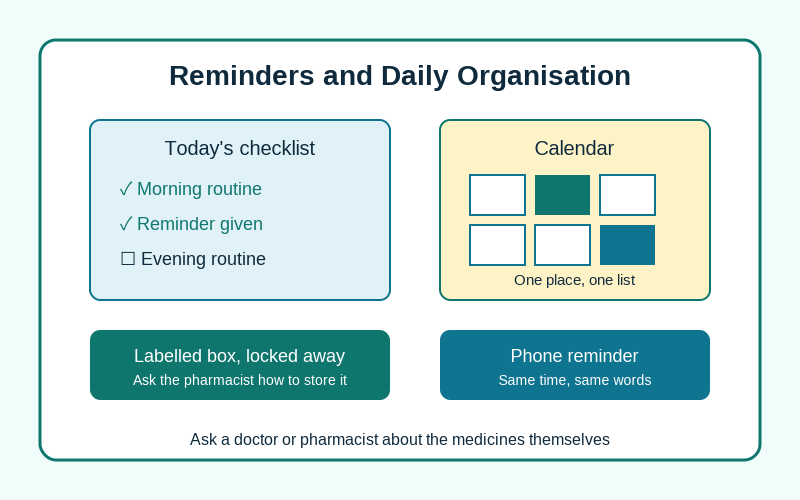
A Simple Daily Checklist
A daily checklist turns the list into a routine. Make a simple sheet for each day, with the day's tasks in order, and a box to tick beside each one. Keep the sheet in the same place every day — on the kitchen table, on a whiteboard, or on a clipboard — and tick each task off as it is done. Use the same words every day, and keep the sheet short: a checklist that is too long will not be used. If a task is done, tick it. If it is not done, leave it unticked, and note why, so the family can see the pattern.
At the end of the day, look at the checklist together and file it away, or keep it in a folder for the week. A week's checklists can show useful patterns: a task that is often missed in the afternoon, a reminder that works better in the morning, or a day when everything went smoothly. Share that pattern with the doctor or pharmacist at the next appointment, because it helps them understand what is happening at home. If a professional caregiver visits, ask them to use the same checklist, and to tick tasks off in the same way, so the family always knows what has been done.
Reminders That Work at Home
Reminders work best when they are simple, consistent, and tied to something your parent already does. A reminder given at the same point in the routine each day — for example, with breakfast, or after a walk — is easier to remember than a reminder given at a random time. Use the same words each time, speak calmly, and give your parent time to respond. A gentle prompt — "it is time for your morning routine, shall we do it together?" — is kinder and more effective than a long explanation or a repeated instruction.
Choose one reminder method, and use it consistently. A phone alarm, a clock with a reminder, a note on the whiteboard, or a simple alarm on a watch can all work, if they are set up correctly and checked regularly. Keep the reminder simple: one sound, one message, at the same point in the routine. Avoid several different alarms, several different notes, and several different people giving reminders in different words, because that only adds confusion. Test the reminder together, and ask your parent what they think of it. If it works, keep it. If it does not, try a different method, and give it a few days before you decide.
Visual reminders can help too. A whiteboard with today's plan, a calendar with large print, or a simple sign in the kitchen can all remind a person what comes next, without anyone having to say it. Keep visual reminders in the same place, update them each morning, and cross items off as they happen. A reminder that is always in the same place, in the same words, becomes part of the home, and part of the routine. For more on signs and cues, see our guide to a calm and familiar home.
Building Reminders into the Daily Routine
Reminders work best when they are part of a steady daily routine, not an extra job on top of it. A predictable day — breakfast at the same time, a walk after breakfast, a rest in the afternoon, and a calm evening — gives the body and the mind a rhythm to follow. Build reminders into that rhythm, at the same points each day, so they become habits rather than interruptions. Our daily routine guide gives a full example of a day built this way, and our guide to daily activities has ideas for filling the day with gentle, enjoyable tasks.
Keep the routine realistic. A routine that tries to do too much, too quickly, will fail, and a failed routine is worse than no routine at all. Start with the most important tasks, build them into the day at natural points, and add more only when the first ones are working well. Allow plenty of time for each task, and do not rush. If a task is missed one day, do not panic, and do not try to catch up by doing it twice. Note what happened, and ask the doctor or pharmacist what to do if a routine task is missed. Their advice, for your parent's own situation, is the only advice to follow.
Safe Storage at Home
Safe storage is part of good organisation. Keep medicines and related items in one place, out of reach of children and visitors, and away from heat, damp, and direct sunlight. Ask the pharmacist how to store them safely at home, and follow their advice exactly. Keep items in their original packaging, with the label from the pharmacist clearly visible, and do not move them into unlabelled containers or mix them together. If a label is damaged or hard to read, ask the pharmacist for a new one, rather than guessing what it says.
Check the storage place regularly. Look for anything that is out of date, damaged, or no longer needed, and ask the pharmacist how to dispose of it safely. Do not keep old or unused items "just in case," and do not share them with anyone else. Keep a lock on the cupboard or box if children visit the house, or if your parent might take something by mistake. If you are unsure about storage, ask the pharmacist — they are the right person to advise, and they will be happy to help. For more on home safety, see our guide to a calm and familiar home.
Appointments, Notes, and Questions for the Doctor
Appointments work better when you arrive prepared. Keep a calendar in one place, with all appointments written in large, clear letters, and a reminder the day before. Bring the list, the week's checklists, and a short note of any questions to the appointment, and write down the answers while you are there. Ask the doctor or pharmacist to check the list with you, and to explain anything you do not understand, in plain language. It is always better to ask a question twice than to leave an appointment unsure.
Between appointments, keep a short note of anything that changes: a task that is often missed, a reminder that no longer works, a change in appetite, sleep, or mood, or a fall or a frightening moment. Bring that note to the next appointment, so the doctor can see the pattern over time. If something changes suddenly — a parent who is suddenly much more confused, very sleepy, or unwell — do not wait for the next appointment. Talk to a doctor promptly, and if someone is in immediate danger, call your local emergency number straight away.
Sharing the Job with Family and Caregivers
Organisation is a shared job, not a job for one person alone. Talk with brothers and sisters, a partner, and any professional caregiver about who will do what, and when. Agree on one list, one checklist, and one reminder method, and agree that everyone will use them in the same way. A short handover note — what was done today, what is still to do, and anything that seemed different — helps the next person take over without confusion, and it helps the family relax when they are away.
If a professional caregiver visits, show them the list, the checklist, and the routine, and ask them to follow the same system. Ask them to tick tasks off as they are done, and to note anything that seemed different, so the family can see what happened. Review the system together once a month, and ask what is working and what is not. If a family member feels overwhelmed by the job, talk about it openly, and share the tasks more fairly. Our guide to when to ask for extra help at home explains how to arrange extra help, and our guide to sleep support covers rest for caregivers too.
When Something Goes Wrong with a Reminder
Sometimes a reminder will be missed, a checklist will be forgotten, or a task will be done twice. That happens in every family, and it is not a reason to blame yourself or anyone else. Note what happened, when it happened, and what you think caused it, and talk to the doctor or pharmacist about it. They can advise what to do in your parent's own situation, and whether anything needs to change. Do not try to fix a missed task by repeating it, or by changing anything, without their advice.
If a mistake happens often, look at the system, not at the person. Is the reminder at the wrong time of day? Is the checklist too long, or in the wrong place? Is the routine too busy, or too rushed? Is a different family member giving reminders in different words? A small change to the system — a reminder moved to breakfast time, a checklist shortened, a routine made calmer — is often enough to fix the problem. Keep a note of the change, and check after a week whether it helped. If it did not, try a different change, and talk to the doctor or pharmacist if you are unsure.
Frequently Asked Questions
What is the best reminder method? The one your parent responds to, and the family can use consistently. A phone alarm, a note on the whiteboard, or a reminder tied to breakfast can all work. Choose one method, test it together, and give it a few days before you decide.
Should I keep a list of medicines at home? Yes, one list, in one place, written exactly as the doctor or pharmacist has advised, and checked with them at every appointment. Take it to every appointment, and keep a copy somewhere safe in case the main copy is lost.
What should I do if a reminder is missed? Note what happened and when, and ask the doctor or pharmacist what to do in your parent's own situation. Do not repeat a task or change anything without their advice.
How should medicines be stored at home? Ask the pharmacist how to store them safely, and follow their advice exactly. Keep them in their original packaging, in one place, out of reach of children and visitors, and away from heat, damp, and direct sunlight.
Can a professional caregiver help with reminders? Yes, a caregiver can follow the same list, checklist, and routine as the family, and tick tasks off as they are done. Show them the system, ask them to use it in the same way, and review it together regularly.
Sources and Further Reading
This guide draws on the following sources, all accessed 29 November 2026.
- Alzheimer's Association — Facts and Figures, and information on dementia care at home. alz.org/alzheimers-dementia/facts-figures
- National Institute on Aging (NIA) — information on Alzheimer's disease, dementia, and caregiving. nia.nih.gov/health/alzheimers-and-dementia
If this guide helped you, please share it with another family who needs it, and read our other guides on daily routines, sleep, and home safety. If you would like to talk about care for your parent, start on our homepage or contact us — a friendly advisor is ready to listen, with no obligation.
Last reviewed: 24 June 2026. This guide is general information and is reviewed regularly. It is not a substitute for medical advice. Always talk to a doctor about diagnosis, treatment, or any change to care or medication.
Tags: dementia home care, medication reminder, senior home care