
Home Care for Alzheimer Support: Supporting Sleep and Rest
Written by the HomeCare editorial team. Sources: Alzheimer's Association, National Institute on Aging (NIA).
Sleep is often one of the first things to change in Alzheimer disease, and one of the hardest for families. Your parent may find it hard to fall asleep, may wake often during the night, or may be awake for hours in the dark. They may be restless in the evening, confused at night, or sleepy during the day. And when your parent does not sleep, you do not sleep either. Tiredness builds up, for both of you, and the days become harder.
This guide shows how to support sleep and rest in Alzheimer home care. It is written for adult children caring for a parent at home, and it focuses on practical, everyday ideas: daylight in the morning, activity during the day, a steady bedtime routine, and a safe, dark bedroom at night. It does not give medical advice about sleep, and it does not recommend any medicine or supplement for sleep. If sleep problems are severe, persistent, or unsafe, talk to a doctor. If you would like the wider picture first, read our complete family guide to dementia care at home and our guide to sleep support and nighttime routine.
Why Sleep Changes in Alzheimer Disease
Sleep changes in Alzheimer disease for several reasons, and understanding them helps you respond with patience. The body's internal clock, which tells us when to sleep and when to wake, can become less reliable. Your parent may feel sleepy during the day and wide awake at night, or may sleep in short bursts rather than in one long stretch. Confusion is often worse in the late afternoon and evening, a pattern often called sundowning, and that can make it hard to settle for the night.
Other factors add to the problem. Pain, discomfort, needing the toilet, hunger, thirst, or a room that is too hot, too cold, too light, or too noisy can all disturb sleep. Low mood and anxiety can make it hard to fall asleep, and daytime inactivity can make nights worse. If your parent naps for long periods during the day, they may not feel tired at night. Understanding these factors helps you see sleep as part of the whole day, not as a problem that starts at bedtime. What happens in the morning and afternoon shapes what happens at night. Our guide to building a daily care plan shows how to build sleep into the day.
Daylight and Morning Light
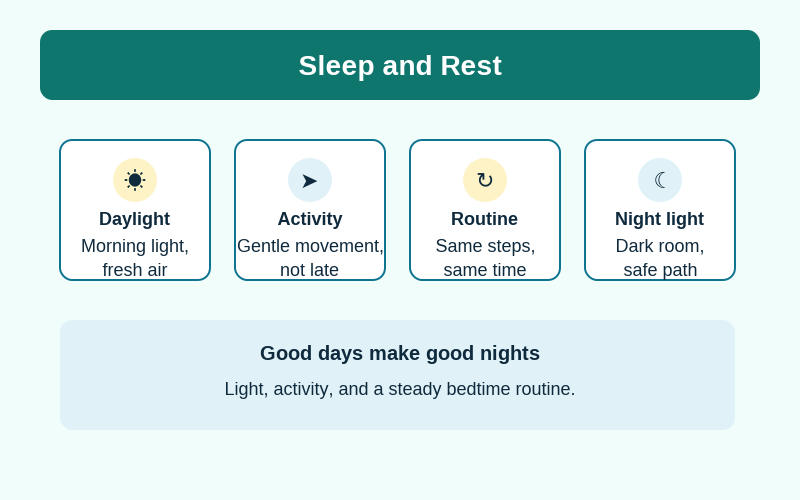
Daylight is one of the most powerful tools for better sleep, and it costs nothing. The body's clock is set by light, especially morning light. When your parent gets bright light in the morning, the body learns that it is daytime, and it becomes easier to feel sleepy at night. Open the curtains as soon as your parent wakes, and encourage them to spend time near a window, in the garden, or outside, in the morning. Even a short time outside in the morning can help.
If the weather is bad, sit by a bright window, or turn on bright lights in the morning. Avoid dim, dark rooms during the day, because they can confuse the body clock and make your parent feel sleepy at the wrong time. In the evening, do the opposite: turn the lights on before it gets dark, so the house does not grow dim, but keep the light warm and gentle, not bright and glaring. A steady pattern of bright mornings and calm evenings helps the body clock more than any single change. Our guide to a safe home setup has more on lighting through the day.
Activity During the Day
Activity during the day helps sleep at night, because a body that has moved during the day is more ready to rest. A short walk in the morning, some time in the garden, or a gentle activity in the afternoon can all help. Keep it simple, keep it short, and do it together, so it feels like a shared pleasure rather than a task. Walk at your parent's pace, not yours, and choose a familiar route.
Avoid vigorous activity late in the day, because it can make it harder to settle for the night. The best time for activity is the morning or early afternoon. If your parent is very inactive, start small: a walk to the end of the garden, a few minutes of gentle stretching in a chair, or helping with a simple household task. Any movement is better than none, and it all adds up over the day. If your parent has difficulty walking, or has fallen, talk to a doctor before starting any new activity. Our guide to meaningful activities at home has more ideas for gentle daytime activity.
A Steady Bedtime Routine
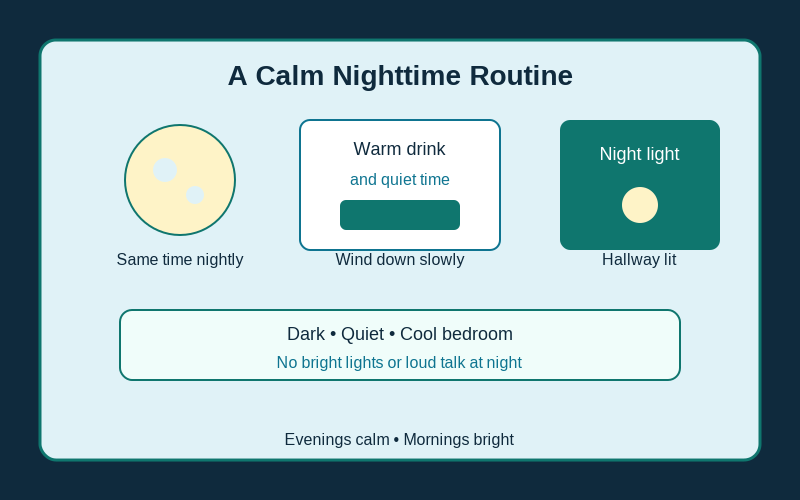
A steady bedtime routine is one of the best tools for better sleep, because it tells the body that night is coming. Keep bedtime at the same time each night, and follow the same steps, in the same order: a warm drink, a wash, night clothes, a short, calm conversation, and lights out. A familiar routine, repeated every night, becomes a signal that it is time to sleep, even when memory is unreliable.
Start winding down an hour or two before bedtime. Turn off the television, lower the lights, and offer a warm drink and a light snack. Avoid visitors, outings, and difficult conversations late in the day. A quiet activity — a photograph album, a familiar song, or simply sitting together — can help the evening feel settled. If your parent resists going to bed, do not argue. Offer a choice, try again a little later, or try a different approach. A warm drink, a familiar blanket, and a calm voice can help more than an argument. Our guide to managing sundowning at home has more on evening restlessness.
The Bedroom and the Night
The bedroom should be dark, quiet, and comfortable, and it should be easy to find the way to the toilet at night. Keep the bedroom at a comfortable temperature, and keep the bed at a height that makes it easy to get in and out. Use curtains that block out light, and keep the room quiet, without a television or radio playing through the night. A familiar object by the bed — a photograph, a blanket, a favourite book — can help your parent feel safe in the dark.
Use a night light in the bedroom, the hallway, and the bathroom, so your parent can see where they are going without turning on bright lights. Keep a clear path from the bed to the bathroom, with nothing to trip over, and keep a glass of water by the bed. If your parent gets up at night and wanders, consider a door alarm that sounds when an outside door opens, so you know if they leave the house. Keep a clear, written note by the bed with the day and date, so your parent can orient themselves if they wake confused. Our guide to sleep support and nighttime routine has more on making the night safe.
Waking at Night
Waking at night is common in Alzheimer disease, and it can be frightening for your parent and exhausting for you. If your parent wakes, keep your response calm and brief. A toilet visit, a drink of water, a reassuring word, and then back to bed. Do not turn on bright lights, do not start a conversation, and do not offer food or activity in the middle of the night, because that can wake your parent fully and make it harder to get back to sleep.
If your parent is confused at night, stay calm and reassuring. Say who you are, where they are, and that it is night-time and time to sleep. Use a gentle voice, and offer something familiar: a blanket, a photograph, or a favourite song, played quietly. If your parent wants to get up and go somewhere, acknowledge the feeling, and gently redirect them back to bed. If waking at night happens often, or if your parent is unsafe at night, talk to a doctor. There may be a medical cause, such as pain, needing the toilet, or a sleep problem, and a doctor should know about it. Do not give any medicine for sleep without a doctor's advice.
Naps: Helpful or Harmful?
Naps can help or harm, depending on when they happen and how long they last. A short rest in the early afternoon, of twenty or thirty minutes, in a comfortable chair, can be refreshing, especially after lunch. But long naps, or naps late in the day, can make nights harder, because your parent may not feel tired at bedtime. If your parent naps for hours in the afternoon, or falls asleep in front of the television every evening, it may be worth gently limiting naps.
Try to keep naps short, and in the early afternoon, not in the evening. Offer a short rest after lunch, with a book or music, and then gently wake your parent after half an hour. Encourage activity in the afternoon, rather than long periods of sitting. If your parent is very sleepy during the day, talk to a doctor, because excessive sleepiness can have many causes, and a doctor should know about it. Do not try to keep your parent awake by force, and do not feel guilty if they nap. A short rest is normal, and it is better than exhaustion. The aim is a balance: enough rest during the day, and enough tiredness at night, to sleep well.
When Sleep Problems Need a Doctor
Some sleep problems need a doctor's help, and it is important to know when to ask. Talk to a doctor if your parent is awake for hours most nights, if they are very sleepy during the day, if they snore loudly or stop breathing in their sleep, if they are restless or agitated at night, or if they have fallen or wandered at night. Talk to a doctor promptly if sleep problems start suddenly, or if they are much worse than usual, because sudden changes can have many causes.
Keep a simple sleep diary for a week or two, and take it to the doctor. Write down what time your parent goes to bed, what time they wake, how often they wake at night, and how they seem during the day. Note any pain, coughing, or needing the toilet at night, and any medicines they take. A short, factual record is far more useful than a general worry. Do not start, stop, or change any medicine for sleep without a doctor's advice, and do not give your parent any sleep remedy, herbal or otherwise, without talking to a doctor first. Sleep medicines can be risky for older people, and a doctor should decide what is safe.
Rest for the Caregiver Too
When your parent does not sleep, you do not sleep either, and that is one of the hardest parts of caring. Broken nights, week after week, can leave you exhausted, irritable, and unwell, and that makes the days harder for both of you. It is important to get help with nights, before you reach breaking point. Talk to other family members about sharing nights, even for a few nights a week. Ask about overnight help, even for a short time, so you can sleep.
Look after your own sleep as well as your parent's. Keep your own bedtime regular, avoid caffeine late in the day, and take a short rest during the day if you can. If you are exhausted, talk to your own doctor, tell another family member, and ask for help. Looking after yourself is part of the same care, and you cannot care for your parent if you are ill yourself. Our guide to planning respite for family caregivers shows how to arrange a break, and our guide to when to ask for extra help at home can help you decide when to ask. If you would like to talk about care, read more about who we are or contact us.
Frequently Asked Questions
My parent is awake for hours at night. What should I do? Keep your response calm and brief: a toilet visit, a drink of water, a reassuring word, and then back to bed. Do not turn on bright lights or start a conversation. If waking at night happens often, or if your parent is unsafe, talk to a doctor.
Should I stop my parent napping during the day? Not entirely. A short rest in the early afternoon can help. But long naps, or naps late in the day, can make nights harder. Keep naps short, in the early afternoon, and encourage activity instead of long periods of sitting.
What if my parent is restless every evening? Start winding down an hour or two before sunset: lights on, curtains closed, familiar music, and a warm drink. Avoid visitors and difficult conversations late in the day. If restlessness is severe or persistent, talk to a doctor.
Is it safe to give my parent something to help them sleep? Do not give any medicine, herbal remedy, or supplement for sleep without a doctor's advice. Sleep medicines can be risky for older people, and a doctor should decide what is safe. Talk to a doctor about sleep problems first.
How can I get any sleep myself? Share nights with other family members, even for a few nights a week, and ask about overnight help. Keep your own bedtime regular, and take a short rest during the day if you can. If you are exhausted, talk to your own doctor and ask for help.
Sources and Further Reading
This guide draws on the following sources, all accessed 29 November 2026.
- Alzheimer's Association — Facts and Figures, and information on Alzheimer disease and sleep. alz.org/alzheimers-dementia/facts-figures
- National Institute on Aging (NIA) — information on Alzheimer's disease, dementia, and caregiving. nia.nih.gov/health/alzheimers-and-dementia
If this guide helped you, please share it with another family who needs it, and read our other guides on Alzheimer support at home. If you would like to talk about care for your parent, start on our homepage or contact us — a friendly advisor is ready to listen, with no obligation. You can write to us at hello@homecare.biz.id.
Tags: alzheimer home care, senior sleep, dementia home care
Last reviewed: 25 June 2026. This guide is general information and is reviewed regularly. It is not a substitute for medical advice. Always talk to a doctor about diagnosis, treatment, or any change to care or medication.