
Home Care and Home Safety: Choosing Grab Bars and Mobility Aids
Written by the HomeCare editorial team. Sources: Alzheimer's Association, National Institute on Aging (NIA).
Most falls at home happen in ordinary moments: standing up from the toilet, stepping into the shower, getting out of bed, or turning on the stairs. A hand reaches for support, finds nothing, and the moment becomes a fall. A grab bar in the right place, and a walking aid that fits the person using it, can change those moments completely. They are among the simplest and most effective safety measures in home care, and they cost far less than a hospital stay. Yet many families buy the wrong bar, fit it in the wrong place, or hand a parent a walker that is too tall, too heavy, or too hard to use, and then wonder why it does not help.
This guide is written for adult children caring for a parent at home. It explains the types of grab bars available, where each one belongs, how to fit them safely, and which bathroom aids are worth having. It then covers walking aids: canes, walkers, and rollators, how to choose between them, and how to fit and adjust them so they help rather than hinder. It finishes with what to do when your parent's needs change. You do not need to buy everything at once. Start with the places where your parent is least steady, usually the bathroom and the stairs, and add the rest as you go. If you are new to caring for a parent with dementia at home, start with our complete family guide to dementia care at home and our complete guide to home care, and then come back here for the fitting details.
Why Support Matters at Home
As people age, and especially as dementia progresses, balance, strength, and confidence all change. Your parent may stand up more slowly, may feel dizzy when they first stand, may have weaker grip, and may be less sure of their footing on a wet floor or a dark staircase. None of that means they should stop moving. In fact, moving less makes balance worse, because muscles weaken and confidence falls further. The answer is not to keep your parent sitting down. The answer is to make moving safer, so they can keep doing the things that matter: washing, dressing, walking to the kitchen, and going out into the garden.
A grab bar works because it is always there, in the same place, ready to be held. Unlike a towel rail or a shower curtain, which can pull away from the wall, a properly fitted grab bar is fixed into the structure of the house and will hold a person's full weight. A walking aid works because it widens the base of support: instead of balancing on two feet, your parent balances on two feet plus a cane or a frame, and that extra point of contact makes a stumble far less likely to become a fall. Both work best when they are fitted to the person and the room, not bought from a catalogue picture. A bar that is too high is useless to a short person. A walker that is too tall makes a person hunch and lose balance. Fit is everything, and this guide shows you how to get it right.
There is also a quieter benefit. A parent who feels safe is a parent who moves more, and a parent who moves more stays stronger, sleeps better, and feels more independent. A grab bar beside the toilet can be the difference between needing help with a private task and managing alone, and that privacy matters enormously to a person's dignity. A walking aid that feels steady can be the difference between staying in the house all day and walking to the garden. When you choose support well, you are not only preventing falls. You are protecting independence, and independence is one of the most precious things in home care. For the wider safety picture, read our fall prevention checklist and our bathroom safety upgrades guide.
Types of Grab Bars
Not all grab bars are the same, and the differences matter. The most common type is the straight bar: a simple horizontal or vertical bar, usually between 30 and 90 centimetres long, fixed to the wall with two or three brackets. Straight bars are the workhorse of the bathroom: beside the toilet, along the bath, and in the shower. Choose a bar with a diameter that fits your parent's hand comfortably, usually around 3 to 4 centimetres, and a surface that is not slippery when wet. A textured or slightly rough finish is better than polished chrome, which can be slippery with wet hands. Some bars have a soft, warm coating, which is kinder to cold hands and easier to grip.
Angled bars and L-shaped bars are useful where a person needs support while changing position, for example when standing up from the toilet or stepping into a bath. An L-shaped bar gives a horizontal grip for pulling up and a vertical grip for steadying, in one fitting. A floor-to-ceiling pole, sometimes called a security pole, is a vertical bar that stands beside a bed, a toilet, or a favourite chair, and is held in place by pressure between the floor and the ceiling. It needs no screws, which makes it useful in a rented home or where the wall cannot take a fixing, but it must be fitted correctly and checked regularly, because a pole that slips is worse than no pole at all. Ask a professional to fit it if you are unsure.
There are also bars that clamp onto the side of a bath, and suction-cup handles that stick to tiles. Treat both with caution. A clamp-on bath rail can be useful as a temporary measure, but it must fit the bath exactly, and it must be checked before every use, because a rail that slips while a person is stepping into a bath can cause a serious fall. Suction-cup handles are not grab bars at all. They are designed to help with balance in the shower, but they are not fixed to the wall and cannot be relied on to hold a person's weight. Never use a suction handle to pull yourself up. If you need support that holds weight, it must be screwed into the wall. A towel rail, a soap dish, a shower curtain rail, and a glass shower screen are also not grab bars, and grabbing them in a fall can pull them off the wall and make the fall worse.
Where to Place Grab Bars
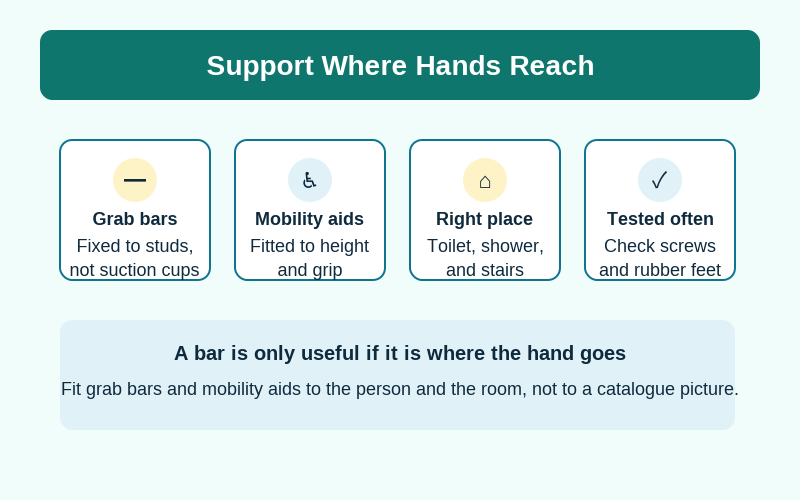
A grab bar is only useful if it is where the hand goes, and the hand goes where the body needs support. The best way to find the right place is to watch your parent. Stand beside them, watch them stand up from the toilet, step into the shower, and get out of bed, and notice where their hand reaches. That is where the bar belongs. As a starting point, the places that help most people are the following, but treat them as a guide, not a rule.
Beside the toilet, fit a horizontal bar on the wall at about the height of your parent's hand when they are sitting, so they can push down on it to stand and hold it to sit. If the toilet is not against a wall, a floor-to-ceiling pole beside it, or a raised toilet seat with armrests, can do the same job. In the shower, fit a horizontal bar at shoulder height for stepping in, and a vertical bar near the entrance for steadying. In the bath, fit a horizontal bar along the wall at the height of a hand reaching out while sitting, and a vertical bar at the end where your parent steps in and out. Near the bed, a bar or a bed rail can help with sitting up and standing, but a bed rail must be fitted so that a person cannot become trapped between the rail and the mattress, and a doctor or care professional should advise on this. On the stairs, a handrail on both sides is ideal, and a handrail that continues around the landing is better still. At the front and back doors, a vertical bar beside the step can help with the change in level.
Place bars where they will be used every day, not where they look tidy. A bar that is fitted neatly but out of reach is decoration, not safety. When you are deciding on a position, have your parent stand in the place where they will use it, and ask them to reach for the bar naturally. If they have to stretch, lean, or twist, the bar is in the wrong place. Move it, or add a second bar. It is better to have two bars in the right places than one bar in a compromise position. If you are unsure where bars should go, ask an occupational therapist, a physiotherapist, or a home care professional to visit and advise. A short visit from a professional can save you from fitting bars in the wrong place and then having to move them, and many health services offer this advice. Our guides to bathroom safety upgrades and lighting and flooring have more on making these rooms safer.
Fitting Grab Bars Safely
A grab bar that is not fixed properly is dangerous. It gives a person confidence to lean on it, and then fails. Every grab bar that is meant to hold weight must be screwed into a solid fixing: a wall stud, a solid brick wall, or a purpose-made backing board. It must never be screwed only into plasterboard, tiles, or a hollow wall, because those will not hold a person's weight. If you are not sure what is behind the wall, find out before you drill. A stud finder, a careful tap, or a professional's advice can tell you where the solid timber or brick is. If there is no solid fixing where the bar needs to go, fit a backing board first, screwed into the studs, and then fit the bar to the board. This is a job for a competent handyman or a professional, and it is worth paying for. A badly fitted bar is worse than no bar.
Before you buy, check the bar's weight rating and make sure it is designed for the job. A bar sold as a grab bar should state the weight it can hold, and it should be made of stainless steel or a similarly strong material, with fixings that match. Avoid cheap bars with thin screws or plastic brackets. When the bar is fitted, test it yourself: hold it with both hands and pull down and out with your full weight, several times, from different angles. If it moves at all, it is not fitted properly, and it must be refitted before anyone leans on it. Then test it again every month. Screws can loosen, especially in a damp bathroom, and a bar that was solid last year may not be solid now. Put a monthly check in your calendar, and write it in the emergency plan so that anyone who cares for your parent knows to check.
Think about the finish as well as the fixing. A bar that is cold to the touch in winter is unpleasant to hold, and a bar that is slippery when wet is dangerous. A bar with a textured or coated surface, in a colour that contrasts with the wall, is easier to see and easier to grip. This matters for a person with dementia or poor eyesight, who may not notice a chrome bar against white tiles. A dark bar on a light wall, or a light bar on a dark wall, is far more visible. Keep the bar clean, and check for rust or wear, especially at the fixings. If a bar is rusted, loose, or damaged, replace it. Do not wait.
Bathroom Aids Beyond Grab Bars
Grab bars are the foundation, but the bathroom has other aids that are worth having. A shower chair or stool lets your parent sit while washing, which is far safer than standing on a wet, slippery floor. Choose a chair with rubber feet, a backrest, and armrests, and make sure it fits inside the shower or bath. A hand-held shower head, on a long hose, lets a seated person wash without standing or reaching. A non-slip mat in the shower and bath, and a non-slip rug beside the bath, reduce the risk of slipping, but make sure the mat itself is fixed down and cannot slide. A raised toilet seat makes sitting and standing easier, especially for a person with stiff knees or hips, and a seat with armrests gives support on both sides.
Keep the bathroom warm, well lit, and simple. A cold bathroom makes muscles stiff and grip weaker, so a small, safe heater that is fixed to the wall and cannot be knocked over is worth having, and it should be checked by an electrician. A bright light, with a switch that is easy to reach, makes the room safer, and a night light means your parent can find the toilet in the dark without waking the house. Keep the floor clear: no laundry, no bottles on the floor, and no loose rugs that can slide. Keep medicines, razors, and cleaning products in a locked cupboard, out of reach, because a person with dementia may not recognise them for what they are. Our guides to safe bathing and personal care and bathroom safety upgrades cover this room in detail, and our medication organisation guide explains how to keep medicines safe and in order.
Choosing a Walking Aid
A walking aid should be chosen for the person, not for the shop. The three main types are canes, walkers, and rollators, and each suits a different level of need. A cane, or walking stick, suits a person who is mostly steady but needs a little extra support, for example on uneven ground or when tired. It is light, easy to carry, and easy to use, but it only gives one extra point of contact, so it is not enough for a person who is unsteady on their feet. A walker, or walking frame, is a light metal frame with four legs that the user lifts and places in front of them, then steps into. It gives a great deal of support, and it is the right choice for a person who is unsteady, who needs to rest often, or who is recovering from a fall. A rollator is a walker on wheels, usually with a seat and a basket, and with brakes on the handles. It suits a person who can walk steadily but needs support over longer distances, and who benefits from being able to sit and rest. The wheels make it easy to push, but they also mean it can roll away, so the brakes must be used every time the person stops, and a rollator is not the right choice for a person who leans heavily on the frame.
When you are choosing, think about the home as well as the person. A wide walker may not fit through a narrow bathroom door. A rollator may be too big for a small hallway. A cane may be better than a frame in a house with steps. Think about weight: your parent must be able to lift a walker, or push a rollator, and to carry a cane without tiring. Think about grip: a handle that is too thin, too thick, or too slippery will not be held. Think about where the aid will be stored: by the front door, beside the bed, or in the car, and whether it folds. And think about your parent's wishes. A person who feels embarrassed by a walking aid may refuse to use it, and an aid that is not used is no aid at all. Let your parent choose the colour and style where you can, and talk about the aid as a tool for independence, not as a sign of decline. Our guide to a calm, familiar home has ideas for arranging the home so that a walking aid can be used easily, and our lighting and flooring guide covers the surfaces the aid will travel over.
Fitting a Walking Aid Properly
A walking aid that is the wrong height is worse than useless: it can cause back pain, shoulder pain, and falls. The correct height is easy to check. Have your parent stand upright, wearing their usual shoes, with their arms relaxed at their sides. The top of the cane handle, or the top of the walker handles, should be at the level of the wrist crease, where the hand meets the arm. If the handles are higher, your parent will hunch their shoulders. If they are lower, they will bend forward. Both make balance worse. Adjust the legs of the walker or the height of the cane until the handles sit at the wrist crease, and then check again after a week, because shoes, posture, and strength can change. If the aid has rubber feet or tips, check them every week. A worn tip is slippery, and a missing tip can scratch the floor and catch on a rug. Replace tips as soon as they show wear, and keep a spare set in the house.
Teach your parent how to use the aid, and practise with them. A cane should be held in the hand opposite the weaker leg, and moved forward at the same time as that leg. A walker should be placed in front, with all four legs on the floor, and the person should step into it, not push it forward while walking. A rollator should be pushed gently, with the brakes on whenever the person stops, turns, or sits on the seat. None of this is obvious, and a person with dementia may forget the steps, so practise little and often, at a calm time, and be patient. Walk with your parent, at their pace, and praise the effort. If the aid is new, practise indoors first, on a clear, level floor, before trying it outside. If your parent leans heavily on the aid, or if the aid tips, wobbles, or feels unstable, stop and ask a professional to check the fit and the type. An aid that tips is the wrong aid, and continuing to use it risks a fall.
When Needs Change
Needs change, and the support in the home should change with them. A parent who managed well with a cane last year may need a walker this year. A bathroom that was safe with one grab bar may need two, a shower chair, and a raised toilet seat. Review the aids in the home every few months, and after any fall, any hospital stay, or any change in health. Watch for the signs that an aid no longer fits: your parent leans heavily on it, holds it with both hands, stops using it, or has a near-fall. Any of those is a reason to ask a professional to reassess, not a reason to wait.
Finally, remember that equipment is only part of safety. A grab bar and a walker help, but they do not replace a clear floor, good lighting, a calm routine, and a person who checks in. The safest home is one where the equipment, the rooms, the routine, and the people all work together. Keep the floor clear, the lights bright, the routine steady, and the check-ins regular, and the equipment will do its job. If you would like help arranging care or equipment, you can contact our team or read more about who we are and how we work.
Frequently Asked Questions
Can I fit grab bars myself? Only if you are confident you can fix them into a solid wall stud or brick, and test them with your full weight. If you are unsure what is behind the wall, or if the bathroom is tiled, ask a competent handyman or a professional. A badly fitted bar is dangerous.
Are suction-cup handles safe as grab bars? No. Suction handles are not fixed to the wall and cannot be relied on to hold a person's weight. They may help with balance in the shower, but never use them to pull yourself up. A real grab bar must be screwed into the wall.
How do I know if my parent needs a cane, a walker, or a rollator? Ask a physiotherapist or occupational therapist to assess your parent. As a rough guide, a cane suits a person who is mostly steady, a walker suits a person who is unsteady, and a rollator suits a person who walks steadily but needs support over longer distances and a seat to rest on.
How do I check the height of a walking aid? Have your parent stand upright in their usual shoes, arms relaxed. The handles should sit at the level of the wrist crease. If they are higher or lower, adjust the legs until they match, and check again after a week.
How often should I check grab bars and walking aids? Test grab bars every month, by pulling on them with your full weight, and check walking aids every week: rubber tips, brakes, wheels, and the frame. Replace worn tips and loose brakes straight away.
Sources and Further Reading
This guide draws on the following sources, all accessed 29 November 2026.
- Alzheimer's Association — Facts and Figures, and information on dementia care at home. alz.org/alzheimers-dementia/facts-figures
- National Institute on Aging (NIA) — information on Alzheimer's disease, dementia, and caregiving. nia.nih.gov/health/alzheimers-and-dementia
If this guide helped you, please share it with another family who needs it, and read our other guides on dementia care and home safety, including our bathroom safety upgrades guide and our fall prevention checklist. If you would like to talk about care for your parent, start on our homepage or contact us — a friendly advisor is ready to listen, with no obligation. You can write to us at hello@homecare.biz.id.
Tags: home care safety, mobility aids, senior living
Last reviewed: 26 June 2026. This guide is general information and is reviewed regularly. It is not a substitute for medical advice. Always talk to a doctor about diagnosis, treatment, or any change to care or medication.