
Home Care and Home Safety: Bathroom Safety Upgrades That Help Daily
Written by the HomeCare editorial team. Sources: Alzheimer's Association, National Institute on Aging (NIA).
The bathroom is the smallest room in the house, and it asks the most of an older person. In a few square metres your parent must step over a bath edge or into a shower, turn around on a wet floor, sit down and stand up again, and do it all with wet hands and bare feet. It is no surprise that the bathroom is where many falls happen at home, and that many older people begin to dread washing, not because they do not want to be clean, but because the room itself feels unsafe. A few thoughtful upgrades can change that feeling completely, and most of them are simple, affordable, and quick to fit.
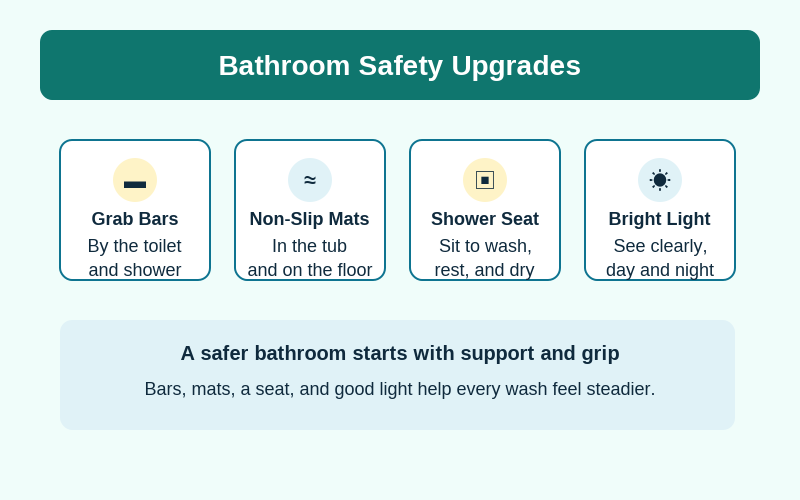
This guide is written for adult children caring for a parent at home. It walks through the bathroom upgrade by upgrade, from grab bars to lighting, and shows how to make washing safer and calmer without turning the room into something that feels clinical. You do not need to rebuild the bathroom to make a real difference. A bar by the toilet, a mat in the shower, a seat to sit on, and a brighter light are small changes, but together they give your parent something solid to hold, a floor that grips, and a clear view of every step. If you would like the wider picture first, read our complete family guide to dementia care at home, our complete guide to home care, and our fall prevention checklist, which covers the whole house room by room.
Why the Bathroom Needs Special Care
Three things make the bathroom risky, and they all happen at once. The floor is wet, the surfaces are smooth and hard, and the person using the room is often barefoot, with wet hands and nothing to hold. A slip in the hallway is frightening; a slip in the bathroom can mean a fall onto a hard edge, a tap, or the side of the bath. Add in the need to step over a high bath edge, turn in a tight space, and stand up from a low toilet seat, and the bathroom becomes the room where strength, balance, and grip are tested most. For a parent living with dementia, there is another layer: the bathroom can be confusing, with mirrors, shiny surfaces, and the sound of running water, and your parent may forget the order of washing or feel unsure about what to do next.
That is why bathroom upgrades are about more than hardware. They are about confidence. When your parent knows there is a bar to hold, a seat to sit on, and a floor that does not slide, they are more willing to wash regularly, and washing regularly matters for skin, comfort, and dignity. A bathroom that feels safe also makes the caregiver's job easier, because helping someone in a small, wet room is hard work, and a fall there can injure the helper too. The upgrades in this guide are arranged in order of impact, starting with the changes that help most and cost least, so you can begin this week. Read our safe bathing and personal care guide alongside this one, because it covers the human side of washing, and our lighting and flooring guide for more on light and floors throughout the home.
Start With What You Already Have
Before you buy anything, spend ten minutes in the bathroom with fresh eyes. Stand where your parent stands, sit on the toilet, and step into the shower or bath the way they do. Notice what your hands reach for when you need support. Is there anything solid to hold, or do your hands find only a towel rail, a soap dish, or a shower curtain? Look at the floor: does the bath mat slide, does water pool near the door, is there a step or a lip you have to think about? Check the lighting: can you see the floor clearly, or are there shadows around the bath and toilet? Open the cupboard and the shelves: is everything your parent needs within easy reach, or must they stretch, bend, or climb?
Write down what you find, and sort it into three groups, just as our fall prevention checklist suggests. Today: remove the sliding mat, move the soap and shampoo within reach, and mop up any water that pools. This week: fit a grab bar, buy a non-slip mat, and add a brighter bulb or a night light. Soon: fit a shower seat, consider a raised toilet seat, or ask a professional about a walk-in shower. Take photographs of the tricky spots, so other family members can see them, and so you can compare before and after. If your parent is willing, ask them what worries them most about the bathroom. They may mention the step into the bath, the cold floor, or the fear of being alone in the room, and their answer tells you where to start. Small, visible improvements build trust, and trust makes the next change easier to accept.
Grab Bars: Where They Help Most
Grab bars are the single most useful bathroom upgrade, and they are also the one most often fitted in the wrong place. A grab bar must be fixed firmly into the wall, with proper fixings, so it can hold a person's full weight. Suction-cup bars that stick to tiles are not a substitute: they can come away without warning, and a person who trusts one and then falls is in more danger than a person who never reached for it. If you are not sure how to fix a bar safely into your wall, ask a qualified tradesperson or an occupational therapist. The cost of proper fitting is small compared with the cost of a fall, and a well-fitted bar will last for years.
Placement matters as much as fitting. A horizontal bar beside the toilet helps your parent sit down and stand up. A vertical bar beside the bath or shower entrance helps with stepping in and out. A horizontal bar inside the shower, at a height your parent can reach comfortably while standing or sitting, helps with turning and washing. The best way to find the right positions is to watch your parent use the bathroom, and to notice where their hands naturally reach for support. Those are the places the bars belong. Ask a professional to confirm the positions before drilling, because every bathroom and every person is different. Our guide to grab bars and mobility aids covers placement and fitting in detail, and our guide to safe exits covers support at the doors of the house as well.
Non-Slip Mats and Flooring
Wet, smooth floors are the bathroom's biggest hazard, and grip is the answer. Start with the bath or shower: a non-slip mat with suction cups underneath, or a non-slip strip applied to the floor of the bath, gives feet something to hold. Choose a mat that covers the area where your parent stands, and check it regularly: if the suction has weakened, or the mat has curled at the edges, replace it. Outside the bath, a non-slip mat on the floor beside it catches drips and gives the first step out of the bath a steady footing. Avoid ordinary bath mats that slide on tiles, and avoid small rugs that bunch up underfoot. If the bathroom floor is very smooth, a larger non-slip mat in front of the sink can help too.
Look at the floor itself as well. Tiles that are glossy when wet are harder to stand on than matt tiles, and a floor that is uneven or has a raised edge can catch a toe. If you are replacing the floor, choose a matt, non-slip finish, and keep the colour even, so the floor reads as one level surface. Keep the floor dry between uses: a quick wipe after a shower takes a minute, and it removes the puddle that causes the next slip. Store the mop or cloth where it can be reached without bending, and make drying the floor part of the bathing routine, not an afterthought. For more on floors throughout the house, read our lighting and flooring guide, and for the kitchen, where wet floors are also a risk, read our kitchen safety guide.
Shower and Tub Safety
The step into the bath or shower is the riskiest moment in the bathroom, because it combines a change in level, a wet surface, and a turn in a small space. A shower seat changes that completely. Sitting down to wash is steadier, less tiring, and easier on balance, and it lets your parent wash their feet and legs without standing on one leg. Choose a seat that fits the shower or bath, with non-slip feet and a backrest if your parent needs one, and test it yourself for stability before your parent uses it. A hand-held shower head is the natural partner to a seat: it lets your parent wash while sitting, without standing under the water and turning around. Keep the shower head, soap, and shampoo within reach of the seat, so there is no stretching or standing up to reach them.
If your parent uses a bath, a bath board or a bath seat can help with getting in and out, but ask a professional for advice before choosing one, because the right choice depends on the bath and on your parent's strength and balance. A non-slip mat in the bath is essential either way. If stepping over the bath edge is becoming too hard, talk to a doctor or an occupational therapist about whether a walk-in shower would be safer, and about what help is available with the cost and the fitting. Never leave your parent alone in the bath if they are unsteady or confused, and never rely on a shower curtain or a towel rail for support. If washing is becoming difficult, read our safe bathing guide, which has gentle ideas for washing without a full bath or shower on difficult days.
Toilet Safety and Comfort
The toilet is used many times a day, including at night, so it deserves the same attention as the shower. The two problems are height and support. A low toilet seat is hard to stand up from, especially for someone with weak legs or stiff knees, and a seat that is too low can tip a person forward as they rise. A raised toilet seat, or a toilet frame with armrests, can make sitting and standing much easier, and it is one of the cheapest and most effective bathroom upgrades. Choose a seat that fits the toilet firmly and does not move, and test it yourself before your parent uses it. A grab bar on the wall beside the toilet, or a frame with arms on both sides, gives your parent something solid to push against when standing.
Think about the night-time visit too. The path from the bed to the toilet should be clear, lit by a night light, and free of anything to trip over. A small light in the bathroom that comes on automatically is ideal, because it works even if your parent forgets to switch it on. Keep toilet paper within easy reach, and keep the bathroom door easy to open: a door that sticks, or a lock that is hard to turn, can trap a person who needs help quickly. If the bathroom door locks from the inside, consider a lock that can be opened from the outside in an emergency, and make sure someone in the family knows how it works. Our sleep and nighttime routine guide has more on safe night-time trips, and our emergency plan guide explains how to make sure help can be reached from any room.
Water Temperature and the Sink
Hot water is a quiet risk in the bathroom, because older skin is thinner and burns more easily, and a person with dementia may not notice that the water is too hot until it is too late. The safest habit is to test the water before your parent steps in or puts their hands under it. Run the water, test it with your hand, and adjust it until it is comfortably warm, not hot. If the water from the taps is very hot, ask a plumber about a thermostatic mixing valve, which limits how hot the water can get, or about turning the water heater down. Do not make these changes yourself unless you know how. Mark the taps clearly, with a simple label or a coloured dot, so hot and cold are easy to tell apart, and consider taps with a lever handle, which are easier to grip and control than round knobs.
The sink area needs the same care. Keep soap, toothpaste, and the toothbrush within easy reach, so your parent does not have to stretch or open a high cupboard with wet hands. A non-slip mat in front of the sink helps with the standing time, and a mirror at a height that works sitting down as well as standing is a kindness for a parent who washes sitting on a seat. Keep the counter clear: bottles, razors, and scissors should be stored safely, and anything sharp should be kept out of reach if your parent is confused or unsteady. If your parent takes care items from the bathroom cupboard, our medication storage and safety guide explains how to keep anything that should not be swallowed in a safe, labelled place. Keep a towel within reach of the sink and the shower, so wet hands and feet can be dried without walking across the room.
Lighting and Visibility
Good light in the bathroom is not a luxury; it is safety. The room should be bright enough to see the floor, the bath edge, and the toilet clearly, with no dark corners and no harsh glare off white tiles or a mirror. Use the brightest bulb the fitting allows, and replace it the same day it fails. A light over the mirror helps with washing and shaving, and a light over the shower helps your parent see the floor of the bath. At night, a small night light in the bathroom, and another in the hallway outside it, means your parent can find the toilet without fumbling for a switch in the dark. A motion-sensor light is ideal, because it switches on as soon as someone enters the room.
Visibility is about more than light. A bathroom with white tiles, a white bath, white towels, and a white toilet can be confusing for an older person, because the edges disappear into each other. A coloured bath mat, a coloured toilet seat, or a towel in a strong colour can help your parent see where things are. Mark the edge of the bath with a contrasting strip, so the step is easy to see, and choose a shower curtain in a light, plain colour rather than a busy pattern, which can be confusing. If your parent has poor eyesight, talk to a doctor or an optician about it, because better glasses can make the whole house safer, and read our lighting and flooring guide for more on light in every room.
Storage, Clutter, and Reaching
A bathroom that is easy to use is a bathroom where everything needed is within reach and nothing extra is in the way. Keep the items your parent uses every day, soap, shampoo, toothbrush, towel, at waist height, between the shoulders and the hips, so there is no climbing onto a chair or bending to the floor. Store heavy bottles low down, and light things higher up. Use a shower caddy or a small shelf inside the shower, so soap and shampoo are at hand height, not on the floor of the bath where they must be reached for with a bend. Keep the floor clear: laundry baskets, cleaning products, and spare towels belong in a cupboard, not on the walking line.
Clutter is not only a trip risk; it is a confusion risk. A crowded shelf with many similar bottles makes it hard for a parent with dementia to find the right one, and a bottle of cleaning product that looks like shampoo can be dangerous. Keep the bathroom simple: one soap, one shampoo, one toothpaste, each in its usual place, and store cleaning products and anything that should not be swallowed in a separate, labelled place, out of reach. Our medication storage guide covers safe storage in detail, and our guide to a calm, familiar home explains why keeping things in the same place matters so much for a person with dementia. A weekly tidy, when you put everything back in its place and throw away empty bottles, keeps the room safe without a big effort.
A Calm Bathing Routine and Dignity
The best bathroom in the world will not help if washing itself has become a battle. Many older people, and especially people living with dementia, resist bathing, and the reasons are often simple: the room is cold, the water is a shock, the process feels rushed, or they feel embarrassed about needing help. A calm routine can change that. Warm the room before the bath or shower, lay out everything that is needed in advance, and keep the routine in the same order each time, so your parent knows what comes next. Offer a choice where you can, such as a shower or a wash at the sink on a difficult day, and a morning or afternoon wash, so your parent keeps some control over their own care.
Dignity matters as much as safety. Keep your parent covered with a towel as much as possible, explain each step before you do it, and ask permission before you help. If your parent is embarrassed about a family member helping, a professional caregiver of the same gender may be more acceptable, and it is worth asking. On a difficult day, a wash at the sink, with a warm flannel and a kind word, is better than a long argument about a shower, and it keeps your parent clean and comfortable. Our safe bathing and personal care guide covers this in detail, and our guide to communicating with calm and patience has ideas for keeping the conversation kind. If bathing is becoming a regular struggle, talk to a doctor, because pain, fear, or a change in health may be part of the problem.
When to Ask for Extra Help
Some bathroom upgrades are simple jobs you can do yourself, and some need a professional. Fitting a grab bar, changing a tap, or fitting a walk-in shower all need someone who knows how to do the work safely, and a badly fitted bar or a leaking shower can make the room more dangerous, not less. Ask an occupational therapist for a home assessment: they can look at the bathroom with professional eyes, recommend the right equipment, and tell you what will help most for your parent. They can also advise on whether a shower seat, a raised toilet seat, or a bath lift is right, and how to use it safely. If you need help with the cost, ask the therapist or your local care services what support is available in your area.
If washing is becoming hard for the family to manage, professional home care can help. A trained caregiver can be there for the shower, the dressing, and the morning routine, at the times of day when help is needed most, and they can do it with a calm, practised hand. The median cost of home care in the United States is around $35 an hour, according to CareScout's 2025 cost of care data, and the exact cost in your area will depend on the provider and the hours you need, so ask local providers for a clear quote. Asking for help is not a failure; it is how a parent stays safely at home. Read our guide to when to ask for extra help, and our guide to home monitoring options, which explains how simple devices can add reassurance when you cannot be there. You can also read our medication reminders guide for keeping care organised day to day.
Frequently Asked Questions
What is the first bathroom upgrade I should make? Fit a grab bar by the toilet and in the shower, and put a non-slip mat in the bath. These two changes give your parent something solid to hold and a floor that grips, and they help every time the bathroom is used.
Are suction-cup grab bars safe? No, they are not a substitute for a properly fixed bar. Suction bars can come away without warning. A grab bar must be fixed into the wall with proper fixings, by someone who knows how to do it safely.
Is a shower seat really necessary? For many older people, yes. Sitting down to wash is steadier and less tiring than standing on a wet floor, and it lets your parent wash their feet and legs safely. A seat and a hand-held shower head work well together.
What if my parent refuses to bathe? Do not turn it into a battle. Warm the room, keep the routine calm and in the same order, offer a choice, and on a difficult day accept a wash at the sink. If refusal becomes frequent, talk to a doctor, because pain, fear, or discomfort may be part of the problem.
How do I keep the bathroom safe at night? Keep the path from the bed to the bathroom clear, add a night light in the hallway and in the bathroom, and consider a light that switches on automatically when someone enters the room.
Sources and Further Reading
This guide draws on the following sources, all accessed 29 November 2026.
- Alzheimer's Association — Facts and Figures, and information on dementia care at home. alz.org/alzheimers-dementia/facts-figures
- National Institute on Aging (NIA) — information on Alzheimer's disease, dementia, and caregiving. nia.nih.gov/health/alzheimers-and-dementia
If this guide helped you, please share it with another family who needs it, and read our other guides on dementia care and home safety at home. If you would like to talk about care for your parent, start on our homepage or contact us — a friendly advisor is ready to listen, with no obligation. You can write to us at hello@homecare.biz.id.
Tags: home care safety, bathroom safety, senior home care
Last reviewed: 26 June 2026. This guide is general information and is reviewed regularly. It is not a substitute for medical advice. Always talk to a doctor about diagnosis, treatment, or any change to care or medication.