
Home Care and Home Safety: Emergency Plan for Seniors Living at Home
Written by the HomeCare editorial team. Sources: Alzheimer's Association, National Institute on Aging (NIA).
An emergency rarely gives warning. A fall in the bathroom, a sudden illness, a fire in the kitchen, a storm that cuts the power, or a parent with dementia who has wandered out of the house: any of these can happen on an ordinary day, and in that moment nobody should have to search for a phone number, remember a plan, or guess what to do. An emergency plan is a simple written document that answers those questions in advance, so that a frightened family member, a visiting caregiver, or a neighbour can act quickly and calmly. It costs nothing but an afternoon to write, and it can change the outcome of the worst day of the year.
This guide is written for adult children caring for a parent at home. It walks through every part of a practical emergency plan: the contacts list, the medical information to keep ready, the exits and escape routes, the grab bag by the door, and what to do for falls, fires, power cuts, and bad weather. It also explains how to practise the plan and how to keep it up to date. You do not need to do it all in one sitting. Work through one section at a time, write things down in large, clear print, and keep the finished plan where everyone can find it. If you are new to caring for a parent with dementia at home, start with our complete family guide to dementia care at home and our complete guide to home care, and then build this plan with the rest of the safety work in our guides.
Why an Emergency Plan Matters
In an emergency, the brain does something unhelpful: it goes blank. Even a calm, capable person can forget a phone number they have known for years, or stand in a hallway unsure which door to use. A person living with dementia is far more vulnerable, because memory, judgement, and the ability to follow instructions may already be limited. They may not recognise danger, may not know how to call for help, and may freeze, hide, or try to go back inside a burning house for a photograph. A written plan does the thinking in advance, so that in the moment, people only have to follow steps.
A plan also protects the caregiver. If you are the only person who knows where the medicines are, which doctor to call, or how to get your parent out of the house, then the day you are ill, away, or simply asleep is the day the plan fails. Writing it down means anyone can step in: a sibling, a neighbour, a professional caregiver, or an emergency responder. It also reduces arguments in a crisis. When the family has already agreed on what to do, nobody has to decide under pressure whether to call the doctor, the emergency number, or a neighbour first. The plan says so, and everyone follows it.
Finally, a plan gives your parent a sense of security, even if they cannot read it or remember it. A person with dementia who has practised walking to the front door, who knows that a certain neighbour will knock, and who has a familiar bag by the door, is less likely to panic when something goes wrong. Familiarity is calming, and a plan creates familiarity with the unfamiliar. The plan itself is simple: one or two pages, large print, plain language, kept in two or three places in the house, and reviewed every few months. The rest of this guide shows you exactly what to put on those pages. For the wider safety picture, read our fall prevention checklist and our guide to a calm, familiar home.
The Contacts List
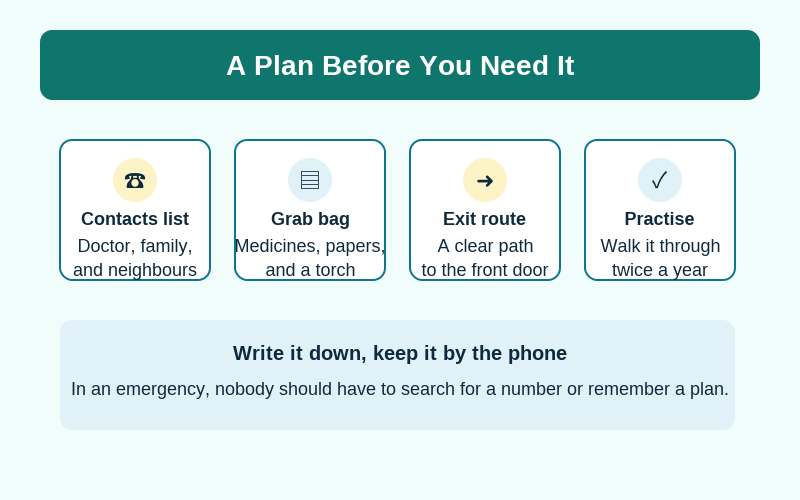
The contacts list is the heart of the plan, and it belongs at the top of the first page, in large print, where anyone can find it in seconds. Keep one copy on the fridge, one by every phone, and one in the grab bag by the door. Write the numbers by hand as well as in a phone, because a phone can be lost, flat, or out of reach, and a paper list still works when the power is out. Use large, clear writing, and write the full name next to every number, so a stranger knows who they are calling.
Your list should include the following, filled in with your own details. First, the local emergency number, written at the very top in the largest print. Second, your parent's doctor, with the surgery name and address, and the out-of-hours number if there is one. Third, the pharmacy your parent uses, so medicines can be checked or replaced quickly. Fourth, family members, in the order they should be called, with their relationship to your parent written next to each name. Fifth, a trusted neighbour, and any other neighbour who has a key. Sixth, the home care provider or professional caregiver, if you use one, with the agency name and the name of the regular caregiver. Seventh, the local hospital and, if your parent has one, the memory clinic or dementia service. Eighth, a poison control or advice line if one exists in your area, and the number for the electricity or gas supplier in case of a leak or outage. Do not invent any of these numbers. Write down only the real numbers from your parent's own records, the surgery, the pharmacy, and your family. If you are unsure of a number, look it up now, while there is time, and check it by reading it back.
Medical Information to Keep Ready
When an ambulance arrives, or when your parent is taken to hospital, the first questions are always the same: what medicines do they take, what conditions do they have, and are they allergic to anything? If you cannot answer quickly, treatment is delayed. Keep a single, up-to-date medical summary on one page, and keep a copy in the grab bag, a copy on the fridge, and a copy in your own bag. Update it whenever anything changes, and date every version so nobody uses an old one by mistake.
The summary should list, in plain language, the medicines your parent takes, including the name, the dose, and when it is taken, as written on the prescription or the pharmacy label. Do not guess at doses, and do not write down a medicine from memory if you are unsure: copy it from the label or ask the pharmacist for a printed list. Many pharmacies will print a current medicines list on request, and that printed list is more reliable than anything written from memory. The summary should also list the main health conditions, any allergies, and any medical devices your parent uses, such as a hearing aid, glasses, or a walking frame. Add the name of the doctor and the pharmacy, and any wishes your parent has expressed about treatment, if those have been recorded formally. If your parent has a medical alert bracelet or card, note that too, and where it is kept.
Exits and Escape Routes
Every person in the house must be able to get out quickly, from every room they use. Walk through the house with that in mind, and look at it as if you had two minutes to leave in the dark. Start with the bedroom. Is there a clear path from the bed to the door, with nothing to trip over? Is there a night light in the hallway, so the way is visible without turning on a bright light? Is the door easy to open, or does it stick? Then check the living room, the kitchen, and the bathroom. Every room should have a clear path to a door, and every door that leads outside should open easily from the inside, without a key that could be lost or a bolt that is hard to reach.
Choose one main escape route and one alternative, and write them down in the plan. The main route is usually the front door. The alternative might be the back door or a ground-floor window that opens easily. Make sure everyone who cares for your parent knows both routes, and that nothing blocks them: no shoes piled in the hallway, no laundry basket by the back door, no furniture in front of a window. If your parent uses a walking frame or wheelchair, check that the route is wide enough, and that there are no steps or thresholds that would stop them. If the house has stairs, think carefully about how your parent would get down them in an emergency, and talk to the care provider or the doctor about whether a stair lift, a downstairs bedroom, or a different arrangement is needed.
Agree on a meeting point outside the house, and write it in the plan. A neighbour's garden, a lamp post, or a spot across the street: somewhere safe, away from the house, where everyone gathers and can be counted. Practise walking to it, so your parent knows the way. Keep the house number clearly visible from the street, so emergency responders can find the house quickly, and keep the path to the front door clear of bins, plants, and ice in winter. If the house is in a rural area or a place that is hard to find, write clear directions in the plan, and keep a torch by the front door so someone can signal from the road. Our guides to lighting and flooring and grab bars and mobility aids have more on keeping paths and exits safe, and our wandering prevention guide explains how to balance safe exits with keeping a person with dementia from leaving unnoticed.
The Grab Bag
A grab bag is a small bag kept by the front door, ready to be picked up in seconds. It holds everything your parent would need if they had to leave the house in a hurry, whether for hospital, for a fire, or for a night with a relative. Use a bag that is easy to carry and easy to recognise, and keep it in the same place always, so nobody has to search for it. Check it every month, and replace anything that has gone out of date.
Inside the bag, keep a copy of the contacts list and the medical summary, a copy of the medicines list, and a few days' supply of medicines in their original packaging, if the pharmacist and doctor agree that is safe and appropriate. Never take medicines out of their packaging into unlabelled containers, and never pack a medicine you are unsure about. Keep a spare pair of glasses, a hearing aid with spare batteries, and a phone charger. Add a change of clothes, a warm layer, a bottle of water, a small snack, and a small amount of cash. Add a familiar object that comforts your parent, such as a photograph, a small blanket, or a favourite book, because a hospital stay is frightening, and something familiar helps. Add a notebook and a pen, so anyone can write down what happened and what was said. Finally, add a copy of the plan itself, so that wherever the bag goes, the plan goes with it.
The grab bag is for your parent, but you should have your own version too, or at least know where your own essentials are. Your phone, your keys, your wallet, and your own medicines should be in a place you can reach in the dark. If you care for your parent alone, think about who would look after them if you were suddenly ill or injured. Write that person's name and number in the plan, and tell them in advance that they are your back-up. A plan that only works when you are well is not a complete plan.
Falls and Medical Emergencies
Falls are the most common home emergency for older adults, and they are the one you are most likely to face. If your parent falls, the first rule is to stay calm and not to rush. Do not try to lift them immediately. Speak to them in a calm voice, ask if they are hurt, and check whether they can move their arms and legs. If they are in pain, cannot move, have hit their head, are bleeding heavily, or are unconscious, call the local emergency number and do not move them. If they are not hurt and can get up, help them slowly, with a chair for support, and watch them closely for the next few hours. Even a fall that seems minor can cause problems later, so tell the doctor about every fall, and keep a short note of when it happened, where, and what your parent was doing.
Learn the warning signs that mean a fall or illness needs urgent help. A sudden change in confusion, much worse than usual, is a reason to call a doctor promptly. So is chest pain, difficulty breathing, a face that droops on one side, weakness in an arm or leg, slurred speech, a fever, vomiting, or a fall that causes a head injury. Do not wait to see if it gets better. In a medical emergency, minutes matter, and it is always better to call and be told it is not serious than to wait and be wrong. If your parent has dementia, remember that they may not be able to describe pain or symptoms. A sudden change in behaviour, such as new agitation, refusal to eat, or unusual sleepiness, can be the only sign that something is wrong, and it deserves a prompt call to the doctor.
Prepare for the moment you are not there. A personal alarm, worn as a pendant or wristband, lets your parent call for help with one press, and some alarms can detect a fall automatically. If your parent will wear one, and understands what it is for, it is one of the most useful safety devices there is. Test it every week, keep the batteries charged, and make sure your parent knows that pressing it is not a nuisance. If your parent is alone for part of the day, arrange a daily check-in: a phone call, a visit from a neighbour, or a call from a care service. Someone should know, every day, that your parent is safe. Our guide to home monitoring options explains alarms, sensors, and daily check-ins in detail, and our sleep and nighttime routine guide covers the night hours when falls are most likely to go unnoticed.
Fire and Home Emergencies
Fire is the home emergency that moves fastest, and the one where preparation matters most. Fit smoke alarms on every floor, and in or near every bedroom, and test them every week. A smoke alarm that does not work is worse than no alarm at all, because it gives a false sense of safety. Change the batteries when the alarm beeps, and replace the alarm itself according to the manufacturer's instructions. If your parent is hard of hearing, consider an alarm with a flashing light or a vibrating pad, and talk to the local fire service about a home safety visit. Many fire services will visit a home, check the alarms, and advise on escape routes, free of charge.
Reduce the fire risks in the home. Keep the kitchen safe: never leave cooking unattended, keep tea towels and paper away from the hob, and consider a hob that switches off automatically if it is left on. Our kitchen safety guide has more on this. Keep heaters away from curtains, bedding, and furniture, and never use a portable heater in a bedroom while someone sleeps. Keep candles out of the house entirely, and be careful with cigarettes: if your parent smokes, they should smoke outside, sitting down, with a deep ashtray, and never in bed. Keep a fire blanket in the kitchen, and make sure you know how to use it. A small fire extinguisher is useful only if you have been shown how to use it and it is the right type for the fire: if in doubt, leave the house and call the emergency number.

Power Outages and Bad Weather
A power cut is a quiet emergency. There is no smoke and no alarm, but the heating stops, the lights go out, the phone may not charge, and medical equipment that needs power stops working. Keep a torch in every room, with spare batteries, and a battery-powered radio so you can hear news and advice. Keep a charged power bank for the phone, and charge it regularly. Keep the numbers in the plan on paper, not only in a phone that may run out of power. If your parent uses any equipment that needs electricity, such as an oxygen concentrator or a powered bed, talk to the doctor and the supplier about what to do in a power cut, and write the answer in the plan. Never use a generator indoors, and never use a gas cooker or a barbecue to heat a room: both can produce carbon monoxide, which is invisible, has no smell, and can kill.
Bad weather needs its own planning. In winter, keep the house warm, keep paths clear of ice, and keep a supply of food, water, and medicines that lasts several days, so a snowstorm does not mean a dangerous trip to the shops. Check on your parent during cold weather, and watch for signs of being too cold, such as shivering, confusion, or unusual sleepiness. In summer, heat is the danger: keep rooms cool, offer water often, and watch for signs of heat illness, such as confusion, dizziness, or not sweating when it is hot. Our seasonal home safety checklist walks through the checks for each season, and it is worth reading alongside this plan. In a storm or flood, follow local advice, keep the radio on, and do not drive through flood water. If the home is at risk of flooding, keep important documents and medicines in a waterproof bag, high up, and know in advance where you would go.
Practise the Plan
A plan that has never been practised is only a piece of paper. Practise it twice a year, at the turn of the seasons, so that it becomes familiar. Walk the escape route with your parent, from the bedroom to the front door, and then to the meeting point outside. Do it slowly, in daylight, at a calm time, and treat it as a walk, not a test. Show your parent where the grab bag is, and let them hold it. Show them what the smoke alarm sounds like, and what to do when they hear it. Practise the phone call: show your parent how to call the emergency number, and what to say. Keep the words simple: name, address, and what has happened.
Practise with the whole family, including any professional caregiver. A caregiver who has walked the escape route and read the contacts list is far more useful in a crisis than one who has only been told about it. After each practice, talk about what worked and what did not. Was the path clear? Was the torch where it should be? Did everyone know where the meeting point was? Write down what needs to change, and change it the same day. Then put the next practice date in your calendar. A plan that is practised twice a year, and reviewed every three months, stays alive. A plan that is written once and filed away is forgotten within weeks. Keep the plan short enough to practise: if it is longer than two pages, it is too long, and nobody will read it in a crisis.
Frequently Asked Questions
How long should an emergency plan be? One or two pages, in large print and plain language. If it is longer, nobody will read it in a crisis. Keep the contacts list at the top of the first page, and keep copies on the fridge, by every phone, and in the grab bag.
What should I write in the contacts list? Write in your own doctor, your own pharmacy, your own family contacts, and the local emergency number. Do not copy numbers from a guide or guess at them. Use only the real numbers from your parent's own records, and check each one by reading it back.
What if my parent refuses to wear a personal alarm? Talk about it at a calm time, and offer a choice of pendant or wristband. Explain it as a way to call for help, not as a sign of weakness. If they still refuse, arrange daily check-ins and door sensors instead, and keep trying the conversation gently.
How often should I practise the plan? Twice a year, at the turn of the seasons, and review the written plan every three months. Practise the escape route, the meeting point, and the phone call, and update anything that has changed the same day.
What should I do first if my parent falls? Stay calm, do not lift them immediately, and check whether they are hurt. If they are in pain, cannot move, have hit their head, or are unconscious, call the local emergency number and do not move them. Tell the doctor about every fall.
Sources and Further Reading
This guide draws on the following sources, all accessed 29 November 2026.
- Alzheimer's Association — Facts and Figures, and information on dementia care at home. alz.org/alzheimers-dementia/facts-figures
- National Institute on Aging (NIA) — information on Alzheimer's disease, dementia, and caregiving. nia.nih.gov/health/alzheimers-and-dementia
If this guide helped you, please share it with another family who needs it, and read our other guides on dementia care and home safety, including our wandering prevention guide and our fall prevention checklist. If you would like to talk about care for your parent, start on our homepage, read more about who we are and how we work, or contact us — a friendly advisor is ready to listen, with no obligation. You can write to us at hello@homecare.biz.id.
Tags: home care safety, emergency plan, senior home care
Last reviewed: 26 June 2026. This guide is general information and is reviewed regularly. It is not a substitute for medical advice. Always talk to a doctor about diagnosis, treatment, or any change to care or medication.