
Home Care and Home Safety: Lighting and Flooring Tips to Prevent Falls
Written by the HomeCare editorial team. Sources: Alzheimer's Association, National Institute on Aging (NIA).
If you ask a family what makes a home safe for an older parent, they will often mention grab bars, or a shower seat, or a walking aid. They rarely mention the light and the floor, yet those two things decide whether your parent can see where they are going and whether their feet land safely. A dim hallway hides a step. A shiny floor hides a spill. A loose rug catches a toe. A dark bedroom means a walk to the bathroom in the dark. Light and flooring are the background of the whole house, and when they are right, every other safety measure works better. When they are wrong, even a careful person can fall.
This guide is written for adult children caring for a parent at home. It walks through light and flooring room by room, and shows you the small, affordable changes that make the biggest difference: brighter bulbs, night lights, non-slip mats, fixed rugs, and clear step edges. You do not need to rewire the house or replace every floor to make a real difference. Most of the changes in this guide can be done in a weekend, and many cost very little. If you would like the wider picture first, read our complete family guide to dementia care at home, our complete guide to home care, and our fall prevention checklist, which covers the whole house room by room.
Why Light and Floors Matter So Much
Older eyes need more light than younger eyes, and they adjust more slowly when moving from a bright room into a dark hallway. A parent who could once walk through the house in the dark now needs light to see the floor, the step, and the edge of the rug. At the same time, older feet are less able to recover from a trip. A younger person who catches a toe on a rug can often catch their balance; an older person, whose muscles are weaker and whose balance is less steady, is more likely to fall. Light and flooring work together: good light lets your parent see the hazard, and a level, non-slip floor means there is less to trip on in the first place. Fix one without the other, and the risk remains.
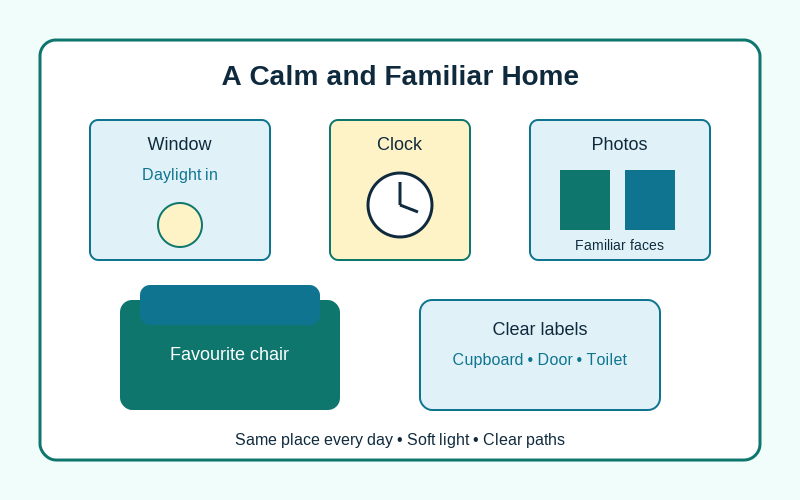
Memory problems make light and flooring even more important. A parent living with dementia may forget where the step is, misjudge the height of a threshold, or try to walk in the dark without remembering to turn on the light. A familiar, well-lit room with a level floor is easier to read than a dark, cluttered one, and a clear visual path, with light on the floor and no sudden changes in colour or level, helps your parent navigate even when memory is uncertain. Our guide to a calm, familiar home explains how a steady, readable home helps a person with dementia, and our sleep and nighttime routine guide shows why the night-time journey to the bathroom deserves special care. Light and flooring are not decoration. They are safety equipment, and they belong in every room your parent uses.
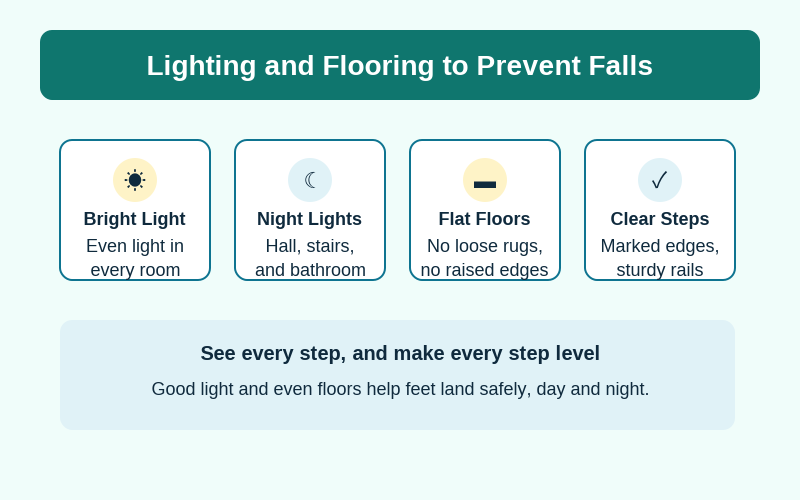
Start With a Walk-Through, Day and Night
Before you buy a bulb or move a rug, walk through the house the way your parent walks it, and do it twice: once in daylight, and once at night. In daylight, notice where the light is poor, where shadows fall across the floor, and where glare from a window hides a step. Notice the floors: is there a rug that slides, a tile that is loose, a threshold that sticks up, or a change in floor level between two rooms? Walk the routes your parent uses every day, from the bed to the bathroom, from the kitchen to the table, and from the front door to the favourite chair. Write down everything you notice, even the small things, and take photographs of the tricky spots.
Then do the same walk at night, with only the lights your parent would normally use. This is the walk that matters most, because the night-time trip to the bathroom is one of the riskiest journeys in the house. Can you see the floor clearly? Can you find the light switch without fumbling? Is there a night light in the hallway and the bathroom? Is the path from the bed to the bathroom clear, or is there a shoe, a bag, or a rug in the way? Sort your list into three groups, as our fall prevention checklist suggests: things you can fix today, such as replacing a failed bulb or removing a rug; things you can fix this week, such as adding a night light or a non-slip mat; and things that need a tradesperson, such as a new light fitting or a flooring repair. Start with the night-time route, because it is where the risk is highest and the fix is often cheapest.
Natural Light and Daylight
Daylight is the best light there is, and it does more than help your parent see. Bright daylight in the morning helps the body's clock, which supports better sleep at night, and a bright, cheerful room lifts mood and helps your parent stay active during the day. Open the curtains first thing in the morning, and keep windows clean, so as much daylight as possible comes in. If heavy curtains or net curtains block the light, consider lighter ones, or tie them back during the day. Arrange your parent's favourite chair near a window, where the light is best, and where they can see the garden or the street, which gives the day a sense of place and time.
Be careful with glare, though. Low winter sun shining across a shiny floor can hide a step edge or a spill, and a bright window behind a television can make the screen hard to see. A sheer blind or a light curtain can soften the glare without blocking the light, and a matt floor finish is easier on the eyes than a shiny one. In the evening, close the curtains before it gets dark, and turn the lights on early, so there is no moment when the house goes dark and your parent is left in shadow. This matters even more for a parent living with dementia, because the change from light to dark can bring confusion and restlessness. Our guide to managing sundowning explains how to handle the difficult hours of the late afternoon and evening, and our daily routine guide shows how daylight and a steady routine work together.
Lighting Room by Room
Every room your parent uses should be bright enough to see the floor clearly, with no dark corners and no harsh glare. Start with the rooms that matter most: the hallway, the stairs, the bathroom, the kitchen, and the bedroom. In the hallway, a bright ceiling light, and a light at each end if the hallway is long, means there is no dark stretch to walk through. On the stairs, a light at the top and at the bottom, with a switch at each end, means your parent never has to climb stairs in the dark. In the bathroom, a bright ceiling light and a light over the mirror means the floor, the bath edge, and the toilet are all easy to see. In the kitchen, a light over the worktops and the stove means cutting and cooking can be seen clearly. In the bedroom, a lamp within reach of the bed means your parent can switch on the light before standing up.
Use the brightest bulbs the fittings allow, and replace any that have failed the same day. Choose bulbs that give a warm, even light, and avoid bare bulbs that glare. If a room has only one light, consider adding a second, such as a table lamp or a floor lamp, to fill in the shadows. Keep lamps where they cannot be knocked over, and keep their cords tucked away. If your parent has poor eyesight, talk to a doctor or an optician, because better glasses can make the whole house safer. For the bathroom and kitchen, where wet floors are a risk, read our bathroom safety guide and our kitchen safety guide, which cover light in those rooms in detail.
Night Lighting and the Trip to the Bathroom
The night-time trip to the bathroom is the journey that most worries families, and it is the one where lighting matters most. Your parent is sleepy, the house is dark, and the route involves getting out of bed, walking down a hallway, and finding the toilet, all without fully waking up. The answer is a chain of light that leads the way: a small light by the bed, a night light in the hallway, and a night light in the bathroom, so the whole route is lit from the moment your parent stands up. A light that comes on automatically when someone moves is ideal, because it works even if your parent forgets to switch it on, and it switches off again by itself.
Keep the night lights low and warm, so they light the floor without waking your parent fully, and place them low on the wall, where they light the path rather than shining in the eyes. Keep the path itself clear: no shoes, bags, or laundry baskets on the floor between the bed and the bathroom, and no loose rug that can slide in the dark. Keep a lamp or a touch light within reach of the bed, so your parent can switch it on before standing, and keep glasses and a phone on the bedside table. If your parent gets up often at night, our sleep and nighttime routine guide has more ideas for calmer, safer nights, and our emergency plan guide explains how to make sure help can be reached from the bedroom. Test the night lights yourself, by walking the route in the dark, and adjust them until you can see every step.
Switches, Controls, and Easy Light
A light is only useful if your parent can switch it on easily, and switches are often in the wrong place: behind a door, at the far end of a hallway, or too high to reach comfortably. Walk through the house and check every switch. Can your parent reach it without stretching or bending? Can they find it in the dark? Is there a switch at both ends of the hallway and at the top and bottom of the stairs? If not, a simple plug-in motion-sensor light, or a light that can be switched on from the bed, can fill the gap. Consider switches with a large, easy-to-press button, and mark them with a small strip of glow-in-the-dark tape, so they can be found at night.
Think about the other controls in the house too. A lamp with a touch switch is easier than one with a small twist knob, and a lamp that can be switched on from the bed is better than one across the room. Keep a torch by the bed and by the front door, with fresh batteries, in case the power fails. If your parent uses a remote control for the television or a radio, keep it in the same place, so it can be found without searching. The principle is the same everywhere in the house: the thing your parent needs should be where their hand naturally reaches, and it should work the first time. Our guide to a calm, familiar home explains why keeping things in the same place matters so much, and our guide to home monitoring options covers devices that can switch lights on and off automatically.
Flooring Types and What to Choose
The safest floors are flat, even, and non-slip, with no sudden changes in height and no shiny glare. If you are choosing new flooring, look for a matt finish rather than a shiny one, because glare can hide a step edge or a spill, and choose a surface that grips even when it is a little wet. Wood, laminate, and vinyl can all be safe if they are level and non-slip, and carpet can be safe too, if it is low-pile, firmly fixed, and free of loose edges. Very thick, soft carpet looks comfortable, but it can catch a walking aid and make it harder to walk, so a firm, low carpet is usually the safer choice. In the bathroom and kitchen, where water is common, a non-slip floor is worth the effort, and a floor that is easy to mop and dry helps keep it safe day to day.
Whatever flooring you have, keep it in good repair. A loose floorboard, a lifted tile edge, a torn carpet, or a cracked vinyl tile can all catch a toe, and they should be fixed as soon as you notice them. Check the floors regularly, especially in the rooms your parent uses most, and after any change, such as new furniture or a new walking aid. If you are not sure whether a floor is safe, ask a tradesperson or an occupational therapist to look at it. They can advise on non-slip treatments, on fixing loose boards, and on whether a floor should be replaced. Avoid polished floors and waxed finishes, which become slippery when wet, and avoid floors with a busy pattern, which can be confusing for a person with poor eyesight or dementia. A plain, even floor, in a colour that contrasts with the walls and the stairs, is the easiest floor to walk on safely.
Rugs, Mats, and Transitions
Loose rugs are one of the most common causes of falls at home, and they are also one of the easiest to fix. Remove any rug that slides on the floor, curls at the corners, or bunches up underfoot. If a rug is important to your parent, fix it down firmly with non-slip backing or double-sided tape, and check it regularly, because backing wears out and tape comes loose. Small rugs and runners in hallways are the riskiest, because they lie directly on the walking line, and they are the first ones to remove. A rug beside the bed, where your parent steps out in the dark, is another one to remove or fix down firmly.
Transitions, where one floor meets another, deserve the same attention. A threshold strip between two rooms, a change from carpet to wood, or a step down into a conservatory can all catch a toe, especially if the change is hard to see. Make each transition level if you can, and if a step cannot be removed, mark it clearly, with good light and a strip of contrasting colour along the edge, so the change in level is easy to see. Use non-slip mats where they help, such as in front of the sink and the stove, and in the bathroom, but make sure each mat has a non-slip backing and lies flat. A mat that slides is worse than no mat at all. Our bathroom safety guide and our kitchen safety guide cover mats in those rooms, and our fall prevention checklist covers the whole house.
Stairs, Steps, and Doorways
Stairs need good light, a firm handrail, and step edges that are easy to see. A light at the top and at the bottom, with a switch at each end, means your parent never has to climb stairs in the dark. A handrail on at least one side, and preferably on both sides, gives support all the way up and down. Test the rail yourself: lean on it, pull it, and check that it does not move. Mark the edge of each step with a strip of non-slip tape or a contrasting colour, so the edge is easy to see, and keep the stairs free of objects, even for a moment. A laundry basket left on a step is a trip waiting to happen. If the stairs have carpet, check that it is firmly fixed, with no loose edges, and if they are wooden, check that the surface is not slippery.
Doorways and single steps need the same care. A step down into another room, or a step up at the front or back door, should be well lit, with a handrail beside it if possible, and a contrasting strip along the edge. Keep the doorway clear, with no shoes or bags in the way, and make sure the door itself opens easily and does not stick. If your parent uses a walking aid, check that it fits through every doorway, and that there is room to turn on both sides. A door that is hard to open, or a step that is hard to see, can turn a simple journey into a fall. Our guide to grab bars and mobility aids covers handrails and support in detail, and our guide to safe exits covers the doors of the house.
Outdoors, Paths, and the Seasons
Light and flooring matter outside the house too. The path to the front door, the steps at the entrance, and the garden path should be level, non-slip, and well lit, with a light by the door that comes on automatically when someone approaches. Check the paths regularly for cracked paving, loose stones, or moss, which becomes slippery when wet, and clear leaves in autumn and ice in winter. A handrail beside the front steps helps with the change in level at the door, and a non-slip mat at the entrance catches wet feet before they reach the hallway floor. Keep the garden tidy, with no hoses, tools, or toys left on the path.
The seasons change what the house needs. In winter, the days are shorter, so the lights are on for longer, and the night lights matter more. In summer, bright sun can cause glare on shiny floors, and open windows can mean a draught that moves a rug. Our seasonal home safety checklist walks through the house season by season, and it is worth reading alongside this guide. Check the bulbs and the night lights when the clocks change, and check the outdoor paths when the weather changes. A quick seasonal check, done four times a year, keeps the light and the floors safe all year round, and it takes less than an hour. If your parent enjoys the garden, our guide to daily activities has ideas for safe, enjoyable time outdoors.
When to Ask for Extra Help
Some lighting and flooring jobs are simple, and some need a professional. Replacing a bulb, adding a night light, or fixing a rug down are jobs you can do yourself. Rewiring a light, fitting a new light fitting, or replacing a floor need a qualified tradesperson, and a badly done job can make the house more dangerous, not less. Ask an occupational therapist for a home assessment: they can look at the light and the floors with professional eyes, recommend the right changes, and tell you what will help most for your parent. They can also advise on whether a stair lift, a different layout, or a move to a ground-floor bedroom is worth considering.
If your parent has fallen, or is afraid to move around the house, talk to a doctor promptly, and ask for a falls assessment. Professional home care can help with the times of day that are riskiest, such as mornings and evenings, and a caregiver can be there for the stairs, the shower, and the walk to the shops. The median cost of home care in the United States is around $35 an hour, according to CareScout's 2025 cost of care data, and the exact cost in your area will depend on the provider and the hours you need, so ask local providers for a clear quote. Asking for help is not a failure; it is how a parent stays safely at home. Read our guide to when to ask for extra help, and our medication storage guide for keeping care organised day to day.
Frequently Asked Questions
What is the cheapest lighting change that helps most? Add night lights along the route from the bed to the bathroom, and replace any failed bulbs the same day. A chain of low, warm light from the bed to the toilet is the single most useful night-time change you can make.
Are rugs really a problem? Yes, loose rugs are one of the most common causes of falls at home. Remove them, or fix them firmly with non-slip backing. If a rug curls at the corners or slides on a hard floor, it is safer to take it away.
What flooring is safest for an older person? A flat, even, non-slip floor with a matt finish, in a plain colour that contrasts with the walls and stairs. Whatever floor you have, keep it in good repair, fix loose boards and tiles quickly, and avoid shiny, slippery finishes.
How do I make stairs safer? A light at the top and bottom, a firm handrail, and a contrasting strip along each step edge. Keep the stairs free of objects, and check the carpet or surface regularly for loose edges.
How often should I check the light and floors? Do a quick check every season, and again after any change, such as new furniture, a new walking aid, or a change in your parent's health. Our seasonal home safety checklist can help you remember what to look at.
Sources and Further Reading
This guide draws on the following sources, all accessed 29 November 2026.
- Alzheimer's Association — Facts and Figures, and information on dementia care at home. alz.org/alzheimers-dementia/facts-figures
- National Institute on Aging (NIA) — information on Alzheimer's disease, dementia, and caregiving. nia.nih.gov/health/alzheimers-and-dementia
If this guide helped you, please share it with another family who needs it, and read our other guides on dementia care and home safety at home. If you would like to talk about care for your parent, start on our homepage or contact us — a friendly advisor is ready to listen, with no obligation. You can write to us at hello@homecare.biz.id.
Tags: home care safety, fall prevention, home safety
Last reviewed: 26 June 2026. This guide is general information and is reviewed regularly. It is not a substitute for medical advice. Always talk to a doctor about diagnosis, treatment, or any change to care or medication.