
Home Care and Home Safety: Fall Prevention Checklist for Seniors
Written by the HomeCare editorial team. Sources: Alzheimer's Association, National Institute on Aging (NIA).
If you are caring for a parent at home, a fall is probably one of your biggest worries, and with good reason. Most falls happen at home, in rooms your parent knows well, during ordinary moments: getting up at night, stepping out of the shower, reaching for a cup, or hurrying to answer the door. A fall can shake confidence as much as it hurts the body, and after one fall many older people move less, which makes the next fall more likely. The good news is that most of the causes of falls at home can be found and fixed, one small change at a time, and this guide will show you how.
This checklist is written for adult children caring for a parent at home. It walks through the whole house, room by room, and gives you clear, practical steps you can take this week. You do not need to rebuild the house or buy expensive equipment to make a real difference. Clearing a hallway, adding a night light, fixing a loose rug, and choosing safer shoes are small jobs, but together they change how safely your parent moves through the day. If you would like the wider picture first, read our complete family guide to dementia care at home and our complete guide to home care.
Why Falls Happen at Home
Falls rarely have a single cause. Usually several small risks add up: a dim hallway, a rug that curls at the corner, shoes that slip, tiredness late in the day, and a moment of hurry. Older bodies also change in ways that make falls more likely. Eyesight gets weaker, so edges and steps are harder to see. Balance becomes less steady, especially when turning quickly or standing up fast. Muscles lose some strength, so recovering from a small trip is harder than it used to be. Add in a home that was designed for a younger, fitter person, and the risk grows. Understanding this matters, because it means there is no single fix. Safety comes from removing several small risks at once, across the whole house and the whole day.
Memory problems add another layer. A parent living with dementia may forget where the step is, misjudge the height of a kerb, or try to get up in the dark without remembering to turn on the light. That is why fall prevention and dementia care go hand in hand. A calm daily routine, covered in our daily routine guide, helps your parent move at steady times of day, when they are rested and the house is prepared. Good lighting and a familiar layout, which we cover in our lighting and flooring guide, matter even more when memory is uncertain. The aim is not to wrap your parent in cotton wool, but to make the home forgiving, so a small mistake does not become a fall.
Start With a Slow Walk-Through
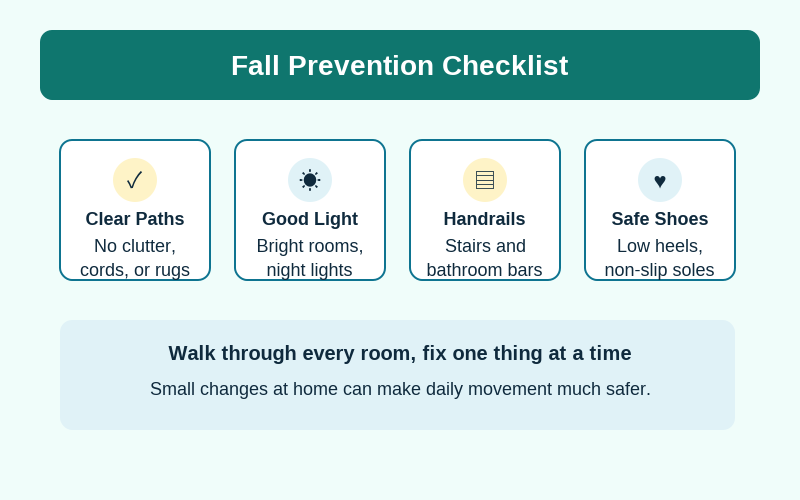
Before you buy anything or move any furniture, walk through the house slowly, the way your parent walks it. Start at the front door and follow the routes your parent uses every day: to the kitchen, to the bathroom, to the bedroom, to the favourite chair. Walk at your parent's pace, and notice what your feet and hands meet. Is there a step you have to think about? A rug that slides? A dark corner where you cannot see the floor? A chair that wobbles when you lean on it? Write down everything you notice, even the small things. Then do the same walk at night, with only the lights your parent would normally use. Night reveals risks that daylight hides, and the night-time route to the bathroom is one of the most important in the house.
It helps to do this walk-through with your parent, if they are willing, and to ask them where they feel unsure. They may tell you about a step they always watch, a corner they avoid, or a time of day when they feel unsteady. Listen without arguing, and thank them for telling you. If your parent uses a walking aid, watch how it moves through each doorway and turn, and check whether it catches on rugs or furniture. Take photographs of the tricky spots, so you can compare before and after, and so other family members can see what needs fixing. Then sort your list into three groups: things you can fix today, such as moving a cord or removing a rug; things you can fix this week, such as adding a night light or a grab bar; and things that need a tradesperson, such as a handrail or a flooring repair. Work through the first group first. Quick wins build confidence, for you and for your parent, and they make the house safer while the bigger jobs are arranged.
Hallways and Stairs
Hallways and stairs are the routes your parent uses most, and they deserve the most attention. A hallway should be wide enough to walk through without turning sideways, and it should be empty. Shoes, bags, laundry baskets, books, and pet bowls all belong somewhere else, not on the walking line. If your parent uses a walking aid, the hallway must be clear along its full width, from one end to the other. Check the floor itself: a loose floorboard, a lifted tile edge, or a threshold strip that sticks up can catch a toe. If the hallway has a step down into another room, mark it clearly, with good light and, if needed, a strip of contrasting colour along the edge so the change in level is easy to see.
Stairs need a handrail on at least one side, and preferably on both sides if your parent is unsteady. The rail should run the full length of the stairs, be easy to grip, and be firmly fixed. Test it yourself: lean on it, pull it, and check that it does not move. The steps should be even, with no broken nosing, and the edges should be easy to see. A strip of non-slip tape or a contrasting edge on each step helps, especially in dim light. Keep the stairs free of objects, even for a moment. If your parent finds stairs difficult, talk to a doctor or an occupational therapist about whether a stair lift or a move to a ground-floor bedroom is worth considering, and read our guide to grab bars and mobility aids for more on support around the home.
Living Room and Bedroom
The living room is where your parent spends most of the day, so it should be the easiest room to move around. Arrange furniture so there is a clear path from the door to the favourite chair, to the window, and to the kitchen and bathroom. Push coffee tables and footstools out of the walking line, and make sure trailing cables from lamps, televisions, and chargers are tucked away or taped down. A chair should be firm, with armrests that your parent can push against to stand, and it should not slide across the floor. Very low, soft sofas look comfortable, but they are hard to get out of, and they can tip a person forward as they stand.
The bedroom matters most at night, when your parent is sleepy and the house is dark. The bed should be at a height where your parent can sit on the edge with feet flat on the floor, and there should be a clear, empty path from the bed to the bathroom door. Keep a lamp or a touch light within easy reach of the bed, so your parent never has to walk in the dark, and add a night light in the hallway and the bathroom. Keep glasses, a phone, and a glass of water on the bedside table, so there is no need to reach across the room in the dark. Avoid loose bedding that trails on the floor, and keep slippers by the bed, not under it, where they can be found without bending. If your parent gets up often at night, our sleep and nighttime routine guide has ideas for calmer, safer nights, and our emergency plan guide explains how to make sure help can be reached from the bedroom.
Bathroom and Kitchen
The bathroom is the most dangerous room in the house for falls. Wet floors, smooth tiles, and the need to step over a bath edge or turn in a small space combine into a real risk, and most bathroom falls happen when nobody else is there. Start with grip: a non-slip mat in the bath or shower and another on the floor beside it, and grab bars by the toilet and in the shower. Never rely on a towel rail or a soap dish for support, because they are not fixed to hold a person's weight. A shower seat lets your parent wash sitting down, which is steadier and less tiring, and a hand-held shower head means they do not have to stand under the water and turn around. Keep soap, shampoo, and towels within easy reach, so there is no stretching or twisting on a wet floor. Our bathroom safety upgrades guide covers all of this in detail, and our safe bathing and personal care guide has gentle ideas for days when washing itself is difficult.
The kitchen has its own risks: water on the floor, things stored too high or too low, and the habit of carrying hot food while walking. Keep everyday items at waist height, between the shoulders and the hips, so your parent never has to climb onto a chair or bend to the floor. Store heavy pots and pans low down, and light things higher up. Mop up spills straight away, and keep a mop and a cloth where they can be reached without bending. Use a sturdy trolley or a tray with a non-slip base to carry food from the kitchen to the table, and sit down to eat rather than carrying a plate across the room. Turn pan handles inward on the stove, so they cannot be knocked, and keep the kitchen floor dry and free of mats that slide. Our kitchen safety guide has more on cooking safely at home, and our mealtime and nutrition guide covers eating well and safely.
Lighting and Flooring
Good light is one of the cheapest and most effective fall prevention measures there is. Older eyes need more light than younger eyes, and they adjust more slowly when moving from a bright room into a dark hallway. Every room your parent uses should be bright enough to see the floor clearly, with no dark corners and no harsh glare. Use the brightest bulbs the fittings allow, and replace any that have failed the same day. Add extra light where it matters most: over the stairs, in the hallway, in the bathroom, and by the bed. Night lights in the hallway, the bathroom, and the kitchen mean your parent can find the way at night without fumbling for a switch. A light that comes on automatically when someone moves is ideal for the hallway and bathroom, because it works even if your parent forgets to switch it on.
Flooring matters just as much as light. The safest floors are flat, even, and non-slip, with no sudden changes in height. Remove loose rugs, or fix them down with non-slip backing or tape, and throw away any rug that curls at the corners. In the bathroom and kitchen, non-slip flooring or mats are worth the effort. Keep cords and cables off the floor, and repair any loose carpet, lifted tile, or uneven board as soon as you notice it. If you are replacing flooring, choose a matt finish rather than a shiny one, because glare can hide a step edge, and choose a colour that contrasts with the walls and the stairs, so edges are easier to see. Our lighting and flooring guide goes through each room in detail, and our seasonal home safety checklist reminds you to check light and floors again as the seasons change and the days get darker.
Footwear and Clothing
What your parent wears on their feet matters more than most families realise. The safest shoes are low-heeled, with a firm sole that grips, a closed back that holds the heel, and a fastening that keeps the shoe on the foot. Slippers that are loose, backless, or smooth-soled are a common cause of falls, especially on wooden or tiled floors. If your parent loves their slippers, look for a pair with a firm sole, a closed heel, and a proper fastening, and keep them for indoors only. Socks alone are slippery on hard floors, so if your parent prefers socks, choose pairs with grips on the soles. Check shoes regularly for worn soles, and replace them before they become smooth. When your parent goes outside, the same rules apply, with the addition of a sole that grips in wet weather, and a shoe that is easy to put on without bending too far.
Clothing matters too. Trousers and skirts that are too long can catch under a foot, and dressing gowns with long ties can trail and trip. Choose clothes that fit well, with hems that clear the floor, and ties that can be tucked away. If your parent dresses sitting down, they are less likely to lose balance than if they stand on one leg to put on trousers. Lay clothes out in the order they are put on, and offer a choice of two items rather than a whole wardrobe, which is gentler on memory and on decision-making. Our daily routine guide has more on making mornings calm and steady, and our guide to communicating with calm and patience can help if your parent resists a change of shoes or clothes. Change is easier when it is offered as comfort, not as a rule.
Movement, Strength, and Balance
A safe home is only half of fall prevention; the other half is how your parent moves through it. Encourage your parent to stand up slowly, sit on the edge of the bed or chair for a moment, and then stand, rather than rising in one quick movement. Standing up too fast can cause dizziness, and dizziness causes falls. When walking, encourage a steady pace, with the walking aid, if one is used, always in place before the first step. Turning should be slow, in small steps, rather than a quick twist. Carrying things while walking divides attention, so encourage your parent to make two trips, use a bag or a trolley, or ask for help with a heavy load. These habits sound small, but they remove the rushed, divided moments when most falls happen.
Strength and balance can be supported by everyday activity, but this is an area to discuss with a doctor before starting anything new. Gentle daily movement, such as a short walk, can help many older people, but the right activity depends on your parent's health, and only a doctor or a qualified professional can advise what is safe for them. Never start a new exercise routine on the basis of a guide alone. What you can do safely is build movement into the day in ordinary ways: a walk to the garden, or a slow stroll to the shops with you. If your parent has fallen before, or feels unsteady, ask a doctor for a falls assessment. Keep a simple note of any fall, however small, with the date, the time, the place, and what happened, so you can share it with the doctor.
Grab Bars and Mobility Aids
Grab bars and mobility aids are tools, not signs of failure, and they work best when they are fitted in the right place and used every day. A grab bar by the toilet helps your parent sit and stand safely. A bar in the shower or by the bath helps with stepping in and out, which is one of the riskiest moments in the house. Bars beside the front and back steps help with the change in level at the door. The key rule is that a grab bar must be fixed into the wall, not stuck on with suction, and it must be placed where your parent's hand naturally reaches. A bar in the wrong place is worse than no bar, because it invites a reach that is not there. Ask a professional, such as an occupational therapist or a qualified tradesperson, to advise on placement and fitting, and never fit a bar yourself unless you know how to fix it safely into the wall.
Mobility aids need the same care. A walking stick should be the right height, with a rubber tip that is not worn smooth, and it should be used on the side your parent finds steadiest, as advised by a professional. A walker or frame should be checked for loose joints and worn tips, and it should fit through every doorway your parent uses. Keep the aid beside the bed at night and beside the chair during the day, so it is always within reach, and never leave it in another room. If your parent has been given an aid and does not use it, find out why: it may be the wrong height, it may feel embarrassing, or it may be hard to manage. Our guide to grab bars and mobility aids covers choosing and fitting these tools in detail, and our guide to home monitoring options explains how simple devices can add reassurance when you cannot be there.
An Emergency Plan for a Fall
Even with the best prevention, a fall can still happen, so the house needs a plan for it. Talk through the plan with your parent while everyone is calm, not in the middle of a crisis. The first question is how your parent will call for help if they fall and cannot get up. A phone should be within reach in every room, or your parent should carry a charged mobile phone, or wear a call device if one is available. Make sure the phone is easy to use, with large buttons and important numbers saved. Our emergency plan guide walks through this step by step, including how to keep a list of contacts where it can be found, and how to make sure someone can get into the house if your parent cannot reach the door.
Agree in advance what to do after a fall. The general advice is to stay still for a moment, check for pain or injury, and call for help rather than trying to get up quickly, but if your parent has a specific plan from their doctor, follow that instead. Keep a torch, a blanket, and a phone charger near the bed, and keep the front door key where a trusted person can reach it. Tell a neighbour or a nearby family member about the plan, so someone close by knows to check in if they do not hear from your parent. After any fall, even one that seems minor, talk to a doctor promptly, because a fall can be a sign of a change in health. Write down what happened, and keep the note with your parent's other care records.
When to Ask for Extra Help
Fall prevention is a family job, but there comes a point when extra help makes everyone safer. If your parent has fallen more than once, if they are afraid to move around the house, if they need help to stand, or if you are exhausted from watching every step, it is time to ask for more support. Talk to a doctor first, and ask for a home safety assessment from an occupational therapist, who can look at the house with professional eyes and suggest changes you may not have thought of. If you need more hands at home, professional home care can help with the times of day that are riskiest, such as mornings and evenings, and a caregiver can be there for the shower, the stairs, and the walk to the shops. The median cost of home care in the United States is around $35 an hour, according to CareScout's 2025 cost of care data, and the exact cost in your area will depend on the provider and the hours you need, so ask local providers for a clear quote before you decide.
Asking for help is not a failure, and it does not mean your parent has to leave home. It means the home is getting the support it needs to stay safe. Talk to your parent honestly about what you have noticed, share the checklist in this guide, and make the decisions together where you can. If your parent needs more care than the family can give at home, our guide to when to ask for extra help explains how to think through that decision with kindness. And remember to look after yourself: a tired caregiver misses risks, so build in breaks, share the watching with other family members, and ask for respite before you reach breaking point.
Frequently Asked Questions
What is the single most important fall prevention step at home? Clear the walking routes and add light, especially at night. Removing clutter, cords, and loose rugs, and adding night lights in the hallway and bathroom, are quick jobs that reduce risk in every room your parent uses.
Are rugs really a problem? Yes, loose rugs are one of the most common causes of falls at home. Remove them, or fix them firmly with non-slip backing. If a rug curls at the corners or slides on a hard floor, it is safer to take it away.
Should my parent use a walking stick or a frame? Only a doctor or a qualified professional can advise what is right for your parent. If they suggest an aid, make sure it is the correct height, in good repair, and always within reach, and encourage your parent to use it every time they walk.
What should I do after a fall, even a small one? Stay calm, help your parent stay still for a moment, and call for help rather than rushing them to their feet. Then talk to a doctor promptly, even if the fall seemed minor, and write down what happened so you can share it.
How often should I re-check the house for fall risks? Do a quick check every season, and again after any change, such as a new piece of furniture, a new walking aid, or a change in your parent's health. Our seasonal home safety checklist can help you remember what to look at.
Sources and Further Reading
This guide draws on the following sources, all accessed 29 November 2026.
- Alzheimer's Association — Facts and Figures, and information on dementia care at home. alz.org/alzheimers-dementia/facts-figures
- National Institute on Aging (NIA) — information on Alzheimer's disease, dementia, and caregiving. nia.nih.gov/health/alzheimers-and-dementia
If this guide helped you, please share it with another family who needs it, and read our other guides on dementia care and home safety at home. If you would like to talk about care for your parent, start on our homepage or contact us — a friendly advisor is ready to listen, with no obligation. You can write to us at hello@homecare.biz.id.
Tags: home care safety, fall prevention, senior home care
Last reviewed: 25 June 2026. This guide is general information and is reviewed regularly. It is not a substitute for medical advice. Always talk to a doctor about diagnosis, treatment, or any change to care or medication.