
Home Care for Memory Care: Music and Reminiscence Activities at Home
Written by the HomeCare editorial team. Sources: Alzheimer's Association, National Institute on Aging (NIA).
A song from long ago can do what a new fact cannot. A parent who cannot remember what they had for lunch may still hum the words of a song from their youth, or smile at a photograph from a wedding fifty years ago. Music and reminiscence work because they reach the parts of memory that often stay working longest: the songs, stories, and feelings from earlier life. This guide is written for adult children caring for a parent at home, and it shows how to use music, photographs, and shared stories to bring comfort, connection, and calm into the day. You do not need musical skill, and you do not need to buy anything special.
The goal is not a performance, and it is not a test. The goal is a good moment together: a song that brings a smile, a photograph that starts a story, a few minutes of shared pleasure. Keep activities short, keep them familiar, and follow your parent's lead. If a song brings joy, play it again. If a photograph brings sadness, put it away gently and try another. If you would like the wider picture first, read our complete family guide to dementia care at home and our guide to activities that support daily engagement, which covers gentle daily activities in more detail.
Why Music and Reminiscence Work
Music is remembered differently from facts. A new fact, such as an appointment next Tuesday, is hard for a person with dementia to hold on to, because that kind of memory is often affected early. But a song learned long ago lives in a different part of the brain, one that often stays working much longer. That is why a parent who cannot tell you what day it is may still know every word of a song from their twenties, or tap their foot to a tune they danced to as a young person. The music does not need to be remembered. It only needs to be heard, and the response follows on its own.
Reminiscence works in a similar way. Talking about the past is often easier than talking about the present, because old memories are held more strongly than new ones. A photograph, a familiar object, or a smell can open a door to a story your parent has told many times, and telling it again brings pleasure and a sense of self. These moments matter, because dementia can take away so much of what makes a person feel like themselves. A song, a story, and a shared laugh remind your parent — and you — of who they are, beyond the diagnosis. Music and reminiscence do not cure dementia. But they can bring comfort, reduce distress, and give the day a few good moments, and that is worth a great deal.
Start With Favourites
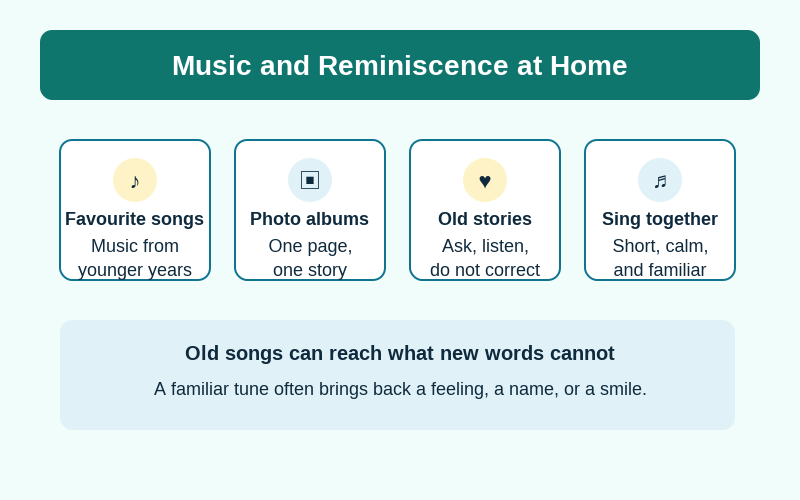
Do not start with what you think your parent should like. Start with what they already love. Ask family members what songs your parent sang, danced to, or played when they were young. Was there a singer they loved, a band they followed, a song at their wedding, a hymn from childhood, a tune from the radio in the kitchen? If your parent can still tell you, ask them, one simple question at a time. If they cannot, ask brothers, sisters, old friends, or anyone who knew them when they were young. The favourites are usually easy to find, because they are the songs that come up again and again in family stories.
Start with one or two songs, and play them at a calm time of day, when your parent is settled. Keep the volume low, and watch the response. A smile, a tap of the foot, a hummed word, or a tear are all responses worth noticing. If a song brings joy, play it again tomorrow. If it brings distress, stop it gently and try another. Do not assume that a song your parent loved will always bring joy. Sometimes a song is tied to a person who has died, or a time that is gone, and it brings sadness. That sadness is real, and it deserves kindness, not avoidance. Sit with it for a moment, acknowledge it, and then offer something else: a different song, a cup of tea, a walk in the garden. Our guide to communicating with calm and patience has more ideas for responding kindly when feelings are strong.
Building a Playlist Together
A playlist is simply a list of songs your parent loves, kept in one place so you can play them whenever they are needed. You can build one on a phone, a tablet, a music player, or a simple radio with a few favourite stations. The tool does not matter. What matters is that the songs are easy to find, and that anyone who helps with care can play them. Write the list down, and keep it with the player. Start with ten songs, and add more as you discover them. Include a mix: happy songs for the morning, calm songs for the evening, and a few for difficult moments.
Build the playlist with your parent, if you can. Play a song, watch the response, and ask a simple question: "Do you like this one?" If the answer is yes, add it. If the answer is no, or if there is no response, move on. Include songs from different parts of your parent's life: childhood songs, songs from young adulthood, songs from the years when their children were small. Ask other family members to add their favourites too, because a song that means nothing to you may mean a great deal to your parent. Keep the playlist short at first. Ten songs that always work are far more useful than a hundred that nobody knows. And keep the player simple: one button to play, one button to stop, and the volume set low. If the technology is complicated, your parent will not use it, and neither will you.
Photo Albums and Life Stories
A photograph is one of the best starting points for reminiscence, because it gives your parent something to look at while they talk. Choose a small number of photographs, and look at one at a time, slowly. Hold the photograph where your parent can see it, and say what you see, simply: "This is your wedding day. You are wearing the blue dress." Then wait. Give your parent time to respond. They may remember a name, a place, or a feeling. They may tell a story you have heard before. Listen to it again, as if it were the first time, because for your parent, it may feel like the first time.
Label the photographs with names, in large print, so the question "who is this?" is answered before it is asked. Keep the albums small: one page, one story, is enough for a sitting. A thick album can be overwhelming, and your parent may lose the thread halfway through. If you are making a new album, choose photographs from across your parent's life, and arrange them in order, from childhood to the present day. Add short captions: a name, a place, a year. A life story book, made together over a few weeks, can become one of the most treasured things in the home, and it can help professional caregivers get to know your parent too. Our guide to creating memory aids around the home has more ideas for using photographs with names.
Singing Together
You do not need to be a good singer to sing with your parent. Singing together is not a performance. It is a shared pleasure, and it works even if the words are wrong or the tune wanders. Choose songs your parent knows well, and sing them slowly, in a low, calm voice. Sit close, so your parent can see your face, and sing the first line together. Often, your parent will join in, even if they have not spoken much that day. A song can unlock words that conversation cannot, and that is a gift worth giving.
Keep singing sessions short: ten or fifteen minutes is usually enough. Sing at a calm time of day, not when your parent is tired or distressed. Hymns, folk songs, songs from school, and songs from the radio of your parent's youth are often the best choices, because they are the ones learned earliest and held longest. If your parent does not want to sing, do not push it. Play the music instead, and let them listen. Listening is enough. Some families find that singing helps at difficult moments too: a familiar song during a wash, or while waiting for a meal, can calm distress in a way that words cannot. If you would like more ideas for gentle activities, read our guide to activities that support daily engagement.
When Music Upsets
Not every song brings joy, and not every memory is a happy one. A song can be tied to a person who has died, a place that is gone, or a time of hardship, and hearing it can bring sadness, tears, or distress. That does not mean the song should never be played. Sadness is a real feeling, and it deserves kindness. But it does mean you should watch the response, and be ready to change the music gently. If your parent becomes upset, stop the song, sit with them for a moment, and acknowledge the feeling: "That song makes you sad. I am here." Then offer something else: a different song, a cup of tea, a walk in the garden, or simply quiet company.
Some sounds are upsetting for a different reason. Loud music, fast music, or music with many instruments can be too much for a person with dementia, especially when they are tired or confused. Keep the volume low, choose slow, simple music, and avoid playing music all day. Silence is also valuable. A quiet house, with no background noise, can be calmer than a house full of sound. If your parent covers their ears, leaves the room, or becomes restless when music plays, take it as a clear message: turn it off, and try again another day, with a different song, at a lower volume. The goal is comfort, not stimulation, and comfort is always the guide.
Music Through the Day
Music can help at different times of day, in different ways. In the morning, a cheerful, familiar song can help your parent wake up and start the day. At midday, gentle music during lunch can make the meal calmer and more pleasant. In the afternoon, a song or two can lift a quiet hour and give you something to share. In the evening, slow, familiar music can help the house wind down, and a lullaby or a hymn before bed can help sleep. The key is to match the music to the moment: lively when you want energy, calm when you want rest.
Music can also help with difficult tasks. A familiar song during a wash, or while getting dressed, can make the task feel less strange and more pleasant. A song in the car can calm a difficult journey. A song before a visit from a doctor can ease anxiety. Keep a small player, or a phone with the playlist, in the room where it is needed, so the music is there when you need it. And remember that music is not only for your parent. A song you both love can lift your mood too, and that matters, because caring is easier when you are not exhausted. Our guide to daily habits that support recall explains how a steady rhythm through the day supports memory and mood.
Reminiscence Conversations
A reminiscence conversation is simply a conversation about the past, started by a photograph, an object, a song, or a smell. It is not a test, and it is not an interview. It is a shared moment, and the only rule is to follow your parent's lead. Start with something concrete: "This is a photograph of your garden. Do you remember the roses?" Then listen. Your parent may tell a story, or name a person, or simply smile. All of those are good responses. Do not correct the details, even if you know they are wrong. If your parent says the wedding was in 1960 and you know it was 1962, let it go. The feeling matters more than the fact.
Ask open, simple questions, one at a time: "What was the house like?" "Who was your best friend at school?" "What did you cook on Sundays?" Avoid questions that feel like a test: "Do you remember who this is?" "What year was that?" If your parent cannot answer, the question brings embarrassment, not pleasure. Instead, offer the answer inside the conversation: "This is Sarah, your granddaughter. She is ten now." Keep conversations short: ten or fifteen minutes is usually enough. If your parent becomes tired, or the story fades, let it end gently. You can always return to the same photograph tomorrow. The pleasure is in the sharing, not in the accuracy.
Simple Hands-On Activities
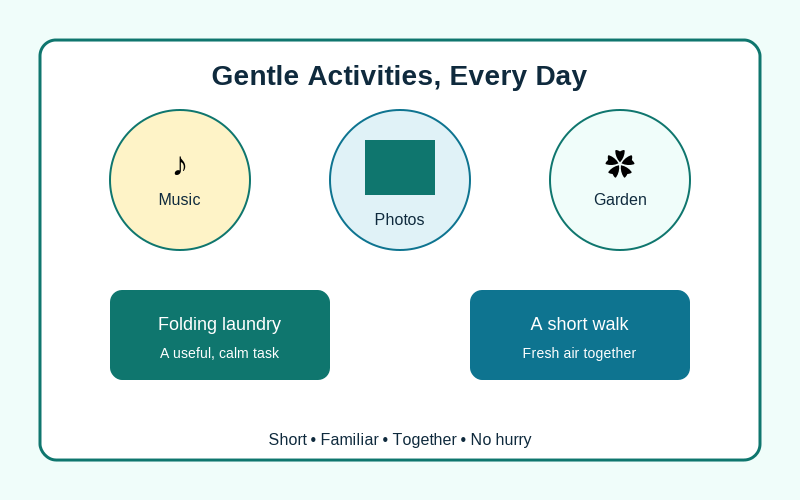
Not every activity needs to be about memory. Sometimes the best activity is a simple, hands-on task that gives your parent something to do with their hands, and a sense of purpose. Folding laundry, sorting photographs, watering a plant, kneading dough, polishing wood, or arranging flowers are all good choices, because they are familiar, they have a clear result, and they can be done slowly. Offer one task at a time, keep it short, and praise the effort rather than the result. The goal is engagement, not achievement.
Match the activity to what your parent can still do, and to what they enjoyed before dementia. A person who gardened all their life may enjoy watering plants, even if they can no longer dig. A person who cooked may enjoy stirring a pot, even if they can no longer follow a recipe. A person who sewed may enjoy folding fabric, even if they can no longer thread a needle. Keep the activity calm, and stop before your parent becomes tired or frustrated. Twenty or thirty minutes, followed by a rest, is often better than an hour that ends in frustration. Our guide to activities that support daily engagement has more ideas, and our guide to exercise and movement ideas for seniors covers gentle physical activity.
When to Ask for Help
Music and reminiscence can bring a great deal of comfort, but they cannot replace medical care, and they cannot solve every problem. If your parent becomes very distressed, very withdrawn, or very agitated, and nothing you try helps, talk to a doctor. A sudden change in mood or behaviour can have a medical cause, and it should be checked promptly. If you are feeling exhausted, or if caring is taking a toll on your own health, talk to your own doctor, tell another family member, and ask for help before you reach breaking point.
There is also professional help available. Some areas have music therapists, reminiscence groups, or dementia cafes where families can meet, sing, and share stories together. A support group can be a lifeline, because it reminds you that you are not alone, and that other families are facing the same challenges. If you would like to explore professional help, read our guide to when to ask for extra help at home and our guide to questions to ask when choosing care support. You can also contact our team to talk through a specific situation in confidence.
Frequently Asked Questions
What if my parent does not respond to music? Not everyone responds to music, and that is normal. Try different songs, at different times of day, at a lower volume. If music does not help, try photographs, objects, or a quiet conversation instead. The right activity is the one your parent enjoys.
Should I play music all day? No. Music is most helpful in short sessions, at calm times of day. A quiet house is also valuable. Ten or fifteen minutes of music, a few times a day, is usually enough.
What if a song makes my parent sad? Sit with the sadness for a moment, acknowledge it kindly, and then offer something else: a different song, a cup of tea, or a walk. Sadness is a real feeling, and it deserves kindness, not avoidance.
Can I correct my parent when they remember something wrong? Usually, it is kinder not to. The feeling matters more than the fact. If the detail does not affect safety, let it go, and enjoy the story as it is told.
When should I ask a doctor about memory or mood changes? If memory problems are new, getting worse quickly, or affecting safety, or if your parent becomes very distressed or withdrawn, talk to a doctor promptly. Only a doctor can assess memory and advise on care.
Sources and Further Reading
This guide draws on the following sources, all accessed 29 November 2026.
- Alzheimer's Association — Facts and Figures, and information on dementia care at home. alz.org/alzheimers-dementia/facts-figures
- National Institute on Aging (NIA) — information on Alzheimer's disease, dementia, and caregiving. nia.nih.gov/health/alzheimers-and-dementia
If this guide helped you, please share it with another family who needs it, and read our other guides on dementia and memory care at home. If you would like to talk about care for your parent, start on our homepage or contact us — a friendly advisor is ready to listen, with no obligation. You can write to us at hello@homecare.biz.id.
Tags: memory care home care, senior activities, dementia care
Last reviewed: 29 June 2026. This guide is general information and is reviewed regularly. It is not a substitute for medical advice. Always talk to a doctor about diagnosis, treatment, or any change to care or medication.