
Home Care for Memory Care: Creating Memory Aids Around the Home
Written by the HomeCare editorial team. Sources: Alzheimer's Association, National Institute on Aging (NIA).
When memory fades, the home itself can help. A label on a drawer, a photograph with a name underneath, a whiteboard with today's plan, a clock that shows the day as well as the time — these simple things answer questions before they are asked. Your parent does not need to remember where the cups are, or what day it is, or what is happening this afternoon, because the home tells them. This guide is written for adult children caring for a parent at home, and it shows how to create memory aids that are simple, kind, and easy to live with. You do not need to buy anything expensive, and you do not need to change the whole house at once.
Memory aids work best when they are made with your parent, not for them. A label your parent helped to write is more likely to be used than one that appears overnight. A photograph your parent chose is more likely to be looked at than one you chose for them. Start with the problems that cause the most daily stress — the lost glasses, the repeated questions about the day, the confusion about which door is the bathroom — and fix one at a time. If you would like the wider picture first, read our complete family guide to dementia care at home and our guide to daily habits that support recall, which explains how steady routines help memory too.
Why Memory Aids Help
Memory aids work because they move the remembering out of the head and into the home. Remembering a new fact is hard for a person with dementia, but reading a word on a door, or looking at a photograph with a name underneath, is much easier. The aid does the remembering, and your parent only needs to look. That is why a parent who cannot tell you what day it is may still follow the day's plan on a whiteboard, or find the bathroom by following a clear sign. The aid turns a memory task into a reading task, and reading a familiar word is often still possible long after recalling a new fact has become hard.
Memory aids also reduce anxiety, for your parent and for you. Much of the distress in dementia comes from not knowing: not knowing where things are, what is happening next, or who the people in photographs are. Every unanswered question adds a little more worry, and worry makes recall harder. A home full of gentle, clear aids answers many of those questions quietly, without anyone having to ask. Your parent feels more confident, because the home itself is helping. And you feel calmer too, because you are not answering the same question for the tenth time that day. The aids do not replace you. They give you both a little more peace, and a little more independence, for longer.
Start Simple, One Room at a Time
Do not try to label the whole house in one weekend. A home suddenly covered in signs can feel strange, even frightening, and it can make your parent feel that they are being treated like a child. Start with one room, and one problem. Which room causes the most confusion? Often it is the kitchen, where there are many cupboards and drawers, or the bathroom, where the door looks like every other door. Spend a few days noticing where your parent hesitates, searches, or asks for help. Those are the places that need an aid.
Choose the simplest aid that solves the problem. A word on a cupboard is often enough. A photograph on a bedroom door can be enough. A single whiteboard in the kitchen can carry the whole day. Make the aid with your parent, if you can, and explain it in one short sentence: "This label says cups, so you can find them easily." Then leave it alone for a week and see whether it is used. If it is, add the next one. If it is not, try a different aid, or a different place. Keep the aids consistent: the same words, the same colours, the same places. When the whole family uses the same aids, your parent does not have to learn a new system every time a different person arrives. Our guide to creating a calm and familiar home has more ideas for arranging rooms so they are easy to read.
Labels That Work
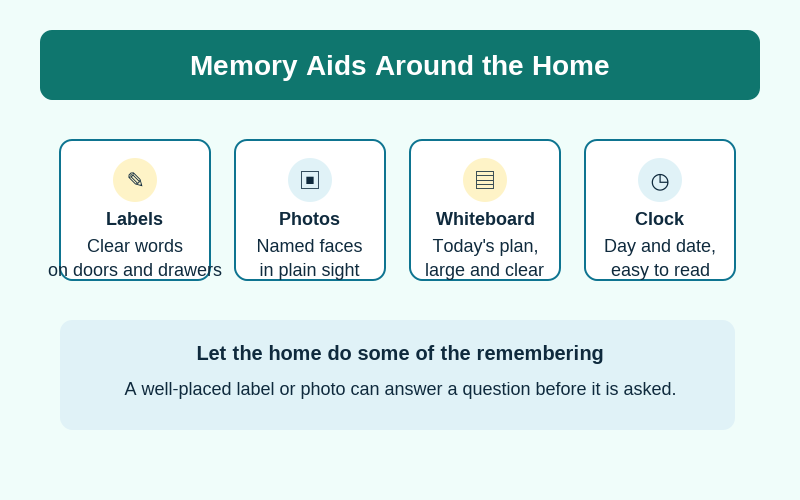
A good label is short, clear, and easy to read. One or two words, in large print, in a dark colour on a light background, at eye level. "Cups." "Plates." "Socks." "Bathroom." Avoid long sentences, small print, and pale colours. A label should be read in a glance, from a step away, without glasses if possible. Use the words your parent uses, not the words a shop would use: if your parent says "the wash room" rather than "the bathroom", label it "wash room". Familiar words are easier to read than correct ones.
Label the things your parent actually looks for. Cupboard doors and drawers are the most useful places: cups, plates, cutlery, towels, socks, underwear, medicines cabinet. Label the outside of the door, not the inside, so the label is seen before the door is opened. Use pictures as well as words where it helps: a simple drawing of a cup next to the word "cups", or a photograph of the contents stuck to the drawer. Keep the number of labels small at first. Too many labels become visual noise, and your parent will stop reading them. Ten well-placed labels are far more useful than fifty. And remember that labels are not only for your parent. They help everyone who comes into the home to help, because they can find things without asking. Our guide to daily habits that support recall explains why the same place for important things matters so much.
Photographs With Names
Photographs are powerful memory aids, because faces and places from the past are often remembered long after recent events are forgotten. A photograph of a grandchild, with their name written underneath in large print, can help your parent recognise someone they love but can no longer name. A photograph of the house where they grew up, or a wedding photograph, can start a conversation and bring back a feeling, even when the details are gone. The key is to add the name. A photograph without a name can cause confusion: "I know this face, but who is it?" A name underneath answers the question quietly.
Choose a small number of photographs, and put them where your parent will see them every day: the living room wall, the bedside table, the hallway. Label each one with a name and, if it helps, a simple relationship: "Sarah, your granddaughter." "Our wedding day, 1972." Use large print, and keep the photographs at eye level. Avoid filling a wall with dozens of photographs, because too many faces become confusing. A few well-chosen photographs, clearly labelled, are better than a crowded display. Photographs can also help with orientation: a photograph of the front door on the inside of the door can remind your parent which way is out, and a photograph of the toilet on the bathroom door can help them find it at night. If a photograph causes distress — for example, a photograph of someone who has died, and your parent asks where they are — remove it gently, and replace it with a photograph that brings comfort.
The Whiteboard: Today's Plan
A whiteboard is one of the most useful memory aids in the home, because it carries the whole day in one place. Put it in the kitchen, or wherever your parent spends most of the morning, at eye level, in good light. Each morning, write the day and the plan in large print: "Tuesday. Breakfast, then a walk. Lunch at twelve. Sarah visits at three." Keep it to three or four lines, in the same format every day. When your parent asks what is happening today, you can point to the board, rather than repeating the answer. Over time, your parent may start to look at the board themselves, and that is a real step towards independence.
Keep the whiteboard simple and up to date. Cross off things as they happen, so the board always shows what is next, not what is past. Use the same words each day, so the format itself becomes familiar. Avoid writing too much: a crowded board is hard to read, and your parent will stop looking at it. If a whiteboard feels too much like an office, use a large-print sheet of paper on the fridge, or a chalkboard, instead. The tool does not matter. What matters is that the day's plan is written down, in large print, in one place, where your parent can see it. Our guide to helping with appointments and daily tasks shows how a shared calendar and a written plan work together.
Clocks and Calendars
Knowing what day it is, and what time it is, is one of the hardest things for a person with dementia, and one of the most important. A clock that shows only numbers can be confusing, because it does not say whether it is morning or evening, or which day it is. A better aid is a clock that shows the day, the date, and whether it is morning, afternoon, or evening, in large, clear words. Put one in the bedroom and one in the living room, where your parent can see it without getting up. Some families use a simple digital clock with the full date; others use a large wall calendar with one day per page, and cross off each day as it passes.
Keep the calendar simple. A large-print wall calendar, with one month per page and plenty of space to write, is usually enough. Write appointments and visits on it in large print, in the same colour, and talk through the week together on Sunday evening or Monday morning. Avoid filling the calendar with too many entries, because a crowded calendar is hard to read. And keep the calendar in the same place, so your parent always knows where to look. If your parent keeps asking what day it is, answer kindly and point to the clock or calendar, rather than testing them. "It is Tuesday, see, here on the clock." The aid does the remembering, and you are simply pointing to it. Our guide to sleep support and nighttime routine explains why a steady sense of day and night matters for sleep too.
Memory Aids in the Kitchen
The kitchen is the room where memory aids are often most needed, because it has the most cupboards, the most objects, and the most steps to remember. Start with labels on the cupboard doors: cups, plates, cutlery, food, cleaning things. Keep the most-used items at eye level, in the same place, so your parent does not need to search. A simple step-by-step card on the wall can help with a familiar task: "Tea: 1. Fill the kettle. 2. Switch it on. 3. Put a tea bag in the mug. 4. Pour the water." Keep the steps short, in large print, with one step per line. Your parent may not follow the card every time, but it is there when they need it.
Safety matters in the kitchen too, and memory aids can help. A clear sign on the stove — "Turn off after use" — can remind your parent at the moment it matters. Keeping the stove area clear, and using the same pan in the same place, reduces the chance of a mistake. If cooking has become unsafe, the kindest aid is to change the task, not to add more signs: prepare simple meals together, or use foods that need little cooking. Keep a glass of water within reach, and offer drinks often, because thirst is easy to forget. Our guide to mealtime help and nutrition tips covers safe eating habits, and our guide to nutrition tips for brain health at home covers food in detail. If you are worried about safety in the kitchen, talk to a doctor, and read our guide to creating a calm and familiar home.
Bathroom and Bedroom
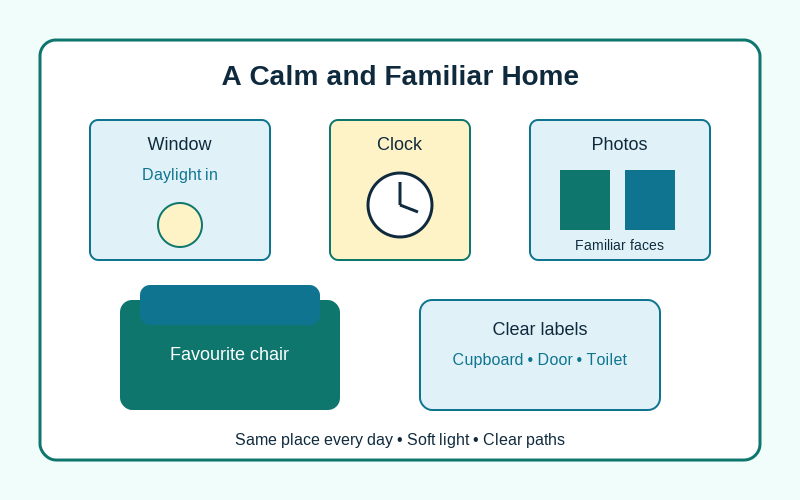
The bathroom needs clear, simple aids, because it is used at night as well as during the day, often when your parent is tired or half asleep. Label the bathroom door clearly, with the word "Bathroom" or "Toilet" in large print, and consider a picture as well as a word. Inside, keep the layout the same: soap, towel, and toothbrush in the same places. A simple card with the steps for washing can help: "1. Wash hands. 2. Brush teeth. 3. Wash face." Use a night light in the hallway and bathroom, so your parent can find the toilet without waking the whole house, and keep a clear path from the bed to the bathroom, with nothing to trip over.
In the bedroom, the most useful aids are the ones that help your parent find their way in the morning and at night. Lay clothes out in the order they are put on, on the same chair or bed, each night. Label the drawers: socks, underwear, shirts, trousers. Keep a photograph or a familiar object by the bed, so your parent wakes to something they recognise. A clock that shows the day and whether it is morning or night can stop the confusion of waking at 3 a.m. and thinking it is time to get up. If your parent gets up at night, a calm, brief response — a toilet visit, a drink of water, a reassuring word, and then back to bed — is usually enough. Our guide to safe bathing and personal care has more ideas for keeping washing and dressing dignified and calm.
The Front Door and Going Out
The front door deserves special attention, because it is where safety and independence meet. A clear sign on the inside of the door — "Keys here" with a hook underneath — helps your parent find what they need before going out. A small tray by the door for keys, wallet, and phone, always in the same place, prevents the daily search. If your parent sometimes tries to leave the house at night, or gets lost when they go out, talk to a doctor about what help is needed, and consider simple aids: a door alarm that sounds when an outside door opens, or a card in a pocket with your parent's name and your phone number, in case they need help while out.
Going out is important, and memory aids should support it, not prevent it. A short, familiar walk, at the same time each day, with the same route, is good for mood, appetite, and sleep. Keep the route simple, and walk it together at first, so it becomes familiar. If your parent wants to go out alone, agree together where they will go, and how long they will be, and make sure they carry a phone and a card with your number. A small notebook in a pocket, with the home address and your number written in large print, can be a quiet safety net. If wandering has become a worry, read our guide to managing sundowning at home and our guide to safe driving decisions and transport options, and talk to a doctor about the safest plan.
When to Change the Aids
Memory aids need to change as dementia changes. A label that helped last year may no longer be read, or a whiteboard that was once followed may now be ignored. When that happens, it is not a failure. It means the dementia has moved on, and the aids need to change with it. Simplify further: fewer words, larger print, more pictures, fewer steps. A photograph may work when a word no longer does. A spoken reminder may work when a written one no longer does. Watch what your parent actually uses, and keep those aids. Remove the ones that are ignored, because too many unused aids become visual noise, and your parent will stop looking at all of them.
Review the aids every few months, and after any change: a move, a hospital stay, a new helper, a bad winter. Ask yourself three questions: does my parent use this aid? Does it make the day easier? Does it keep them safe? If the answer is yes, keep it. If the answer is no, change it or remove it. And remember that aids are not only for your parent. They help everyone who comes into the home to help, because they can find things, follow the day, and understand the plan without asking. Share the aids with family, friends, and professional caregivers, so the same system works whoever is there. If you would like help setting up memory aids, you can contact our team or read more about who we are and how we work.
Frequently Asked Questions
How many labels should I put up? Start with ten or fewer, in the places that cause the most confusion. Well-placed labels are far more useful than a house covered in signs. Add more only if the first ones are used.
Will labels make my parent feel like a child? They can, if they appear overnight without explanation. Make the aids with your parent, explain them in one short sentence, and use the words your parent uses. A label is a tool, not a judgement.
What if my parent ignores the whiteboard? Try a different place, larger print, or fewer words. Some people prefer a paper sheet on the fridge, or a spoken reminder. The tool does not matter, as long as the day's plan is written down somewhere your parent can see it.
Are photographs with names a good idea? Yes, for most families. A name underneath a photograph answers the question "who is this?" quietly, without anyone having to ask. If a photograph causes distress, remove it gently and replace it with one that brings comfort.
When should I ask a doctor about memory aids? If memory problems are new, getting worse quickly, or affecting safety — getting lost, leaving the stove on, forgetting to eat or drink — talk to a doctor promptly. Only a doctor can assess memory and advise on care.
Sources and Further Reading
This guide draws on the following sources, all accessed 29 November 2026.
- Alzheimer's Association — Facts and Figures, and information on dementia care at home. alz.org/alzheimers-dementia/facts-figures
- National Institute on Aging (NIA) — information on Alzheimer's disease, dementia, and caregiving. nia.nih.gov/health/alzheimers-and-dementia
If this guide helped you, please share it with another family who needs it, and read our other guides on dementia and memory care at home. If you would like to talk about care for your parent, start on our homepage or contact us — a friendly advisor is ready to listen, with no obligation. You can write to us at hello@homecare.biz.id.
Tags: memory care home care, dementia home care, home safety
Last reviewed: 28 June 2026. This guide is general information and is reviewed regularly. It is not a substitute for medical advice. Always talk to a doctor about diagnosis, treatment, or any change to care or medication.