
Home Care for Memory Care: Exercise and Movement Ideas for Seniors
Written by the HomeCare editorial team. Sources: Alzheimer's Association, National Institute on Aging (NIA).
Movement is one of the simplest ways to look after an older person at home, and one of the most often overlooked. A short walk, a few gentle stretches, or a little gardening can lift mood, help sleep, improve appetite, and keep the body strong enough to do everyday tasks. For a person with dementia, movement also gives the day shape, and it gives the mind something calm to focus on. This guide is written for adult children caring for a parent at home, and it shows how to build gentle, safe movement into the day. You do not need special equipment, and you do not need to be fit yourself.
The ideas in this guide are gentle, everyday activities: walking, stretching, balance practice, and small household tasks. They are not a treatment for dementia, and they are not a substitute for medical advice. If your parent has a medical condition, a heart problem, difficulty breathing, or a history of falls, talk to a doctor before starting any new activity. If you would like the wider picture first, read our complete family guide to dementia care at home and our guide to activities that support daily engagement, which covers gentle daily activities in more detail.
Why Movement Matters
Movement matters because the body and the mind work together. When an older person moves regularly, even a little, they sleep better, eat better, and feel calmer. Their muscles stay stronger, which makes it easier to stand up, walk to the bathroom, and climb stairs safely. Their balance improves, which makes falls less likely. And their mood lifts, because movement brings fresh air, daylight, and a sense of achievement, however small. For a person with dementia, who may spend much of the day sitting, even a short walk can change the whole afternoon.
Movement also gives the day a shape. A walk after breakfast, a stretch before lunch, a turn in the garden in the afternoon: these small, regular activities break the day into parts, and they give your parent something to look forward to. They also give you something to share. A walk together is a conversation, a pleasure, and a break from the daily tasks of care. The goal is not fitness, and it is not a target to reach. It is a little movement, every day, at a pace your parent enjoys, in a place that feels safe. A little, often, is far better than a lot, once.
Start Small, Every Day
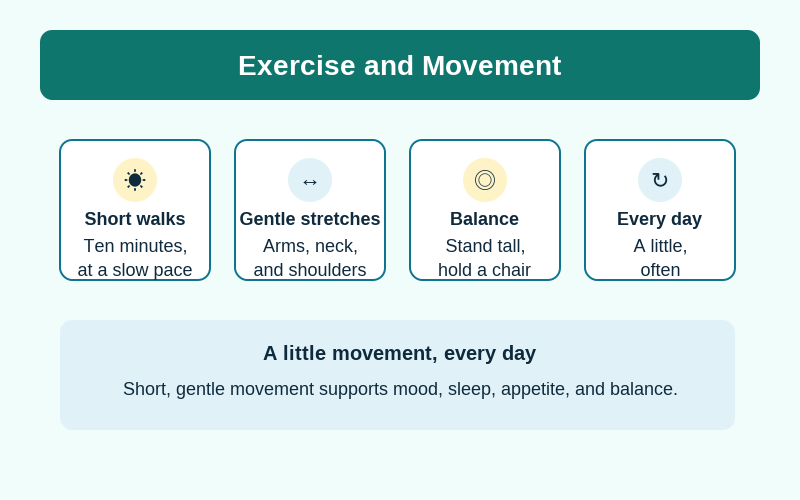
Do not start with a big plan. Start with one small activity, at the same time each day, and keep it going for a week. A ten-minute walk after breakfast, or a few gentle stretches before lunch, is enough to begin. When the habit feels settled, add a little more: a longer walk, or a second activity in the afternoon. Small, regular movement is far more useful than an ambitious plan that is abandoned after a week. And it is far safer, because the body adapts gradually, and your parent learns what they can do without becoming tired or frightened.
Choose the time of day when your parent has the most energy. For many people with dementia, that is the morning, when sleep has cleared some of the tiredness and the house is quiet. Avoid starting a new activity when your parent is tired, hungry, or distressed, because it will feel like a demand, not a pleasure. Keep the activity short at first: ten minutes is enough. Stop before your parent becomes tired, and praise the effort, not the distance or the speed. "That was a lovely walk" is better than "We only walked for ten minutes." If your parent resists, do not push it into a battle. Try again tomorrow, or try a different activity. Our guide to daily habits that support recall explains how a steady rhythm through the day supports movement too.
Walking: The Simplest Exercise
Walking is the simplest exercise of all, and one of the best. It needs no equipment, it can be done anywhere, and it can be as short or as long as your parent wishes. A slow walk around the garden, to the end of the street and back, or around a local park can be enough. Fresh air and daylight help the body clock, and gentle movement can improve mood and appetite. Walk at your parent's pace, not yours, and choose a familiar route, so your parent does not have to think about where they are going. If walking is difficult, sitting in the garden or by an open window can give some of the same benefit.
Make walking a habit, not a chore. Walk at the same time each day, on the same route, so it becomes part of the day rather than a special event. Wear comfortable shoes, and bring water. If your parent uses a walking stick or a frame, make sure it is in good condition, and that the route is flat, with places to sit and rest. Avoid busy roads, uneven pavements, and steep hills. If the weather is bad, walk indoors: around the house, up and down the hallway, or in a shopping centre. A short walk, every day, is worth more than a long walk once a week. And a walk together is a pleasure in itself: a conversation, a shared moment, and a break from the house. Our guide to safe driving decisions and transport options has more ideas for getting out and about safely.
Gentle Stretches at Home
Gentle stretches can be done at home, in a chair, with no equipment, and they can help with stiffness, circulation, and comfort. Keep them simple, and keep them slow. Shoulder rolls: lift the shoulders up, back, and down, five times, slowly. Neck turns: turn the head gently to the left, then to the right, holding for a few seconds each way. Arm raises: lift both arms above the head, hold for a few seconds, then lower them slowly. Ankle circles: lift one foot slightly, and circle the ankle slowly, five times each way, then change feet. Finger stretches: open and close the hands slowly, five times.
Do the stretches together, at the same time each day, perhaps after breakfast or before lunch. Sit in a sturdy chair, with your feet flat on the floor, and keep the movements slow and gentle. Never force a stretch, and stop if it hurts. If your parent has arthritis, or another condition that affects joints, talk to a doctor before starting new stretches. Keep the session short: five or ten minutes is enough. A few gentle stretches, every day, can make a real difference to comfort and mobility, and they can be a calm, shared moment in the day. If you would like more ideas for gentle activities, read our guide to activities that support daily engagement.
Balance and Staying Steady
Balance becomes harder with age, and harder still with dementia, and a fall can have serious consequences. Gentle balance practice, done safely, can help your parent stay steady on their feet. The simplest practice is standing: stand behind a sturdy chair, hold the back with both hands, and lift one foot slightly off the floor, holding for a few seconds, then change feet. As balance improves, try holding with one hand, then with fingertips only, always with the chair within reach. Never practise balance without something sturdy to hold, and never practise alone if your parent is unsteady.
Balance is also helped by the home itself. Keep the floor clear, the rug flat or removed, and the way to the kitchen and the toilet obvious. Use good lighting, especially at night, and keep a night light in the hallway and bathroom. Wear shoes that fit well, with low heels and non-slip soles, and avoid loose slippers or socks on smooth floors. If your parent has fallen, or is falling often, talk to a doctor promptly, because falls can have a medical cause, and because a fall can be frightening enough to make your parent afraid to move at all. Our guide to preparing the home for changing needs has more ideas for a safer home, and our guide to creating a calm and familiar home covers lighting and clear paths.
Gentle Strength, Using the Body
Strength matters for everyday tasks: standing up from a chair, climbing stairs, carrying a bag, or getting out of bed. Gentle strength practice, using the body itself, can help your parent keep doing these things for longer. The simplest practice is standing up and sitting down: from a sturdy chair, with arms if needed, stand up slowly, hold for a moment, and sit down again, five times, with a rest in between. As strength improves, try it with less help from the arms. Another simple practice is marching on the spot: lift the knees gently, one at a time, holding a chair for balance, for a minute or two.
Everyday tasks are also strength practice. Folding laundry, watering a plant, kneading dough, or carrying a light shopping bag all use muscles, and they have a clear result, which makes them more enjoyable than an exercise done for its own sake. Offer one task at a time, keep it short, and praise the effort. Never push your parent to lift anything heavy, and stop if they are breathless, in pain, or dizzy. If your parent has a heart problem, difficulty breathing, or another medical condition, talk to a doctor before starting any new activity. Strength practice should feel like a gentle effort, not a struggle, and it should always be done with someone nearby.
Movement Through the Day
Movement does not need to be a separate activity. It can be built into the day, in small pieces, so that your parent moves a little, often, without ever thinking of it as exercise. A short walk after breakfast, a stretch before lunch, a turn in the garden in the afternoon, a few steps to the kitchen to help with tea: these small movements add up over the day, and they are often easier to keep going than a formal exercise session. The key is to build movement into the routine, at the same times each day, so it becomes part of the day rather than an extra task.
Look for chances to move that your parent will enjoy. A walk to the shops, a visit to a friend, a turn in the garden, or a dance to a favourite song in the kitchen are all movement, and they are all pleasures too. Avoid long periods of sitting still, especially in front of the television, because sitting still for hours makes stiffness worse, and it makes the next movement harder. A short break every hour — a stand, a stretch, a walk to the kitchen for a drink — is enough to keep the body moving. Our guide to daily habits that support recall explains how a steady rhythm through the day supports movement, and our guide to music and reminiscence activities at home has ideas for dancing and singing together.
Making Movement Enjoyable
Movement works best when it is enjoyable, and it is most likely to be kept going when your parent looks forward to it. Choose activities your parent enjoyed before dementia, and simplify them, rather than introducing something entirely new. A person who gardened all their life may enjoy watering plants, even if they can no longer dig. A person who danced may enjoy swaying to a favourite song in the kitchen. A person who walked a dog may enjoy a short walk with a family member. The activity matters less than the pleasure it brings.
Do the activity together, whenever you can. A walk alone is exercise. A walk together is a conversation, a pleasure, and a shared moment. Keep the activity short, and stop before your parent becomes tired or frustrated. Twenty or thirty minutes, followed by a rest, is often better than an hour that ends in exhaustion. Praise the effort, not the distance or the speed. And if your parent does not want to move today, do not push it into a battle. Try again tomorrow, or try a different activity. A day without movement is not a failure. It is simply a day to rest, and to try again tomorrow.
When to Be Careful
Movement is good, but it needs care, especially for an older person with dementia. Stop the activity and talk to a doctor promptly if your parent becomes breathless, has chest pain, feels dizzy or faint, or is in pain. Do not start a new activity if your parent is unwell, has a fever, or has just come home from hospital, without talking to a doctor first. Avoid exercise in very hot weather, or when your parent is dehydrated, because heat and dehydration can make confusion worse. Keep water within reach, and offer drinks often, especially during and after movement.
Be careful, too, with the environment. Avoid uneven ground, wet floors, and cluttered rooms. Use good lighting, and wear shoes that fit well, with low heels and non-slip soles. Never leave your parent to exercise alone if they are unsteady, or if they have a history of falls. And remember that a fall, however small, should be taken seriously. If your parent falls, talk to a doctor, even if they seem unhurt, because a fall can have a medical cause, and because it can make your parent afraid to move again. Our guide to preparing the home for changing needs has more ideas for a safer home.
Asking for Help With Movement
You do not need to handle movement alone. Other family members can walk with your parent, or take them to a local group, and a regular arrangement — a daughter on Tuesdays, a neighbour on Saturdays — is better than asking for help at the last minute. Some areas have exercise groups, walking groups, or day centres for older people, and it is worth asking your local council or support service what is available. A group can be a pleasure in itself, because it gives your parent company, and it gives you a break.
There is also professional help available. A doctor can advise on what activity is safe for your parent, and a physiotherapist can suggest exercises that match your parent's abilities. If you would like to explore professional help, read our guide to when to ask for extra help at home and our guide to questions to ask when choosing care support. You can also contact our team to talk through a specific situation in confidence, or read more about who we are and how we work.
Frequently Asked Questions
How much exercise does an older person need? A little, every day, is far better than a lot, once. Ten minutes of walking, a few gentle stretches, or a turn in the garden, every day, is a good start. Build up slowly, and stop before your parent becomes tired.
What if my parent does not want to move? Do not push it into a battle. Try a different activity, or try again tomorrow. A walk together, a favourite song, or a small household task is often more appealing than an exercise done for its own sake.
Is walking enough exercise? For most older people, walking is one of the best exercises there is. It is simple, safe, and enjoyable, and it supports mood, sleep, appetite, and balance. A short walk every day is a very good habit.
What if my parent falls? Talk to a doctor, even if they seem unhurt, because a fall can have a medical cause. Keep the home clear and well lit, use good shoes, and never leave your parent to exercise alone if they are unsteady.
When should I ask a doctor about exercise? Before starting any new activity, if your parent has a heart problem, difficulty breathing, a history of falls, or another medical condition. Only a doctor can advise on what activity is safe.
Sources and Further Reading
This guide draws on the following sources, all accessed 29 November 2026.
- Alzheimer's Association — Facts and Figures, and information on dementia care at home. alz.org/alzheimers-dementia/facts-figures
- National Institute on Aging (NIA) — information on Alzheimer's disease, dementia, and caregiving. nia.nih.gov/health/alzheimers-and-dementia
If this guide helped you, please share it with another family who needs it, and read our other guides on dementia and memory care at home. If you would like to talk about care for your parent, start on our homepage or contact us — a friendly advisor is ready to listen, with no obligation. You can write to us at hello@homecare.biz.id.
Tags: memory care home care, senior exercise, dementia home care
Last reviewed: 29 June 2026. This guide is general information and is reviewed regularly. It is not a substitute for medical advice. Always talk to a doctor about diagnosis, treatment, or any change to care or medication.