
Home Care for Memory Care: Daily Habits That Support Recall
Written by the HomeCare editorial team. Sources: Alzheimer's Association, National Institute on Aging (NIA).
If you are caring for a parent whose memory is fading, you may notice that the same question comes back again and again: what day is it, where are the keys, what happens next? It is easy to feel that memory is simply slipping away, and that nothing you do can slow it. But memory is not one single thing, and daily habits can support the parts that remain. A steady routine, a familiar place for important things, and a gentle cue at the right moment can help your parent find what they need without having to remember it from scratch. This guide is written for adult children caring for a parent at home, and it shows how small, repeated habits can make recall easier, day after day.
You do not need special training, and you do not need to change everything at once. The habits in this guide are ordinary: waking at the same time, eating at the same table, keeping glasses in the same drawer, saying the day's plan out loud. What makes them powerful is repetition. When the same things happen in the same order, the body and the home remember the pattern, even when the mind cannot name it. If you would like the wider picture first, read our complete family guide to dementia care at home and our daily routine guide for families, which cover the whole day in more detail.
Why Daily Habits Help Recall
Memory works in more than one way. Remembering a new fact, such as an appointment next Tuesday, is hard for a person with dementia, because that kind of memory is often affected early. But remembering a habit — how to brush teeth, where the tea cups live, the way to the bathroom — is different. Habits live in a part of the brain that often stays working longer, and they are held by repetition rather than by thinking. That is why your parent may forget what you told them five minutes ago, yet still make a cup of tea in exactly the same way they always have. A habit does not need to be recalled. It only needs to be started, and then the body follows the familiar steps.
This is good news for families, because habits are something you can build together, one small step at a time. When you keep the day in the same order, you are giving your parent fewer new things to remember. When you keep important objects in the same place, you are removing the need to remember where they are. And when you give a gentle cue — a word, a picture, a familiar song — you are offering a bridge to the memory, rather than asking your parent to cross the gap alone. None of this will restore memory that has been lost. But it can make the memory that remains work better, and it can make the day calmer for everyone. A parent who can find their own glasses, follow the morning routine, and know what is happening next feels more confident, and a confident parent is usually a calmer one.
The Same Time, Every Day
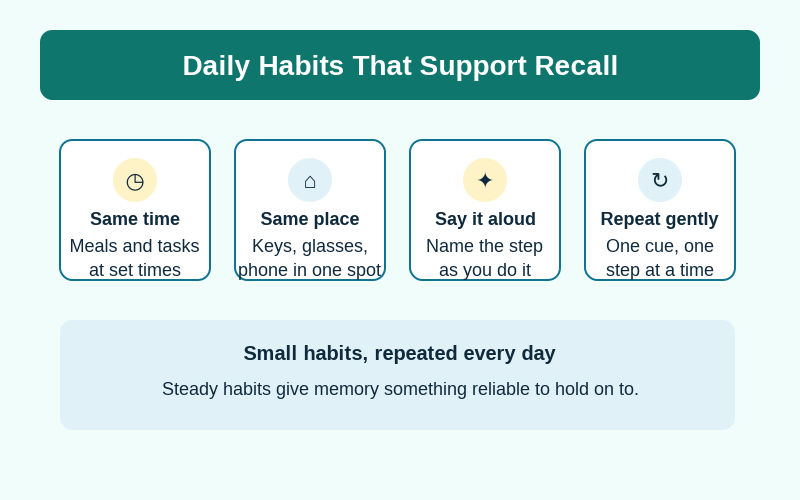
The simplest habit of all is keeping the same times. Wake at the same time, eat at the same time, walk at the same time, and go to bed at the same time. When the day has a steady rhythm, your parent does not need to remember what happens next, because the time itself tells them. The morning light means washing and breakfast. The afternoon quiet means tea and a rest. The evening dark means dinner and bedtime. A regular rhythm also helps the body clock, which supports sleep, appetite, and mood, and it makes the day easier for everyone who helps with care, because the same plan works whoever is there.
Start with one anchor time, not a whole new timetable. Choose the part of the day that causes the most confusion — often the morning, or the evening — and make only that part steady for a week. Set the wake time, open the curtains, and follow the same steps in the same order: wash, dress, breakfast, at the same table. When that feels settled, add the next anchor. Write the times down where everyone can see them, on a whiteboard or a large-print sheet, and keep them the same on weekends too, as far as you can. If the day slips — a late night, a visitor, a bad day — do not worry. Return to the usual times the next day. The habit is the pattern over weeks, not perfection on any single day. Our guide to building a calm daily routine walks through the whole day, hour by hour.
The Same Place for Important Things
Few things cause more daily distress than losing something small and important: glasses, keys, a wallet, a hearing aid, a phone. For a person with dementia, searching for a lost object is not a minor annoyance. It can feel frightening, because the object has vanished from a mind that cannot retrace its steps. The habit that prevents this is simple: everything important lives in the same place, always. Glasses go in the same drawer. Keys go on the same hook by the door. The phone charges on the same table. The wallet stays in the same bag. When the place never changes, your parent does not need to remember where the object is. They only need to remember the place, and the place never moves.
Choose the places together, and make them obvious. A bright tray by the front door for keys and wallet, a small bowl on the bedside table for glasses, a hook at shoulder height for a coat. Label the place if it helps, with a word or a picture. Then guard the habit gently: when you find the glasses on the kitchen table, put them back in their place, and say so, kindly. "Glasses in the drawer, Mum." Over time, the place becomes the memory. This habit also helps you. When you arrive to help, you know where everything is, and you do not spend the morning searching. It is worth doing the same for the things your parent uses every day: the same mug, the same chair, the same coat, the same bag. Familiar objects, in familiar places, are easier to find and easier to use. Our guide to creating memory aids around the home has more ideas for labels, photographs, and simple tools.
Say It Aloud as You Do It
One of the most useful habits is also the simplest: say what you are doing, out loud, as you do it. "I am putting your coat on the hook." "We are having lunch now, then a rest." "Your glasses are in the drawer." Spoken out loud, an ordinary action becomes a cue. Your parent hears the words, sees the action, and the two together make the moment easier to follow and easier to remember later. This is sometimes called narrating the day, and it works best when it is calm, short, and unhurried. One sentence at a time, in a warm voice, with no rush.
Saying things aloud also helps you, because it slows you down. When you narrate, you cannot rush through a task in silence while your parent is left wondering what is happening. It also gives your parent a chance to join in: "Yes, the blue coat." "Lunch, then a rest." If your parent asks the same question again, answer it again, in the same words. Repetition is not failure. It is the cue working. Avoid the temptation to say "I already told you" or "You just asked that." Those words add shame to confusion, and shame makes recall harder, not easier. A calm, repeated answer costs you a few seconds and saves your parent a great deal of distress. Our guide to communicating with calm and patience has more ideas for keeping conversation kind and easy.
Gentle Repetition, Not Testing
Repetition helps memory, but testing does not. There is an important difference. Gentle repetition means offering the same cue again, in the same kind words: "Today is Tuesday, and we are having lunch at twelve." Testing means asking your parent to prove what they remember: "What day is it? Who is this? What did we do yesterday?" Testing puts your parent on the spot, and when they cannot answer, it brings embarrassment and anxiety. Anxiety makes recall worse, so testing often achieves the opposite of what a family intends. If you want to know whether your parent remembers something, watch what they do, rather than asking them to perform.
Instead of testing, repeat the useful information yourself, as part of the day. Say the day and the plan in the morning, repeat it at lunch, and repeat it again before an outing. Put it on the whiteboard where your parent can see it. Use the same words each time, so the words themselves become familiar. When your parent does remember something — a name, a song, a story from long ago — notice it warmly, and let them enjoy it. Do not immediately ask a harder question. Enjoyment is the point. The goal of repetition is not to measure memory. It is to make the day easier to live in, and to give your parent as many successful moments as possible. A day with many small successes is a good day, whatever the score on any test would be.
Morning Habits That Set the Day
Mornings are often the best time of day for a person with dementia, because sleep has cleared some of the tiredness and the house is quiet. That makes the morning the best time to build habits that support recall for the rest of the day. Start with the same wake time, open the curtains to let in daylight, and greet your parent by name, in a warm voice. Say the day and the plan in one or two short sentences: "Good morning, Mum. It is Tuesday. We will have breakfast, then a walk." A whiteboard with the day's plan, written in large print, can carry the message through the morning, so your parent can look at it whenever they forget.
Break the morning into small steps, one at a time, in the same order each day. Lay clothes out in the order they are put on, and offer a simple choice where you can: "the blue shirt or the green one?" Keep breakfast at the same table, at the same time, with the same simple foods. If your parent resists a task, do not push it into a battle. Try again a little later, or try a different approach: a wash at the sink instead of a shower, or breakfast in the garden instead of the kitchen. The habit that matters is the steady order of the morning, not any single task done perfectly. Our guide to safe bathing and personal care has more ideas for mornings when washing is hard, and our guide to nutrition tips for brain health at home covers food in detail.
Mealtime Habits
Meals are one of the best places to build habits that support recall, because they happen several times a day and they follow the same shape each time. Keep meals at the same times, at the same table, with the same simple pattern: a drink, a main plate, a little fruit or pudding. Sit together, eat slowly, and keep the table calm. Offer one course at a time, and use the same words: "Lunch now. Soup first, then bread." When the pattern is steady, your parent does not need to remember what a meal is or how it works. The table, the time, and the smell of food tell them.
Small habits around food help in other ways too. Keep a glass of water within reach all day, and offer drinks often, because thirst is easy to forget and easy to miss. Use the same mug and the same plate, so they are familiar. If your parent forgets they have eaten, or asks for another meal, answer kindly and offer a small snack or a drink rather than arguing. If they forget to eat, a regular time and a familiar table are more helpful than reminders. Keep a short note of what was eaten and drunk, so you can tell a doctor if appetite or weight changes. Our guide to mealtime help and nutrition tips covers safe eating habits and hydration in more detail.
Evening Habits and Winding Down
Evenings are often the hardest part of the day, because tiredness grows and confusion can increase as the light fades. A steady evening habit is one of the best tools you have, because it gives the evening a shape before the difficulty starts. Begin winding down an hour or two before sunset: turn the lights on before it gets dark, close the curtains, put on familiar music, and offer a warm drink and a light snack. Keep dinner at the same time, at the same table, and keep it simple. After dinner, a quiet activity — a photograph album, a familiar song, or simply sitting together — can help the evening feel settled.
Keep the bedtime steps the same each night: a warm drink, a wash, night clothes, a short, calm conversation, and lights out. A familiar object by the bed — a photograph, a blanket, a favourite book — can help your parent feel safe in the dark. If restlessness happens, stay calm. Do not argue or raise your voice. Acknowledge the feeling, offer a simple reassurance, and gently redirect: "I can see you are worried. I am here with you. Let us sit in the kitchen and have some tea." Avoid visitors, outings, and difficult conversations late in the day. Our guide to managing sundowning at home covers difficult evenings in detail, and our guide to sleep support and nighttime routine has more ideas for safer, calmer nights.
Cues and Prompts That Work
A cue is a small hint that helps your parent find a memory or start a task. The best cues are simple, specific, and kind. A word: "Your coat is on the hook." A picture: a photograph of a grandchild on the wall. A sound: a favourite song before a walk. An object: a shopping list in a familiar notebook. A cue works when it gives just enough help, and no more. Too much help takes away the chance to do it alone. Too little leaves your parent stuck. The right cue is the smallest one that works, offered calmly, with time to respond.
Watch which cues help your parent, and use those again. Some people respond best to words, some to pictures, some to music, some to touch. If a cue does not work, try a different one, rather than repeating the same cue more loudly. And remember that a cue is not a test. Do not ask "What is this for?" or "Do you remember what this is?" Instead, offer the answer inside the cue: "Here is your blue coat, for our walk." Keep cues consistent: the same words, the same pictures, the same places. When the whole family uses the same cues, your parent does not have to learn a new system every time a different person arrives. Write the useful cues down, and share them with everyone who helps with care. Our guide to creating memory aids around the home has more ideas for labels, photographs, and simple tools that work as cues.
When Habits Stop Working
Habits help for a long time, but dementia changes, and a habit that worked last year may stop working. Your parent may forget the morning steps, lose the thread of a task halfway through, or no longer recognise the whiteboard. When that happens, it is not a failure, and it is not your fault. It means the dementia has moved on, and the habits need to change with it. Simplify further: fewer steps, more help, more cues. Break tasks into even smaller pieces. Offer one step at a time, and do the harder parts together. If the morning routine has become too much, keep only the most important parts: waking, eating, drinking, and a little fresh air.
A sudden change is different from a slow one. If your parent is much more confused than usual, cannot be woken, has a fever, has fallen, or is in pain, talk to a doctor promptly. A sudden worsening can have a cause that needs medical attention, and it should not be waited out as a bad day. Keep a short daily note — sleep, appetite, mood, any incidents — so you can tell a doctor what has changed, and when. And when habits need more support than one family can give, it is time to ask for extra help, before you reach breaking point. Our guide to when to ask for extra help at home explains the signs, and our guide to questions to ask when choosing care support can help you compare options. You can also contact our team to talk through a specific situation in confidence.
Frequently Asked Questions
Can daily habits really help memory? Habits do not restore lost memory, but they can make the memory that remains work better. A steady routine, familiar places, and gentle cues mean your parent has less to remember from scratch, and more chances to succeed at everyday tasks.
How long does it take for a new habit to settle? Give a new habit at least a week, and change only one thing at a time. Small, repeated steps, kept steady for a week or two, are far more likely to settle into a pattern than a big change made all at once.
What if my parent resists the routine? Do not turn it into a battle. Offer a choice, try again a little later, or try a different approach. If refusal becomes frequent, talk to a doctor, because pain, fear, or discomfort may be part of the problem.
Should I correct my parent when they forget? Gentle, kind correction is usually better than arguing, but often the kindest response is to offer the answer inside the conversation, rather than pointing out the mistake. "Yes, it is Tuesday, and we are having lunch now" is kinder than "You already asked that."
When should I ask a doctor about memory changes? If memory problems are new, getting worse quickly, or affecting safety — getting lost, leaving the stove on, forgetting to eat or drink — talk to a doctor promptly. Only a doctor can assess memory and advise on care.
Sources and Further Reading
This guide draws on the following sources, all accessed 29 November 2026.
- Alzheimer's Association — Facts and Figures, and information on dementia care at home. alz.org/alzheimers-dementia/facts-figures
- National Institute on Aging (NIA) — information on Alzheimer's disease, dementia, and caregiving. nia.nih.gov/health/alzheimers-and-dementia
If this guide helped you, please share it with another family who needs it, and read our other guides on dementia and memory care at home. If you would like to talk about care for your parent, start on our homepage or contact us — a friendly advisor is ready to listen, with no obligation. You can write to us at hello@homecare.biz.id.
Tags: memory care home care, dementia home care, senior care
Last reviewed: 28 June 2026. This guide is general information and is reviewed regularly. It is not a substitute for medical advice. Always talk to a doctor about diagnosis, treatment, or any change to care or medication.