
Home Care for Memory Care: Helping with Appointments and Daily Tasks
Written by the HomeCare editorial team. Sources: Alzheimer's Association, National Institute on Aging (NIA).
Appointments and daily tasks are where memory problems show up most clearly. A doctor's visit next Tuesday, a prescription to collect, a bill to pay, a grandchild visiting on Saturday — each one needs to be remembered, planned for, and carried out in the right order. For a person with dementia, that chain is easily broken. A date is forgotten, a step is missed, or the whole plan simply slips away. This guide is written for adult children caring for a parent at home, and it shows how to help with appointments and daily tasks using simple tools: one calendar, gentle reminders, and a written plan. You do not need complicated systems, and you do not need to do everything yourself.
The goal is not to take over your parent's life. It is to give them the support they need to keep doing as much as they can, for as long as they can. A shared calendar, a reminder at the right moment, and a short note after a visit can make the difference between a day that works and a day that falls apart. Start with the appointments that matter most, and build the system one step at a time. If you would like the wider picture first, read our complete family guide to dementia care at home and our guide to daily habits that support recall, which explains how steady routines help memory too.
Why Planning Helps
Planning helps because it moves the remembering out of the head and onto paper. Remembering a future event — a doctor's appointment, a visit, a bill — is one of the hardest things for a person with dementia, because it needs a kind of memory that is often affected early. But following a written plan is much easier. When the appointment is written on the calendar, and the calendar is in the same place every day, your parent does not need to remember the date. They only need to look. When the steps for the day are written down, one at a time, your parent does not need to hold the whole plan in mind. They only need to follow the next step.
Planning also reduces anxiety, for your parent and for you. Much of the distress in dementia comes from not knowing what is happening next, or from worrying that something important has been forgotten. A written plan answers those worries quietly. Your parent can see the day, and you can see it too, and you both know what is coming. That shared certainty makes the day calmer, and it makes it easier for other family members and professional caregivers to help, because everyone is following the same plan. The plan does not need to be complicated. One calendar, one whiteboard, and one notebook are usually enough. What matters is that the plan is written down, in one place, and that everyone uses it.
One Calendar, in One Place
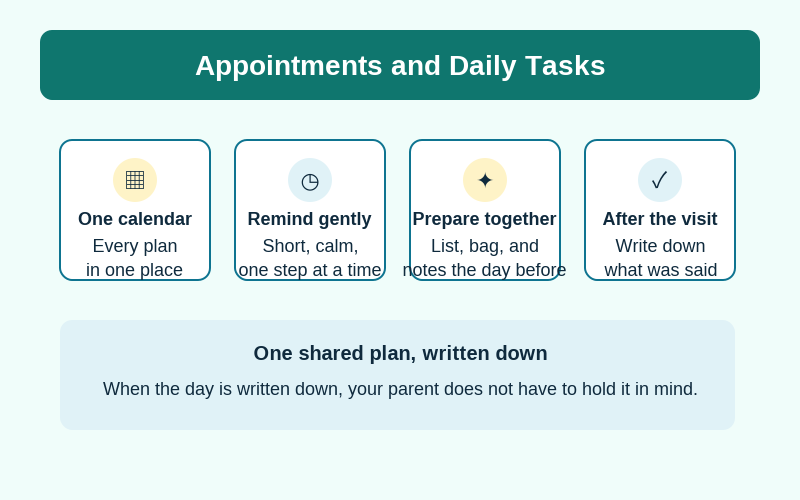
The first rule of planning is simple: one calendar, in one place, used by everyone. Not three calendars, not a calendar on the fridge and another on a phone and another in a notebook. One. A large-print wall calendar, with one month per page and plenty of space to write, is usually the best choice, because it is always visible, always in the same place, and easy to read. Put it in the kitchen, or wherever your parent spends most of the morning, at eye level, in good light. Write every appointment, visit, and important event on it, in large print, in the same colour, as soon as it is arranged.
Keep the calendar simple. Write the time, the place, and one short word about what it is: "Doctor, 10 a.m." "Sarah visits, 3 p.m." "Haircut, 11 a.m." Avoid filling the calendar with too many entries, because a crowded calendar is hard to read, and your parent will stop looking at it. Talk through the week together, on Sunday evening or Monday morning, and point to the calendar as you do. "This week, we have the doctor on Tuesday, and Sarah on Saturday." If other family members keep their own calendars, make sure everything is copied onto the one shared calendar, so nothing is missed. Our guide to creating memory aids around the home has more ideas for clocks, calendars, and whiteboards.
Simple Reminders That Work
A reminder works when it is simple, specific, and given at the right moment. "The doctor is tomorrow at ten" is a good reminder. "Do not forget about tomorrow" is not, because it does not say what tomorrow is, or when, or where. The best reminders are short, calm, and repeated gently. Say the reminder in the morning, repeat it at lunch, and repeat it again before you leave. Use the same words each time, so the words themselves become familiar. Write it on the whiteboard too, so your parent can see it whenever they forget.
Reminders work best when they are tied to something your parent already does. "After breakfast, we will get ready for the doctor." "After lunch, Sarah is coming." Tying a new event to a familiar routine makes it easier to remember, because the routine itself becomes the reminder. Avoid giving too many reminders at once. One reminder, about one event, is enough. If you list five things that are happening this week, your parent will remember none of them. Give one reminder at a time, and let it settle. And remember that a reminder is not a test. Do not ask "Do you remember what is happening tomorrow?" Instead, offer the answer: "Tomorrow we are seeing the doctor at ten." Our guide to communicating with calm and patience has more ideas for keeping reminders kind and easy.
The Day Before an Appointment
Preparation the day before makes the appointment itself far easier. The evening before, sit down together and talk through what will happen tomorrow, in simple terms: where you are going, what time, how you will get there, and how long it will take. Write it on the whiteboard, and put it on the calendar. Prepare everything that will be needed, and put it in one place: a bag with any papers, a list of questions, a bottle of water, and anything else your parent might need. Lay out clothes for the morning, so there is one less decision to make.
Keep the evening before an appointment calm. Avoid visitors, outings, and difficult conversations. A good night's sleep matters more than last-minute preparation, so keep the bedtime steps the same, and allow plenty of time in the morning. If your parent becomes anxious about the appointment, acknowledge the feeling kindly: "I know appointments can be worrying. I will be with you the whole time." Do not dismiss the worry, and do not promise that everything will be fine. A calm, honest reassurance is more helpful than a false one. If the appointment is with a doctor, write down the questions you want to ask, and the changes you have noticed, so you do not have to remember them in the moment.
On the Day Itself
On the day of an appointment, keep the morning steady and unhurried. Wake at the usual time, follow the usual steps, and allow extra time for everything. Rushing makes confusion worse, and it makes your parent anxious. Say the plan out loud, one step at a time: "We are having breakfast now. Then we will get dressed. Then we will go to the doctor at ten." Give your parent time to respond to each step, and do not hurry them. If they resist, do not push it into a battle. Try again a little later, or try a different approach.
Travel to the appointment in the calmest way you can. If you are driving, allow extra time, and choose a familiar route. If you are using public transport, check the times the day before, and allow time for delays. Bring water, a snack, and something familiar — a photograph, a small book, or a favourite song on a phone — to help pass the time. Arrive a little early, so there is time to sit, settle, and use the toilet before the appointment. If your parent becomes distressed on the way, stay calm. Acknowledge the feeling, offer a simple reassurance, and gently redirect: "I know this is hard. I am here with you. We will be home soon." Our guide to safe driving decisions and transport options has more ideas for getting out and about safely.
At the Appointment
At the appointment itself, your role is to help your parent be heard, and to help them understand what is said. Sit where your parent can see you, and speak clearly and slowly. If the doctor or professional speaks quickly, or uses words your parent does not understand, ask them to slow down, or to explain in simpler terms. Do not be afraid to ask. It is your parent's appointment, and they deserve to understand what is happening. If your parent struggles to explain a symptom or a problem, help them gently: "Mum has been sleeping badly this week, and she has been more confused in the evenings."
Take notes during the appointment, in a notebook you bring with you. Write down what was said, what was decided, and what happens next, in short, simple words. Do not rely on memory, because appointments are stressful, and it is easy to forget what was said by the time you get home. If the doctor gives instructions, repeat them back to check you have understood: "So we will come back in three months, and we should watch for any change in appetite." Ask for written instructions if they are available. Before you leave, check that you know the next step: what happens next, when, and who to contact if you are worried. If you are unsure about anything, ask before you go, rather than worrying about it later.
After the Visit: Writing It Down
What happens after an appointment matters as much as the appointment itself. On the way home, or as soon as you are home, write down what was said and what was decided, in the notebook, in short, simple words. Write the date, who you saw, what they said, and what happens next. Then copy the important parts onto the calendar: the next appointment, any changes to the routine, anything to watch for. If the doctor gave written instructions, keep them in one place — a folder by the calendar, or a file on the shelf — so you can find them again.
Tell your parent, in simple terms, what happened and what happens next. "The doctor was pleased with you. We will go back in three months. Nothing changes for now." Keep it short, and repeat it if your parent asks again. If other family members need to know, share the note with them, so everyone has the same information. A short, written note prevents misunderstandings, and it means you do not have to remember everything yourself. It also helps the next time you see a doctor, because you can show them what was decided last time, and when. Keep the notebook safe, and bring it to every appointment. Our guide to when to ask for extra help at home explains when a change in your parent's condition should be checked by a doctor promptly.

Daily Tasks, One Step at a Time
Appointments are only part of the day. Daily tasks — washing, dressing, eating, taking a walk, paying a bill — also need help, and the same simple approach works: one step at a time, in the same order, with a gentle cue. Break each task into small steps, and offer one step at a time. "First, let us wash your hands." "Now, the blue shirt." "Now, breakfast." When the steps are small and steady, your parent can follow them, and the task gets done without a battle. If a task becomes too hard, break it into even smaller steps, or do the harder parts together.
Keep daily tasks in the same order, at the same times, as far as you can. A steady routine means your parent does not need to remember what comes next, because the day itself tells them. Use the same words for the same tasks, so the words become familiar. And let your parent do as much as they can, for as long as they can. Doing a task together — you and your parent, side by side — keeps skills alive and dignity intact. If you do everything for your parent, they will lose skills faster, and they will feel less like themselves. Do with, not for, whenever you safely can. Our guide to how to support independence safely explains how to balance help and independence, and our guide to building a calm daily routine walks through the whole day.
When Plans Change
Plans change, and for a person with dementia, a change can be very distressing. An appointment is moved, a visitor cancels, a familiar helper is ill, and the day that was written on the whiteboard no longer matches reality. When a plan changes, tell your parent as soon as you know, in simple terms, and explain what will happen instead. "The doctor has moved our appointment to Thursday. We will go on Thursday instead." Say it once, write it on the whiteboard, and repeat it if your parent asks again. Do not assume they will remember the change, even if you told them yesterday.
Keep the rest of the day as steady as you can. If one thing changes, keep everything else the same, so the day still has a familiar shape. If your parent becomes distressed by the change, acknowledge the feeling kindly: "I know it is disappointing. We will still go, just on a different day." Then offer something pleasant to look forward to: a favourite meal, a walk, a song. If plans change often, it may help to write the plan in pencil, or to use a whiteboard that can be changed easily, so the change itself feels normal, not alarming. And if you are the one who finds change stressful, remember that you are not alone. Caring for a parent with dementia is hard, and it is normal to feel tired, frustrated, or sad. Talk to another family member, or a support group, and ask for help before you reach breaking point.
Asking for Help With Planning
You do not need to do all the planning alone. Other family members, friends, and professional caregivers can all help, if they know the plan. Share the calendar, the whiteboard, and the notebook with everyone who helps with care, so the same system works whoever is there. If a brother or sister lives far away, they can still help: they can phone to remind your parent of an appointment, or they can keep a copy of the calendar and check it with you each week. If a professional caregiver comes to the house, show them the calendar and the notebook on their first visit, and ask them to write down anything important.
There is also help available from local services. Some areas have dementia support services, carer support groups, or advice services that can help with planning, paperwork, and appointments. A support group can be a lifeline, because it reminds you that you are not alone, and that other families are facing the same challenges. If you would like to explore professional help, read our guide to questions to ask when choosing care support. You can also contact our team to talk through a specific situation in confidence, or read more about who we are and how we work.
Frequently Asked Questions
How do I stop my parent from missing appointments? Use one shared calendar, in one place, with every appointment written on it in large print. Remind your parent gently, in the morning and again before you leave, and prepare everything the day before. One system, used by everyone, is the best protection against a missed appointment.
What if my parent refuses to go to an appointment? Do not turn it into a battle. Acknowledge the feeling, explain the plan simply, and try again a little later. If refusal becomes frequent, talk to a doctor, because pain, fear, or discomfort may be part of the problem.
Should I tell my parent about an appointment in advance? Yes, but keep it simple. Tell them the day before, and again in the morning, in the same words. Too much advance warning can cause days of worry, while too little can cause confusion. The day before, and the morning itself, is usually the right balance.
What should I write down after a doctor's visit? The date, who you saw, what they said, what was decided, and what happens next. Keep the note short and simple, and share it with other family members so everyone has the same information.
When should I ask a doctor about memory changes? If memory problems are new, getting worse quickly, or affecting safety — getting lost, leaving the stove on, forgetting to eat or drink — talk to a doctor promptly. Only a doctor can assess memory and advise on care.
Sources and Further Reading
This guide draws on the following sources, all accessed 29 November 2026.
- Alzheimer's Association — Facts and Figures, and information on dementia care at home. alz.org/alzheimers-dementia/facts-figures
- National Institute on Aging (NIA) — information on Alzheimer's disease, dementia, and caregiving. nia.nih.gov/health/alzheimers-and-dementia
If this guide helped you, please share it with another family who needs it, and read our other guides on dementia and memory care at home. If you would like to talk about care for your parent, start on our homepage or contact us — a friendly advisor is ready to listen, with no obligation. You can write to us at hello@homecare.biz.id.
Tags: memory care home care, senior home care, family caregiver
Last reviewed: 29 June 2026. This guide is general information and is reviewed regularly. It is not a substitute for medical advice. Always talk to a doctor about diagnosis, treatment, or any change to care or medication.