
Home Care for Memory Care: Safe Driving Decisions and Transport Options
Written by the HomeCare editorial team. Sources: Alzheimer's Association, National Institute on Aging (NIA).
Driving is one of the hardest conversations a family can have. For many older people, driving is not just transport. It is independence, identity, and freedom: the ability to go where you want, when you want, without asking anyone. Giving it up can feel like giving up a part of yourself. And for the family, raising the subject can feel like an accusation, or a betrayal. But driving with dementia can become unsafe, for your parent and for others on the road, and avoiding the conversation does not make the risk go away. This guide is written for adult children caring for a parent at home, and it shows how to approach driving decisions kindly, honestly, and early, before a crisis forces the issue.
The goal is not to take the keys away as quickly as possible. It is to keep your parent safe, and to keep them mobile, for as long as possible. Many people with early dementia can drive safely for a time, with sensible limits and regular checks. And when driving does need to stop, there are other ways to get out and about, and they can work well, if they are planned in advance. Start the conversation early, while your parent can still take part in the decision, and keep it going over time. If you would like the wider picture first, read our complete family guide to dementia care at home and our guide to supporting independence safely.
Why Driving Is a Hard Conversation
Driving matters because it means so much more than getting from one place to another. For a person who has driven for fifty years, the car is part of who they are: the driver in the family, the one who took the children to school, the one who drove to work every morning. Losing that role can feel like losing a part of yourself, and it can bring grief, anger, and shame. Your parent may know, deep down, that driving is becoming harder, and still resist the conversation, because admitting it feels like admitting defeat. That resistance is understandable, and it deserves kindness, not argument.
The conversation is hard for the family too. Adult children often feel guilty for raising it, as if they are accusing their parent of being unsafe, or taking something precious away. They may worry about the argument that will follow, or about being blamed. And they may put the conversation off, week after week, until something happens — a near miss, a dented car, a journey home that took far too long — and then the decision is made in a crisis, in anger and fear, rather than calmly, together. Starting early, and starting kindly, is the best way to avoid that. The conversation does not need to end with a decision the first time. It only needs to begin, so that the subject is no longer forbidden, and so that your parent knows you are thinking about safety, not punishment.
Signs to Watch For
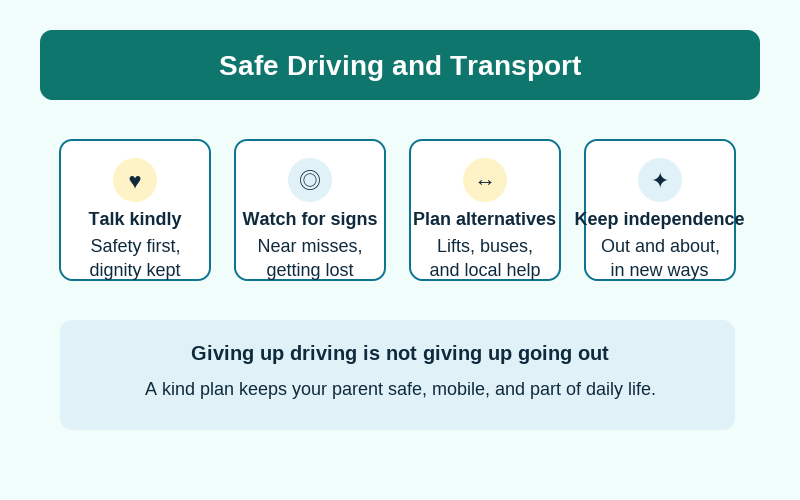
There is no single test that says a person with dementia must stop driving, and dementia affects everyone differently. But there are signs worth watching for, and if you notice several of them, it is time to talk to a doctor. Getting lost on familiar routes, or taking much longer than usual to get home. Near misses, or small accidents that are explained away. Difficulty following road signs, or confusion at junctions and roundabouts. Driving too slowly, or too fast, or braking suddenly for no clear reason. Forgetting where the car is parked, or how to get home. Difficulty with parking, or with judging distances. Becoming easily distracted, or angry, while driving.
Watch, too, for changes outside the car. If your parent is becoming more confused in everyday life, if they are forgetting appointments, or if they are struggling with tasks that need planning and quick decisions, driving is likely to be affected too, because driving needs all of those skills at once. Keep a short, private note of what you notice, with dates, so you can describe it clearly to a doctor. Do not spy on your parent, and do not follow them in the car. Simply notice what happens when you travel together, and listen to what other family members and friends have noticed. If several people have the same worry, it is worth taking seriously. And if you are ever unsure, talk to a doctor. It is better to ask early than to wait for an accident.
Starting the Conversation
Choose a calm time, and a quiet place, to start the conversation. Not in the car, not during an argument, and not after a frightening incident. A cup of tea at the kitchen table, on an ordinary day, is a better setting than a crisis. Start with care, not with criticism: "Dad, I have been thinking about your safety, and I would like to talk about driving." Use "I" rather than "you": "I am worried about the journey home last week" is kinder than "You are a dangerous driver." Acknowledge what driving means: "I know driving matters to you, and I know this is hard to talk about."
Listen to what your parent says, and take it seriously. They may have noticed the same things you have, and they may be relieved that someone has raised it. Or they may be angry, and that anger deserves patience, not argument. Do not try to win the conversation in one sitting. It is enough to plant the idea, and to agree to talk about it again, or to ask a doctor together. Offer to be part of the solution: "Let us talk to the doctor together, and see what they say." If your parent will not talk to you, ask another family member, a trusted friend, or a doctor to raise it. Sometimes the same words are easier to hear from someone else. Our guide to communicating with calm and patience has more ideas for keeping difficult conversations kind.
Talking With a Doctor
A doctor is often the best person to talk about driving, because the advice comes from a professional, not from a family member, and it is easier for your parent to accept. If you are worried about your parent's driving, talk to their doctor, and describe what you have noticed, with dates and examples. The doctor can assess memory, attention, and reaction time, and can advise on whether driving is still safe, and what checks are needed. In some places, the doctor can also advise on whether a formal driving assessment is needed, or whether the driving licence authority should be told.
Ask your parent if you can go to the appointment together, and explain why: "I would like to come with you, so I can understand what the doctor says." At the appointment, let your parent speak first, and add what you have noticed gently, without contradicting them. Take notes, and write down what the doctor advises. If the doctor says driving should stop, let the doctor say it, and support your parent through the sadness that follows. If the doctor says driving can continue for now, ask what limits apply, and when it should be reviewed again. And remember that a doctor's advice is about safety, not punishment. It is given to protect your parent, and everyone else on the road. If you are unsure about the rules where you live, ask the doctor, or check with your local driving licence authority.
Practical Steps While Still Driving
If driving continues for now, sensible limits can make it safer. Many families agree together on simple rules: driving only in daylight, only on familiar routes, only for short journeys, and never on motorways or in heavy traffic. Avoid driving at night, in bad weather, or when tired or unwell. Keep the car in good condition, and consider simple aids: a larger mirror, a clear sat nav with a familiar voice, or a car with automatic transmission if that is easier. Keep a phone charged, and a card with your number in the car, in case your parent needs help.
Review the limits regularly, together, and be honest about whether they are working. If your parent is breaking the agreed limits, or if new signs appear, it is time to talk to a doctor again. Do not agree to limits that nobody follows, because they give a false sense of safety. And do not let the conversation stop after one talk. Driving safety is not a decision made once. It is a conversation that continues, as dementia changes, and as your parent's abilities change with it. Keep the conversation going, gently, and keep the doctor involved. Our guide to helping with appointments and daily tasks shows how to plan journeys and appointments together.
When Driving Needs to Stop
When the time comes to stop driving, it is a loss, and it deserves to be treated as one. Your parent may feel grief, anger, shame, or relief, often all at once. Acknowledge the loss kindly: "I know this is hard, and I know what driving has meant to you." Do not dismiss the feelings, and do not rush your parent to feel better. Give them time to grieve, and let them talk about it, as often as they need to. The sadness may last for weeks, and that is normal. What helps most is not a lecture about safety, but a plan for what comes next, so that stopping driving does not mean stopping going out.
Make the practical arrangements together, as soon as you can. Decide what happens to the car: will it be sold, or kept for other family members to use? Will your parent keep the keys, or will someone else hold them? If your parent keeps driving after agreeing to stop, talk to a doctor, and consider practical steps, such as keeping the keys out of sight, or arranging for the car to be used by someone else. Do not hide the keys secretly, or disable the car without telling your parent, because that breaks trust, and trust is hard to rebuild. Be honest, be kind, and keep your parent involved in every decision. If the conversation becomes very difficult, ask a doctor, a family member, or a trusted friend to help.
Transport Options That Keep Independence
Stopping driving does not have to mean staying at home. There are usually several ways to get out and about, and the best plan is one your parent helps to choose. Family and friends can offer lifts, and a regular arrangement — a daughter on Tuesdays, a neighbour on Saturdays — is better than asking for help at the last minute. A local bus, if the route is familiar and the stop is close, can work well, especially if someone travels with your parent at first, until the route becomes familiar. Some areas have community transport, volunteer drivers, or dial-a-ride services for older people, and it is worth asking your local council or support service what is available.
Taxis and ride services can also work, especially for appointments, if they are booked in advance and the driver is told where to go. Some families keep a small fund for taxis, so your parent can go out without feeling they are a burden. If your parent uses a wheelchair or a walking aid, check that the transport can carry it, and allow extra time. The best transport plan is one that is written down, shared with everyone who helps, and reviewed regularly. Write it on the calendar, so your parent can see how they will get to each appointment or outing. Our guide to helping with appointments and daily tasks shows how to plan journeys together, and our guide to preparing the home for changing needs covers getting out and about safely.
Keeping Going Out
Going out matters, and it should not stop when driving stops. A walk in the garden, a visit to a friend, a trip to the shops, a service at a place of worship, a lunch with family — these are the things that make life worth living, and they are worth planning for. Keep a regular pattern of outings, at the same times each week, so your parent has something to look forward to. A Tuesday lunch, a Saturday walk, a Sunday visit: the rhythm matters as much as the outing itself. If your parent becomes reluctant to go out, start small: a short walk, a cup of tea in the garden, a drive with a family member to a familiar place.
Going out also helps memory and mood. Fresh air, daylight, movement, and conversation all support wellbeing, and they are much harder to get at home alone. If your parent is lonely, or spending most of the day alone, talk to a doctor, and consider whether more company, or more help at home, would help. A befriending service, a day centre, or a regular visit from a friend can make a real difference. And remember that going out is not only for your parent. A shared outing can be a pleasure for you too, and it can remind you both of the life you share, beyond the daily tasks of care. Our guide to exercise and movement ideas for seniors has ideas for gentle outings, and our guide to music and reminiscence activities at home has ideas for shared pleasures.
Planning Ahead as a Family
The best time to plan for the end of driving is before it becomes urgent. Talk as a family, while your parent can still take part, about what will happen when driving stops. Who will offer lifts, and when? What transport is available locally? How will appointments be reached? What will happen to the car? Write the plan down, and share it with everyone who helps with care, so the same plan works whoever is there. A written plan, made together, is far kinder than a decision made in a crisis, after an accident or a frightening incident.
Planning ahead also means talking about money, if the car is sold, or if taxis and transport will cost more. Be honest about what can be afforded, and what help is available. Some families find that selling the car pays for a year of taxis, or for extra help at home. Others find that a family member is glad to take the car, and glad to offer lifts in return. Whatever the plan, make it together, and review it regularly, as needs change. And keep the conversation going. Driving is not a subject to be raised once and never mentioned again. It is a conversation that continues, gently, over time, as dementia changes and as your parent's needs change with it.
Asking for Help
You do not need to handle driving decisions alone. Other family members, friends, and professional caregivers can all help, if they know the plan. Share the transport plan with everyone who helps with care, so the same system works whoever is there. If a brother or sister lives far away, they can still help: they can phone to check on your parent, or they can pay for a taxi, or they can come to a doctor's appointment. If a professional caregiver comes to the house, ask them to help with outings, or to travel with your parent to appointments.
There is also help available from local services. Some areas have driving assessment centres, where a professional can assess whether driving is still safe, and advise on what to do next. A support group can be a lifeline, because it reminds you that you are not alone, and that other families are facing the same difficult conversations. If you would like to explore professional help, read our guide to when to ask for extra help at home and our guide to questions to ask when choosing care support. You can also contact our team to talk through a specific situation in confidence.
Frequently Asked Questions
How do I know when driving is no longer safe? There is no single test. Watch for signs: getting lost on familiar routes, near misses, confusion at junctions, difficulty with parking, or changes in everyday memory and decision-making. If several signs appear, talk to a doctor promptly.
What if my parent refuses to stop driving? Do not turn it into a battle. Acknowledge the loss, keep the conversation going, and involve a doctor. A doctor's advice is often easier to accept than a family member's, because it comes from a professional.
Can my parent still drive with early dementia? Many people with early dementia can drive safely for a time, with sensible limits and regular checks. Talk to a doctor, agree limits together, and review them regularly as dementia changes.
What transport options are available? Family lifts, friends, local buses, community transport, volunteer drivers, and taxis are all worth exploring. The best plan is one your parent helps to choose, written down, and shared with everyone who helps.
When should I ask a doctor about driving? As soon as you notice signs that worry you, or if your parent's memory or decision-making is changing. It is better to ask early than to wait for an accident. Only a doctor can assess fitness to drive and advise on care.
Sources and Further Reading
This guide draws on the following sources, all accessed 29 November 2026.
- Alzheimer's Association — Facts and Figures, and information on dementia care at home. alz.org/alzheimers-dementia/facts-figures
- National Institute on Aging (NIA) — information on Alzheimer's disease, dementia, and caregiving. nia.nih.gov/health/alzheimers-and-dementia
If this guide helped you, please share it with another family who needs it, and read our other guides on dementia and memory care at home. If you would like to talk about care for your parent, start on our homepage or contact us — a friendly advisor is ready to listen, with no obligation. You can write to us at hello@homecare.biz.id.
Tags: memory care home care, senior transport, dementia home care
Last reviewed: 29 June 2026. This guide is general information and is reviewed regularly. It is not a substitute for medical advice. Always talk to a doctor about diagnosis, treatment, or any change to care or medication.