
Home Care for Memory Care: Preparing the Home for Changing Needs
Written by the HomeCare editorial team. Sources: Alzheimer's Association, National Institute on Aging (NIA).
A home that worked well for years can slowly become harder to live in as memory fades. A dark hallway, a loose rug, a confusing bathroom, a kitchen full of cupboards: small difficulties add up, and they can make the day harder, and the home less safe. The good news is that most of the changes that help are small, cheap, and easy to make, especially if they are made early, before a crisis forces them. This guide is written for adult children caring for a parent at home, and it shows how to prepare the home for changing needs, one small change at a time. You do not need to rebuild the house, and you do not need to spend a great deal of money.
The best time to change the home is before it becomes urgent. A grab bar fitted before a fall is worth far more than one fitted after it. A clear path made before a stumble is worth more than a clear path made after one. Start with the changes that make the biggest difference for the least effort, and make them with your parent, not for them. A home that still feels like home — familiar, comfortable, and personal — is worth more than a home that is perfectly safe but feels like a hospital. If you would like the wider picture first, read our complete family guide to dementia care at home and our guide to creating a calm and familiar home.
Why Plan Ahead
Planning ahead matters because dementia changes gradually, and the home needs to change with it. A home that was safe and comfortable last year may not be safe and comfortable this year, and it may be less safe still next year. If you wait until a crisis — a fall, a fire, a night of wandering — the changes are made in a hurry, in fear, and often without your parent's agreement. If you plan ahead, the changes are made calmly, one at a time, with your parent's involvement, and the home stays familiar, because it changes slowly, in small steps.
Planning ahead also saves money, because small changes made early are usually cheaper than big changes made late. A night light, a non-slip mat, and a clear path cost very little. A bathroom rebuild, a hospital stay, or a move to residential care cost a great deal more. And planning ahead gives your parent a voice in the changes. When your parent helps to choose a grab bar, or to decide where a label goes, they are more likely to use it, and more likely to feel that the home is still theirs. Talk as a family, while your parent can still take part, about what the home needs now, and what it may need next. Write the plan down, and review it every few months, as needs change.
Small Changes First
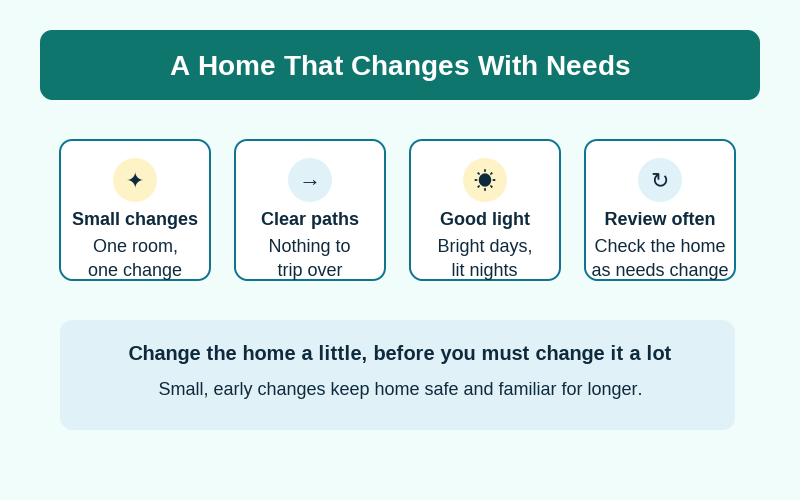
Start with the changes that make the biggest difference for the least effort. Clear the floor: remove loose rugs, trailing cables, and clutter from the paths your parent walks every day. Improve the light: replace dim bulbs, add a lamp in a dark corner, and put a night light in the hallway and bathroom. Label the cupboards: one or two words, in large print, on the doors your parent opens every day. Put the most-used items at eye level, in the same place, so your parent does not need to reach, climb, or search. These four changes — clear floors, good light, clear labels, and familiar places — cost very little, and they make the home safer and easier to live in, straight away.
Make one change at a time, and let your parent get used to it before making the next one. A home that changes all at once can feel strange, even frightening, and your parent may resist it. A home that changes slowly, one small improvement at a time, stays familiar. Explain each change in one short sentence: "This light will help you see the bathroom at night." "This label says cups, so you can find them easily." And ask your parent what they think. If they do not like a change, try a different one. The home belongs to your parent, and the changes should make it feel more like home, not less. Our guide to creating memory aids around the home has more ideas for labels, photographs, and simple tools.
Room by Room: What to Check
Walk through the home, room by room, as if you were seeing it for the first time, and ask yourself three questions in each room: can my parent find what they need here? Can they move around safely? Can they see what they are doing? In the living room, check that the favourite chair is in the same place, with a small table nearby for a drink, a book, or glasses. Keep the television and radio simple to use, with a remote control that has large, clear buttons. Keep the floor clear, the rug flat or removed, and the way to the kitchen and the toilet obvious.
In the hallway, check the light, and the path. A night light, a clear floor, and a handrail on the stairs, if there are stairs, make a real difference. In the kitchen, check the labels, the most-used items, and the stove. In the bathroom, check the door, the light, and the path from the bed. In the bedroom, check the bed, the clothes, and the clock. In each room, look for the same things: good light, a clear path, familiar places, and nothing to trip over. Write down what needs changing, and do one room at a time. A room-by-room check, done every few months, is one of the simplest ways to keep the home safe as needs change. Our guide to creating a calm and familiar home walks through each room in more detail.
Lighting: Bright Days, Lit Nights
Good lighting matters more as we age, and it matters most for a person with dementia, whose eyesight may already be weaker, and whose sense of day and night may already be confused. Bright, even light during the day helps the body clock, supports mood and sleep, and makes it easier to see what you are doing. Dim, uneven light, or sudden changes from bright to dark, can cause confusion, and can make a fall more likely. Open the curtains in the morning, let in the daylight, and keep the lights on in the rooms your parent uses, even during the day, if they are dark.
At night, the rule is the opposite: a dark, quiet bedroom for sleep, with a night light in the hallway and bathroom, so your parent can find the toilet without waking the whole house. Use a warm, low light for the night light, not a bright white one, because bright light at night can make sleep harder. Avoid sudden changes in light: turn the lights on before it gets dark, so the house does not go dark all at once, and close the curtains before sunset, so the change is gradual. If your parent is confused by shadows, or by reflections in windows and mirrors, cover the mirror, or close the curtains earlier. Light is one of the cheapest and most effective changes you can make, and it is worth getting right.
Floors and Clear Paths
Falls are one of the biggest risks for an older person at home, and the floor is where most falls begin. Keep the floor clear, everywhere your parent walks, every day. Remove loose rugs, or fix them down with non-slip backing. Move trailing cables, and keep them against the wall, or under a cover. Pick up clutter: shoes, bags, magazines, and pet toys are all trip hazards. Keep the paths wide and obvious: from the bed to the bathroom, from the chair to the kitchen, from the front door to the garden. If a piece of furniture blocks a path, move it, even if it has been there for years.
Look at the floor itself. Smooth, shiny floors can be slippery, especially when wet. A non-slip mat in the bathroom, and by the kitchen sink, can help. Avoid highly patterned carpets, because strong patterns can be confusing, and can look like steps or holes to a person with dementia. Use a plain, even floor covering, in a colour that contrasts with the walls, so the edge of the room is easy to see. And wear good shoes: shoes that fit well, with low heels and non-slip soles, and avoid loose slippers or socks on smooth floors. Our guide to exercise and movement ideas for seniors has more ideas for balance and staying steady, and our guide to supporting independence safely explains how a safer home supports independence.
Bathroom and Kitchen
The bathroom and kitchen are the two rooms where safety matters most, because they have water, heat, and hard surfaces, and because they are used at night as well as during the day. In the bathroom, the most useful changes are simple: a grab bar by the toilet and in the shower, a raised toilet seat, a non-slip mat in the bath or shower, and a clear label on the door. Keep the layout the same: soap, towel, and toothbrush in the same places. Use a night light, and keep a clear path from the bed to the bathroom, with nothing to trip over. If the bath has become difficult, consider a shower seat, or a walk-in shower, and talk to a doctor about what help is available.
In the kitchen, keep the most-used items at eye level, in the same place, and label the cupboards. Keep the work surfaces clear, and use the same pan in the same place. A clear sign on the stove — "Turn off after use" — can remind your parent at the moment it matters. If cooking has become unsafe, change the task, not the person: prepare simple meals together, or use foods that need little cooking. Keep a glass of water within reach, and offer drinks often. Our guide to safe bathing and personal care has more ideas for the bathroom, and our guide to mealtime help and nutrition tips covers the kitchen in detail.
The Bedroom
The bedroom should be a calm, familiar place, where your parent can sleep well and wake safely. Keep the bed in the same place, with the same bedding, and a familiar object by the bed: a photograph, a blanket, a favourite book. Lay clothes out in the order they are put on, on the same chair or bed, each night. Label the drawers: socks, underwear, shirts, trousers. Keep a clock that shows the day and whether it is morning or night, so your parent does not wake at 3 a.m. and think it is time to get up. Use a night light, and keep a clear path from the bed to the bathroom.
Keep the bedroom cool, dark, and quiet at night, with curtains that close properly, and no television left on. A regular bedtime, at the same time each night, helps the body clock, and a short, calm bedtime routine — a warm drink, a wash, night clothes, a few quiet words — helps sleep. If your parent wakes at night, a calm, brief response is usually enough: a toilet visit, a drink of water, a reassuring word, and then back to bed. If nights become unsafe, or if your parent is wandering at night, talk to a doctor, and consider a door alarm that sounds when an outside door opens. Our guide to sleep support and nighttime routine has more ideas for safer, calmer nights.
The Front Door and Outside
The front door deserves special attention, because it is where safety and independence meet. A clear sign on the inside of the door — "Keys here" with a hook underneath — helps your parent find what they need before going out. A small tray by the door for keys, wallet, and phone, always in the same place, prevents the daily search. Keep the path to the front door clear, well lit, and free of steps if possible, or with a handrail if there are steps. Outside, keep the garden path clear, with good lighting, and a place to sit and rest.
Going out is important, and the home should support it, not prevent it. A short, familiar walk, at the same time each day, with the same route, is good for mood, appetite, and sleep. Keep the route simple, and walk it together at first, so it becomes familiar. If your parent sometimes tries to leave the house at night, or gets lost when they go out, talk to a doctor about what help is needed, and consider simple aids: a door alarm, or a card in a pocket with your parent's name and your phone number. If wandering has become a worry, read our guide to managing sundowning at home, and talk to a doctor about the safest plan.
Review Regularly as Needs Change
The home is never finished. As dementia changes, the home needs to change with it, and a regular review is the best way to keep up. Every few months, walk through the home, room by room, and ask the same three questions: can my parent find what they need here? Can they move around safely? Can they see what they are doing? Write down what needs changing, and do one room at a time. Review the home after any change, too: a move, a hospital stay, a new helper, a bad winter, or a fall. Each change is a chance to check the home again, and to make one small improvement.
Keep a short list of changes you have made, and changes you plan to make, so you can see progress, and so other family members can help. Share the list with everyone who helps with care, so the same plan works whoever is there. And remember that the home belongs to your parent. Changes should make it feel more like home, not less. If a change makes your parent unhappy, try a different one. The goal is a home that is safe, familiar, and comfortable, for as long as possible. If you would like help preparing the home, you can contact our team or read more about who we are and how we work.
Asking for Help
You do not need to prepare the home alone. Other family members can help with small changes, or with the cost of larger ones, and a regular arrangement is better than asking for help at the last minute. A professional caregiver can help with daily tasks, and can tell you what changes would help most, because they see the home every day. There is also help available from local services. Some areas offer home safety checks, grants for adaptations, or advice services that can visit the home and suggest changes. It is worth asking your local council or support service what is available.
If you would like to explore professional help, read our guide to when to ask for extra help at home and our guide to questions to ask when choosing care support. You can also contact our team to talk through a specific situation in confidence. And if you are feeling exhausted, or if caring is taking a toll on your own health, talk to your own doctor, tell another family member, and ask for help before you reach breaking point.
Frequently Asked Questions
What is the most important change to make first? Clear the floors, improve the light, and put a night light in the hallway and bathroom. These three changes cost very little, and they make the home safer straight away. Then add labels, and put the most-used items in the same place.
How much will it cost to prepare the home? Most of the changes that help most are small and cheap: a night light, a non-slip mat, a label, a clear path. Larger changes, such as a walk-in shower or a stair lift, cost more, and it is worth asking your local council or support service what help is available.
Will changes make the home feel like a hospital? They should not, if they are made slowly, one at a time, with your parent's involvement. Keep familiar furniture, photographs, and objects, and choose aids that are discreet. A home that still feels like home is worth more than a home that is perfectly safe but feels strange.
How often should I review the home? Every few months, and after any change: a move, a hospital stay, a new helper, a bad winter, or a fall. A room-by-room check, done regularly, is one of the simplest ways to keep the home safe as needs change.
When should I ask a doctor about the home? If your parent has fallen, is wandering at night, or is becoming unsafe in the home, talk to a doctor promptly. Only a doctor can assess memory and advise on care.
Sources and Further Reading
This guide draws on the following sources, all accessed 29 November 2026.
- Alzheimer's Association — Facts and Figures, and information on dementia care at home. alz.org/alzheimers-dementia/facts-figures
- National Institute on Aging (NIA) — information on Alzheimer's disease, dementia, and caregiving. nia.nih.gov/health/alzheimers-and-dementia
If this guide helped you, please share it with another family who needs it, and read our other guides on dementia and memory care at home. If you would like to talk about care for your parent, start on our homepage or contact us — a friendly advisor is ready to listen, with no obligation. You can write to us at hello@homecare.biz.id.
Tags: memory care home care, home safety, senior living
Last reviewed: 29 June 2026. This guide is general information and is reviewed regularly. It is not a substitute for medical advice. Always talk to a doctor about diagnosis, treatment, or any change to care or medication.