
Home Care and Home Safety: Seasonal Home Safety Checklist for Seniors
Written by the HomeCare editorial team. Sources: Alzheimer's Association, National Institute on Aging (NIA).
A home that is safe in June may not be safe in January. In summer, the danger is heat, dehydration, and a house that stays too warm at night. In winter, the danger is cold, ice on the path, and a heating system that fails on the coldest night of the year. In spring, the garden grows wild, the paths become slippery with rain, and the winter's damage shows itself. In autumn, leaves cover the steps, the light fades early, and the house needs to be made ready for the cold. Each season brings its own risks, and each season brings its own small jobs that prevent the big problems of the next one. A seasonal checklist is a simple way of staying ahead: four short checks a year, at the turn of each season, that keep a home safe all year round.
This guide is written for adult children caring for a parent at home. It gives you a checklist for each season, with the checks for heat, cold, and daily comfort, and the jobs that are easy to forget: testing alarms, clearing paths, checking the heating, and making sure medicines and food will last through a storm. It also covers storms, floods, and power cuts, and how the seasons affect daily comfort at home. You do not need to do everything in one day. Work through one season's list over a weekend, tick the jobs off as you go, and put the next season's date in your calendar. If you are new to caring for a parent with dementia at home, start with our complete family guide to dementia care at home and our complete guide to home care, and then use this checklist alongside our fall prevention checklist.
Why the Seasons Matter
Older adults feel the seasons more sharply than younger people. The body's ability to regulate temperature weakens with age, so a hot day that is merely uncomfortable for you can be dangerous for your parent, and a cold house that you would notice straight away may not be noticed by a person with dementia at all. A person with dementia may not recognise that they are too hot or too cold, may not know to drink water, may not be able to put on a jumper, and may not be able to tell you that the heating has stopped working. That is why the seasons matter more in home care than in any other kind of housekeeping: the person you care for may not be able to warn you when something is wrong, so the house itself has to be ready.
The seasons also change the light, and light changes behaviour. In winter, the days are short, the evenings are long, and the house is dark by late afternoon. For a person with dementia, that long dark evening can bring confusion and restlessness, the pattern often called sundowning. In summer, the light lasts until late, and a parent who is used to going to bed when it gets dark may stay up too late and become exhausted. In spring and autumn, the light changes quickly from week to week, and a routine built around daylight needs to be adjusted. A seasonal check is not only about the house. It is about the routine, the clothes, the food, and the day, and how they all need to change when the season turns.
Finally, the seasons change the risks outside the house. In spring, rain makes paths slippery and the garden grows fast. In summer, a garden path can become too hot to walk on, and a parent can become dehydrated on a short walk. In autumn, wet leaves cover steps and paths, and the first frost can make a morning path treacherous. In winter, ice, snow, and early darkness make every trip outside a risk. A seasonal checklist that covers the garden, the paths, and the front door is as important as one that covers the heating and the alarms. Our guide to managing sundowning at home explains how light and the seasons affect behaviour, and our guide to sleep and nighttime routine covers the nights that follow.
Checks for Every Season
Some checks matter in every season, and they are the backbone of the checklist. Do them four times a year, at the turn of each season, and you will catch most problems before they become emergencies. Start with the alarms. Test every smoke alarm and carbon monoxide alarm, and replace the batteries if they are low. Test the personal alarm, if your parent wears one, and make sure it is charged. Test the door sensors and the motion sensors, if you have them, and change their batteries. A sensor with a flat battery is no sensor at all, and the only way to know is to test it. Our home monitoring guide explains how to test and maintain alarms and sensors.
Next, check the medicines and the contacts. Read the medicines list against the pharmacy list, and check that nothing has run out or gone out of date. Check the contacts list in the emergency plan, and make sure every number is still correct. Check the grab bag by the front door: are the clothes still the right size and season, is the water in date, and are the medicines still current? Check the torch in every room, and replace the batteries. Check the phone charger, and make sure there is a paper copy of the contacts list by every phone, because a phone can run out of power at the worst moment.
Then walk the house. Check every grab bar by pulling on it with your full weight. Check the walking aid: the rubber tips, the brakes, the wheels, and the frame. Check the handrails on the stairs, and make sure the carpet or the non-slip strips are fixed down. Check the lights in every room and hallway, and replace any bulb that is dim or flickering. Check the floors for trip hazards: cables, rugs, clutter, and thresholds. Check the bathroom: the non-slip mat, the shower chair, the raised toilet seat, and the temperature of the hot water, which should not be so hot that it can scald. Check the kitchen: the cooker, the fridge, and the cupboard where cleaning products are stored. Our guides to grab bars and mobility aids, bathroom safety upgrades, and kitchen safety cover these rooms in detail.
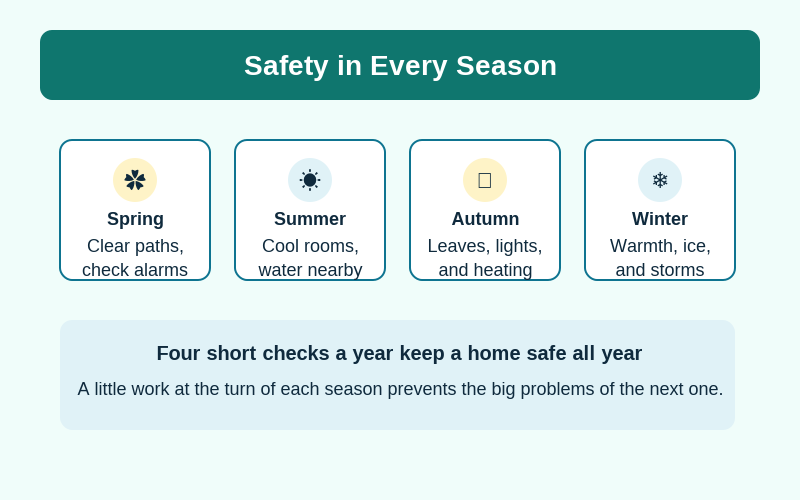
Spring Checklist
Spring is the season of clearing and checking. After winter, the house and garden need to be looked at with fresh eyes, and the damage of the cold months needs to be found and fixed. Start outside. Clear the paths of winter debris, moss, and mud, and check for cracks or loose stones that winter frost may have caused. Clear the gutters and drains, so spring rain does not overflow and make the paths slippery. Check the fence and the garden gate, and repair any damage from winter storms. Cut back any plants that have grown over the path, and make sure the path is clear and level. If the garden has a pond, make sure it is covered or fenced, because a person with dementia may not recognise the danger of water.
Inside, spring is the time to check the heating and the alarms. Have the heating system serviced before you stop using it for the summer, so that any problem is found now, not on the first cold night of autumn. Test the smoke alarms and carbon monoxide alarms, and replace the batteries. Check the windows: do they open easily for fresh air, and do they lock securely? Check the curtains and blinds, and make sure the rooms get enough daylight, because daylight helps the body clock and improves sleep. Spring is also a good time to sort out the wardrobe: put away the heavy winter clothes, bring out lighter layers, and check that your parent has shoes that fit well and have good grip. A pair of shoes that is too loose, or has a smooth sole, is a fall waiting to happen, in any season.
Spring is also a time for fresh routines. As the days get longer, the evening routine needs to change: the lights can go on later, the curtains can be closed later, and the walk can be later in the day. Talk to your parent about the change, and adjust the routine gently, a little at a time. Spring is a good time to start a garden activity, such as planting herbs or watering flowers, because a small daily task in the garden gives your parent a reason to go outside and a sense of purpose. It is also a good time to review the care plan, the medicines list, and the emergency plan, and to make sure everything is up to date after the winter. If your parent has been indoors all winter, a gradual return to walking and activity is better than a sudden long walk: build up slowly, at their pace, and watch for tiredness.
Summer Checklist
Summer's danger is heat, and heat is quiet. A house that warms up during the day can stay hot at night, and a person with dementia may not recognise that they are too hot, may not drink enough, and may not be able to open a window or turn on a fan. The summer checklist starts with keeping the house cool. Close curtains and blinds on the sunny side of the house during the day, and open windows in the evening when the air is cooler, if it is safe to do so. Keep a fan in the bedroom and the living room, and make sure your parent knows how to use it, or that someone turns it on for them. If the house has air conditioning, check that it works before the first hot day, and set it to a comfortable temperature. Never leave your parent in a closed, hot room, and never leave them in a parked car, even for a few minutes.
Water is the second part of the summer checklist. Keep water within reach in every room, in a glass or bottle that your parent can lift easily, and offer it often. A person with dementia may not feel thirsty, or may forget to drink, so do not wait for them to ask. Offer water with every meal, and offer it again in the afternoon. Keep a jug of water in the fridge, and a bottle by the bed. Watch for the signs of dehydration and heat illness: confusion that is worse than usual, dizziness, a dry mouth, not passing urine, or a headache. If your parent seems unwell in hot weather, move them to a cool room, offer water, and talk to a doctor promptly. Do not wait to see if it gets better. Heat illness can become serious quickly, especially in an older adult.
Summer is also the season of light clothing, sun protection, and outdoor safety. Make sure your parent has light, loose clothing, a hat for going outside, and sunscreen if they will be in the sun. Keep the garden shaded, with a place to sit out of the direct sun, and plan walks for the morning or the evening, not the middle of the day. Check that the garden path is not too hot to walk on, and that there is water to drink outside. Summer is a good time for outdoor activities, such as sitting in the garden, listening to birds, or watering plants, but keep them short, and bring your parent inside to rest and drink. Check the fridge, too: hot weather makes food spoil faster, so check dates, and make sure there is enough fresh food and water in the house for several days, in case a heatwave or a storm makes a trip to the shops difficult. Our guide to mealtime help and nutrition has more on food and drink at home.
Autumn Checklist
Autumn is the season of preparation. The days get shorter, the light fades earlier, and the house needs to be made ready for winter before the cold arrives. Start with the heating. Have the boiler or heating system serviced, and check that it works in every room. Bleed the radiators if they are cold at the top, and check that the thermostat is set to a comfortable temperature. Make sure there is enough fuel, whether that is gas, oil, or electricity, and that the bill is paid and the supply is secure. Check the insulation: are there draughts around the windows and doors, and can they be sealed with a simple draught excluder? A warm house is a safe house in winter, and autumn is the time to make sure of it.
Outside, autumn's danger is leaves and light. Wet leaves on steps and paths are slippery, and they can hide a crack or a step edge. Sweep the paths and steps regularly, and clear the leaves from the gutters, so rain does not overflow. Check the outdoor lights, and make sure the front door, the path, and the garden gate are lit at dusk, because darkness comes early in autumn and a person with dementia may misjudge a step in the dark. Check the handrails on the outdoor steps, and make sure they are secure. Bring in the garden furniture that will not be used, and store it safely, so it does not become a trip hazard or blow over in a storm. If the garden has a hose, drain it and store it away before the first frost.
Autumn is also the time to change the routine for the shorter days. The lights should go on earlier, the curtains should be closed earlier, and the evening wind-down should start earlier, because a dark house in the late afternoon can bring confusion and restlessness. A bright light in the living room, familiar music, and a warm drink can make the evening feel settled before the darkness brings difficulty. Autumn is a good time to sort out the wardrobe again: bring out warm layers, a warm coat, and shoes with good grip for wet and icy paths. Check that your parent has a warm hat, gloves, and a scarf, and that they are easy to find by the front door. Finally, review the emergency plan, the grab bag, and the food and medicine supplies, so that the house is ready for winter storms and power cuts. Our emergency plan guide and our lighting and flooring guide are worth reading alongside this checklist.
Winter Checklist
Winter's dangers are cold, ice, and darkness, and they arrive together. A cold house, an icy path, and a dark evening can each cause a serious problem, and a person with dementia may not be able to recognise or respond to any of them. The winter checklist starts with warmth. Keep the house warm, in every room your parent uses, and check the temperature regularly. A room that feels warm to you may feel cold to an older adult, and a person with dementia may not say they are cold. Watch for the signs of being too cold: shivering, confusion, unusual sleepiness, or pale, cold skin. If your parent seems too cold, warm the room, offer a warm drink and a blanket, and talk to a doctor if they do not warm up. Keep the heating on at a steady temperature, rather than turning it on and off, because a house that cools down and warms up again is harder to keep comfortable, and the pipes are more likely to freeze.
Outside, winter is about ice and light. Keep the paths and steps clear of ice and snow, and keep a bag of grit or salt by the front door, so the path can be treated before your parent uses it. Wear shoes with good grip, and help your parent put them on before going outside. Avoid going out in icy weather if it can be avoided, and if a trip is necessary, go with your parent, walk slowly, and use the handrail. Keep the outdoor lights working, and keep a torch by the front door, because winter evenings are long and dark. Keep the car ready, if you use one: check the tyres, the battery, and the fuel, and keep a blanket, a torch, and a phone charger in the car. If the house is in an area that floods, keep important documents and medicines in a waterproof bag, high up, and know in advance where you would go.
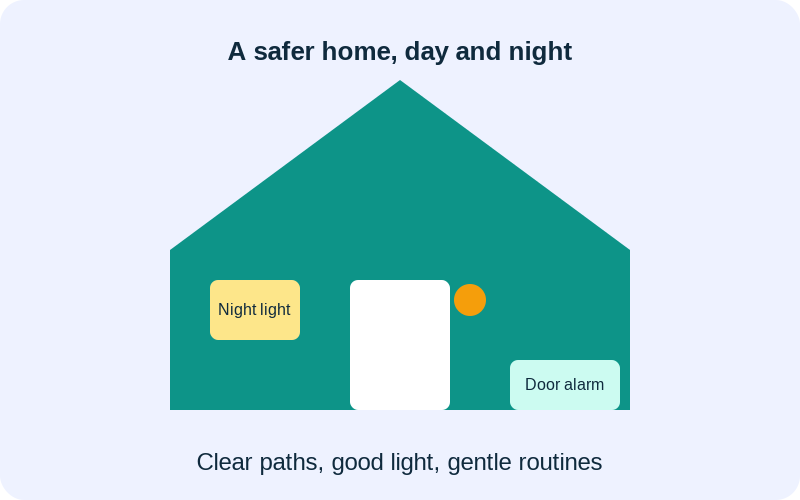
Heat, Cold, and Daily Comfort
Comfort is not a luxury in home care. It is safety. A person who is too hot becomes confused, dehydrated, and unsteady. A person who is too cold becomes confused, sleepy, and unsteady. A person who is uncomfortable in any way is more likely to wander, to fall, or to become distressed. Daily comfort means keeping the house at a temperature that suits your parent, not the temperature that suits you. Older adults often feel the cold more, so a house that feels warm to you may feel cold to them. Ask your parent how they feel, watch for shivering or sweating, and adjust the heating or the clothing accordingly. Keep a thermometer in the living room and the bedroom, so you can check the temperature rather than guessing.
Clothing is part of comfort. Lay out clothes in the order they are put on, and choose layers that can be added or removed as the day warms up or cools down. A light layer indoors, a warm layer for going outside, and a warm blanket for sitting in the evening are simple measures that make a large difference. Shoes matter too: well-fitting shoes with good grip, worn with socks, are safer than slippers that slip off or have smooth soles. In summer, light, loose clothing and a hat are important. In winter, a warm coat, hat, gloves, and scarf are important, and they should be easy to find by the front door, not buried in a cupboard. If your parent has dementia, they may put on too many layers, or too few, or clothes that do not match the weather. Check gently, without making a fuss, and offer a choice: "Would you like the blue jumper or the green one?"
Storms, Floods, and Power Outages
Every season can bring a storm, and a storm can bring a power cut, a flood, or a fallen tree. The seasonal checklist is the time to prepare for the worst the weather can do. Keep a torch in every room, with spare batteries, and a battery-powered radio, so you can hear news and advice when the power is out. Keep a charged power bank for the phone, and charge it regularly. Keep the contacts list on paper, not only in a phone that may run out of power. Keep a supply of food, water, and medicines that lasts several days, so a storm does not mean a dangerous trip to the shops. Keep a warm blanket, a change of clothes, and a small amount of cash in the grab bag by the front door, and make sure everyone knows where it is.
If your parent uses any equipment that needs electricity, talk to the doctor and the supplier about what to do in a power cut, and write the answer in the emergency plan. Never use a generator indoors, and never use a gas cooker or a barbecue to heat a room, because both can produce carbon monoxide, which is invisible, has no smell, and can kill. Fit a carbon monoxide alarm, and test it with the smoke alarms at every seasonal check. In a flood, do not walk or drive through flood water, and move to higher ground if the house is at risk. Follow local advice, keep the radio on, and call the local emergency number if anyone is in danger. In a storm, stay indoors, keep away from windows, and do not go outside until the storm has passed. After a storm, check the house and garden for damage, especially the roof, the fence, and the paths, and fix anything that is dangerous before your parent uses it.
Frequently Asked Questions
How often should I do a seasonal safety check? Four times a year, at the turn of each season. Use the checklists in this guide, and put the next date in your calendar. Review the emergency plan every three months at the same time.
What is the biggest summer risk for an older adult at home? Heat and dehydration. A person with dementia may not recognise that they are too hot or remember to drink. Keep the house cool, keep water within reach, offer it often, and watch for confusion, dizziness, or a dry mouth.
What is the biggest winter risk? Cold, ice, and darkness together. Keep the house warm, keep paths clear of ice, keep outdoor lights working, and avoid going out in icy weather if you can. Watch for shivering, confusion, or unusual sleepiness.
What should I keep in the house for a storm or power cut? A torch in every room with spare batteries, a battery-powered radio, a charged power bank, a paper copy of the contacts list, several days of food, water, and medicines, and a warm blanket. Never use a generator indoors or a gas cooker to heat a room.
How do I keep my parent's routine steady when the seasons change? Keep the anchors the same all year: the same order, the same rough times, the same meals and activities. Change only the details, such as the time of the walk or the clothes, and make one small change at a time.
Sources and Further Reading
This guide draws on the following sources, all accessed 29 November 2026.
- Alzheimer's Association — Facts and Figures, and information on dementia care at home. alz.org/alzheimers-dementia/facts-figures
- National Institute on Aging (NIA) — information on Alzheimer's disease, dementia, and caregiving. nia.nih.gov/health/alzheimers-and-dementia
If this guide helped you, please share it with another family who needs it, and read our other guides on dementia care and home safety, including our fall prevention checklist and our emergency plan for seniors. If you would like to talk about care for your parent, start on our homepage, read more about who we are and how we work, or contact us — a friendly advisor is ready to listen, with no obligation. You can write to us at hello@homecare.biz.id.
Tags: home care safety, senior home care, home checklist
Last reviewed: 27 June 2026. This guide is general information and is reviewed regularly. It is not a substitute for medical advice. Always talk to a doctor about diagnosis, treatment, or any change to care or medication.