
Home Care and Home Safety: Wandering Prevention and Safe Exits
Written by the HomeCare editorial team. Sources: Alzheimer's Association, National Institute on Aging (NIA).
One of the most frightening moments in home care is discovering that your parent has left the house and you do not know where they have gone. A person living with dementia may walk out of the front door in the middle of the afternoon, or slip away at night while the house is asleep, and then be unable to find the way back. They are not trying to cause trouble. They may be looking for a childhood home, trying to get to a job they left years ago, searching for a person who is no longer alive, or simply following a feeling of restlessness they cannot explain. Understanding that wandering usually has a reason, even when the reason is hard to see, is the first step toward preventing it.
This guide is written for adult children caring for a parent at home. It explains why wandering happens, how to spot the warning signs, and what practical steps make a home safer without turning it into a locked building. You will find ideas for doors and exits, alarms that let you know when someone leaves, a safe outdoor space where your parent can walk freely, identification that helps others bring them home, and a daily routine that reduces the urge to wander in the first place. Wandering prevention is not about taking away freedom. It is about shaping the home so that freedom stays safe. If you are new to caring for a parent with dementia at home, start with our complete family guide to dementia care at home and our complete guide to home care, and then come back here for the safety details.
Why People Wander
Wandering is common in dementia, and it is rarely random. Memory loss changes how a person understands where they are and what time it is. Your parent may wake up and believe they are in a different house, or that they need to go home, even when they are already home. The word home may mean the house they grew up in, or the home they shared with a spouse who has died. When that feeling is strong, walking toward it feels like the only sensible thing to do. Arguing that they are already home rarely helps, because the feeling is real to them even when the facts are not.
Other reasons are simpler and easier to fix. Your parent may be hungry, thirsty, too hot, too cold, in pain, or needing the toilet, and wandering is their way of searching for relief. They may be bored, lonely, or under-stimulated, and walking is the only activity available to them. They may be following a habit from a working life: leaving at the same time each morning to catch a bus, or walking to the shops at the same hour each day. They may be frightened by noise, by visitors, or by a change in the house, and walking away feels safer than staying. Or they may simply enjoy walking, as many people do, and the problem is not the walking itself but the fact that they cannot find their way back.
It helps to think of wandering as communication. Your parent is telling you something with their feet, because words have become hard. When you find the message behind the walk, you can often meet the need without stopping the walking. A person who walks because they are bored needs company and activity, not a locked door. A person who walks because they are looking for a bathroom needs a clear sign and a clear path, not a scolding. A person who walks at the same time every evening may be following an old work routine, and a short, planned walk at that hour can satisfy the urge safely. Keep a simple note of when wandering happens, where your parent was heading, and what happened just before. After a week or two, patterns usually appear, and patterns can be worked with. Our guide to building a calm daily routine shows how a steady day can reduce restlessness, and our guide to communicating with calm and patience has ideas for responding when your parent says they want to go home.
Know the Triggers
Most wandering has a trigger, and many triggers can be softened or removed. The most common trigger is a change in the environment or the routine. A new caregiver, a visitor staying overnight, a rearranged room, a loud television, or a house full of people at a family gathering can all make a person with dementia feel unsettled. When the world feels strange, walking is a way of searching for something familiar. Try to keep the home and the day as steady as you can, and warn your parent gently, in simple words, when a change is coming. If visitors are expected, keep the visit short and calm, and give your parent a quiet room to retreat to.
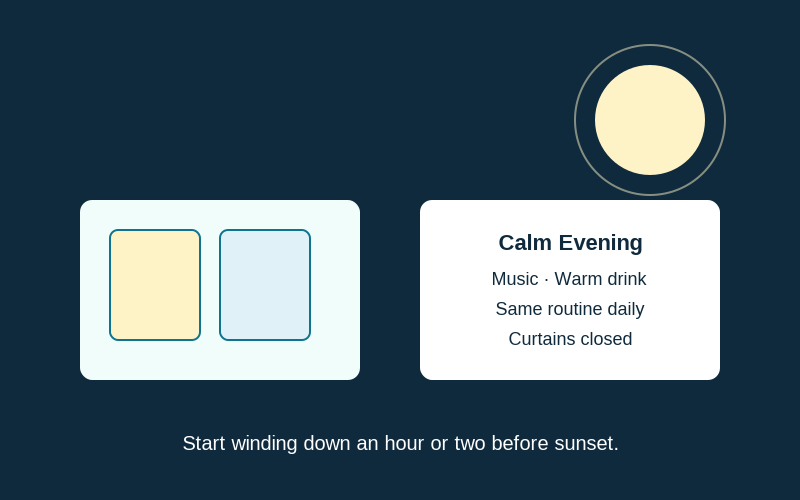
Time of day matters too. Many people become more restless in the late afternoon and evening, a pattern often called sundowning. As light fades, shadows grow, and tiredness builds, confusion can increase. If your parent tends to wander in the evening, that is a clue, not a coincidence. Turning the lights on before dark, closing the curtains, putting on familiar music, and offering a warm drink can make the evening feel settled before restlessness starts. Our guide to managing sundowning at home explains this pattern in detail, and our guide to sleep support and nighttime routine covers the nights that follow.
Physical discomfort is another trigger that is easy to miss. Pain, hunger, thirst, a full bladder, constipation, or a urinary infection can all make a person restless, and a person with dementia may not be able to say what is wrong. If wandering starts suddenly, or becomes much worse than usual, think about the body first. Is your parent eating and drinking enough? Are they in pain? Have they had a fall? Is there a fever? A sudden change is a reason to talk to a doctor promptly, not a behaviour to wait out. Tiredness is a trigger too: a day with too many visitors, too much noise, or too little rest can end in an evening walk. Watch for the small signs that wandering is coming. Pacing, fiddling with a coat or shoes, standing by the door, asking repeatedly about going somewhere, or saying they need to check on something are all warnings. When you see them, act early: offer a drink, suggest a walk together, start a familiar activity, or simply sit with your parent for a while. Early attention is far more effective than a locked door after the fact.
Safe Exits and Doors
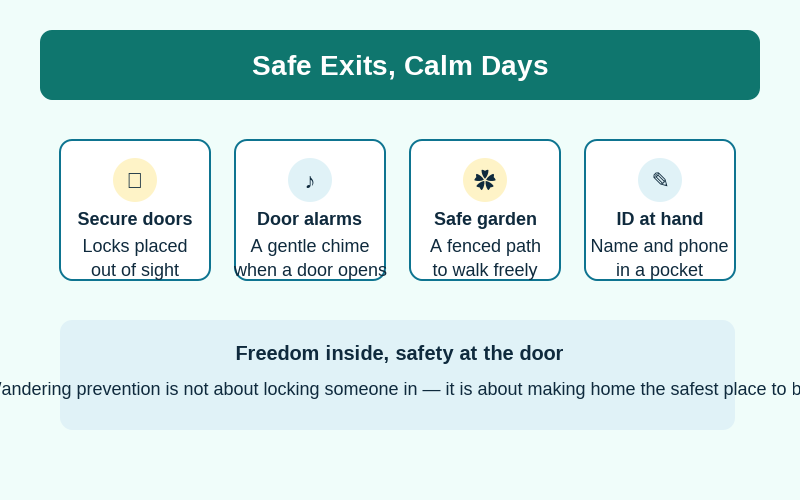
The front door is where most wandering begins, so it deserves the most thought. The goal is to make leaving unnoticed harder, while keeping the house safe in a fire or other emergency. Never lock a person inside a house with no way out, and never block a door with furniture. In an emergency, everyone in the house must be able to leave quickly, and firefighters must be able to get in. Every measure below works with that rule: it delays or alerts, it does not trap.
Start with the simplest changes. A lock fitted high on the door, or low near the floor, is often out of the line of sight of a person with dementia, and a bolt they cannot easily see may be enough to slow them down while you notice. A key-operated lock is fine as long as the key is always in the same place that every family member knows, and never left where your parent can take it and lock themselves in. Some families fit a second lock that is used only at night, when everyone is home and awake to it. Others paint the door the same colour as the wall, or hang a curtain over it, so the door stops drawing the eye. A mirror on or beside the door can also work: a person who sees their own reflection often pauses, and that pause is enough for a caregiver to notice.
Think about all the exits, not just the front door. Back doors, side gates, garage doors, and patio doors are all ways out, and a person who finds the front door locked will often try the next one. Walk around your home and list every way out, then make each one a little harder to use unnoticed. Fit the same kind of discreet lock or alarm to each door, and keep the garden gate closed and latched. A gate that opens inward, with a latch that needs a deliberate lift, is harder to push open by accident than a gate that swings freely. Keep car keys out of sight too: a person who cannot find the front door key may still find the car key, and a car is far more dangerous than a walk. If your parent still drives, that is a separate conversation to have with a doctor, and you can read more in our guide to when to ask for extra help.
Alarms and Alerts That Help
An alarm does not stop someone leaving. It tells you that they have left, while there is still time to follow. That difference matters, because most wandering ends safely when someone notices quickly. The simplest alarm is a bell or chime on the door: a small battery-powered chime that sounds when the door opens, the kind sold for shops, costs very little and needs no wiring. Hang it where you will hear it, including at night, and test it every week. A slightly more advanced option is a door sensor that sends an alert to your phone. These are widely available, easy to fit with adhesive strips, and useful if you are in another room or in the garden. Choose one with a sound you can hear from the bedroom, and check the batteries on a schedule you can remember, such as the first day of each month.
For night-time, a pressure mat beside the bed can alert you when your parent gets up. A mat that sounds a gentle chime in your room, or sends an alert to your phone, gives you time to get up and help before your parent reaches the front door. Motion sensors in the hallway work in a similar way: a sensor that switches on a soft light and a quiet alert when someone passes in the night. Keep the alert sound gentle. A loud siren can frighten a person with dementia and make the situation worse. The goal is to wake the caregiver, not to startle the person walking.
Wearable devices can help too, but only if your parent will wear them. A simple wristband or pendant with a button your parent can press for help is useful if they understand what it is for and remember to wear it. A tracking device that lets a family member see a location on a phone can be reassuring, but it raises questions about privacy and consent, and it only helps if someone is watching and able to act. Talk about it with your parent if you can, and with other family members, and agree together on what is used and why. Technology is a tool, not a replacement for a person. No alarm or tracker removes the need for someone to be nearby, or to check in regularly. Our guide to home monitoring options for families explains sensors, cameras, and wearable alerts in more detail, and our emergency plan guide shows how to write down what to do when an alert sounds.
A Safe Garden and Outdoor Space
If your parent likes to walk, the best answer is often a safe place to walk in, rather than a locked door. A fenced garden with a clear, level path gives your parent freedom, fresh air, and exercise, without the risk of a road. Walk the garden yourself and look at it as your parent would. Is the fence high enough and in good repair, with no gaps a person could slip through? Is the gate latched? Is the path level, with no loose stones, roots, or steps that could cause a fall? Are there places to sit in the shade, and water within reach? A garden chair, a small table, and a bird feeder can turn a garden from a corridor into a destination, somewhere your parent wants to be rather than somewhere they pass through on the way out.
Make the garden interesting enough to hold attention. A few raised beds with herbs or flowers give your parent something to tend, and a simple task like watering plants or picking tomatoes can fill a restless hour. A wind chime, a familiar statue, or a photograph fixed to the fence can act as a landmark, so your parent always knows where they are in the garden. If the garden is large, a circular path is better than a path that ends at a gate: a person who walks in a loop stays inside, while a person who reaches a dead end often looks for a way through. Keep the path well lit in the evening, with a light that comes on automatically at dusk, so a late walk is still a safe one.
Walking together is even better than walking alone. A short walk with your parent, at the same time each day, can satisfy the urge to move before it becomes a problem. Walk at their pace, on a familiar route, and talk about what you see. If your parent wants to walk and you cannot go with them, a walk in the garden, or a walk to the end of the street and back with a neighbour, can be a safe compromise. Some families arrange a regular walking companion: a neighbour, a relative, or a professional caregiver who walks with their parent for an hour each day. That hour of company and movement can be the best wandering prevention there is. Fresh air, daylight, and gentle exercise also help sleep, which in turn helps the evenings and nights. You can read more about suitable activities in our guide to daily activities and engagement, and about making the home itself calm and familiar in our guide to a calm, familiar home.
Identification and What to Do If Someone Leaves
Even with the best prevention, a person with dementia may still leave the house and become lost. Planning for that moment, before it happens, makes all the difference. The single most useful thing is identification that your parent carries at all times. A card in a pocket or wallet, with their name, your name, and your phone number, written in large, clear print, can help a stranger or a passer-by bring them home. A bracelet or necklace with the same details works even better, because it cannot be left behind in a coat pocket. Some families sew a small label with a name and phone number into a favourite coat, so the identification travels with the coat your parent always wears. Keep the wording simple and kind: a name, a phone number, and a short line such as "I have memory problems, please call my family". Do not put a home address on anything your parent carries, because a lost card with an address can be misused.
Keep a recent photograph of your parent, and a short written description, ready at all times. The photograph should show what your parent usually wears, and the description should include height, build, hair colour, glasses, and any distinctive clothing or shoes. If your parent goes missing, you will be too worried to describe them clearly, and a ready-made description saves precious minutes. Keep a copy on your phone and a printed copy by the front door. Tell your neighbours, too. A neighbour who knows your parent has dementia, and who knows your phone number, is one of the best safety nets there is. Ask neighbours to call you if they see your parent out alone, especially at night or in bad weather, and let them know the places your parent tends to head for: a former home, a park, a shop, a church, or a bus stop.
If your parent leaves and you cannot find them, act quickly and calmly. Search the house first, including cupboards, the garden, and the garage, because a person with dementia may hide or fall asleep somewhere unexpected. Then search the places your parent knows best and the routes they used to walk, and call the neighbours. If you cannot find them within a short time, call your local emergency number and report a missing vulnerable adult. Give the description and photograph you prepared, say that your parent has dementia and may be confused, and name the places they may be heading for. Do not wait for hours hoping they will come back on their own: a person with dementia can walk a long way in a short time, and can become cold, dehydrated, or frightened very quickly. After your parent is found, do not scold them. Sit down, offer a drink and a warm blanket, and when everyone is calm, think about what changed and what you can add to the plan. Every incident is information for the next version of your prevention plan. Our emergency plan guide has a step-by-step checklist for exactly this situation, and it is worth reading and filling in before you need it.
A Daily Routine That Calms Restlessness
Prevention works best when it starts in the morning, not at the front door. A person who is tired, bored, hungry, or lonely is far more likely to wander than a person who has had a full, calm day. A steady routine gives the day a shape, so your parent does not have to search for something to do. Breakfast at the same time, a short walk in the morning, lunch at the same table, a favourite activity in the afternoon, and a calm evening with familiar music and a warm drink: none of these are dramatic, but together they fill the day with anchors. A person who has walked in the morning, eaten well, and spent time with someone they like is less likely to feel the restlessness that leads to wandering.
Build movement into every day. A walk in the morning, gardening, light housework, or dancing to a favourite song all count. Movement uses energy, lifts mood, and helps sleep, and it gives a restless person somewhere to put that restlessness. Build company into the day too. Loneliness is a powerful trigger for wandering: a person who feels alone may go looking for people. A phone call from a grandchild, a visit from a neighbour, a shared meal, or an hour with a professional caregiver can all reduce the urge to leave. Build purpose into the day as well. A small job, such as folding towels, sorting photographs, watering plants, or setting the table, gives your parent a role in the home. A person who feels useful is less likely to feel that they need to go somewhere else to matter.
Watch the transitions in the day, because wandering often happens at the edges: when a caregiver leaves, when a visitor arrives, when the light changes, or when the house goes quiet. Plan for those moments. If you are leaving the house, say goodbye clearly, say when you will be back, and leave your parent with an activity and a person, not alone in a silent room. If evening is the difficult time, start the wind-down early, before the restlessness begins. Keep a notebook for a week and write down when wandering or restlessness happens, what came before it, and what helped. Patterns will appear, and once you see the pattern, you can change the hour before it rather than reacting after it. For more on building a day that works, read our guides to a calm daily routine, mealtime help and nutrition, and sleep and nighttime routine.
Frequently Asked Questions
Is it cruel to lock the doors to stop my parent wandering? Safety and dignity both matter. A lock that delays someone while a caregiver notices is different from locking a person in alone with no way out. Never block an exit or lock someone in a house with no escape in an emergency. Use discreet locks, alarms, and a safe garden together, and talk to your parent about the plan where you can.
What should I do first if my parent goes missing? Search the house and garden, then the places they know best, and call the neighbours. If you cannot find them quickly, call your local emergency number and report a missing vulnerable adult, with the photograph and description you prepared in advance. Do not wait for hours hoping they will return on their own.
Why does my parent keep saying they want to go home when they are already home? Home may mean the house they grew up in, or a home shared with someone who has died. The feeling is real to them. Do not argue. Acknowledge the feeling, offer a drink and a familiar activity, and gently redirect. Our guide to communicating with calm and patience has more ideas.
Will a tracking device stop my parent getting lost? No device stops wandering. A tracker can help you find someone faster, but only if someone is watching and able to act. Talk it through with your parent and family, and use it alongside locks, alarms, identification, and a daily routine, not instead of them.
When should I ask a doctor about wandering? If wandering starts suddenly, becomes much more frequent, or happens at night, talk to a doctor promptly. A sudden change can have a medical cause, such as pain, infection, or a medication effect, and a doctor can advise on what may help.
Sources and Further Reading
This guide draws on the following sources, all accessed 29 November 2026.
- Alzheimer's Association — Facts and Figures, and information on dementia care at home. alz.org/alzheimers-dementia/facts-figures
- National Institute on Aging (NIA) — information on Alzheimer's disease, dementia, and caregiving. nia.nih.gov/health/alzheimers-and-dementia
If this guide helped you, please share it with another family who needs it, and read our other guides on dementia care and home safety, including our emergency plan for seniors and our fall prevention checklist. If you would like to talk about care for your parent, start on our homepage, read more about who we are and how we work, or contact us — a friendly advisor is ready to listen, with no obligation. You can write to us at hello@homecare.biz.id.
Tags: home care safety, dementia home care, wandering prevention
Last reviewed: 26 June 2026. This guide is general information and is reviewed regularly. It is not a substitute for medical advice. Always talk to a doctor about diagnosis, treatment, or any change to care or medication.