
Home Care and Home Safety: Kitchen Safety for Older Adults at Home
Written by the HomeCare editorial team. Sources: Alzheimer's Association, National Institute on Aging (NIA).
The kitchen is the heart of most homes, and for an older parent it is often the room that matters most. It is where breakfast happens, where the kettle goes on, where a favourite meal is made, and where a parent who has cooked for a family for decades still feels useful and independent. It is also a room full of heat, sharp edges, heavy pans, and slippery floors, and it asks a lot of a person whose strength, balance, eyesight, and memory are no longer what they were. Kitchen safety is not about taking the kitchen away from your parent. It is about arranging the room, and the routines around it, so your parent can keep cooking and making a cup of tea with confidence, for as long as possible.
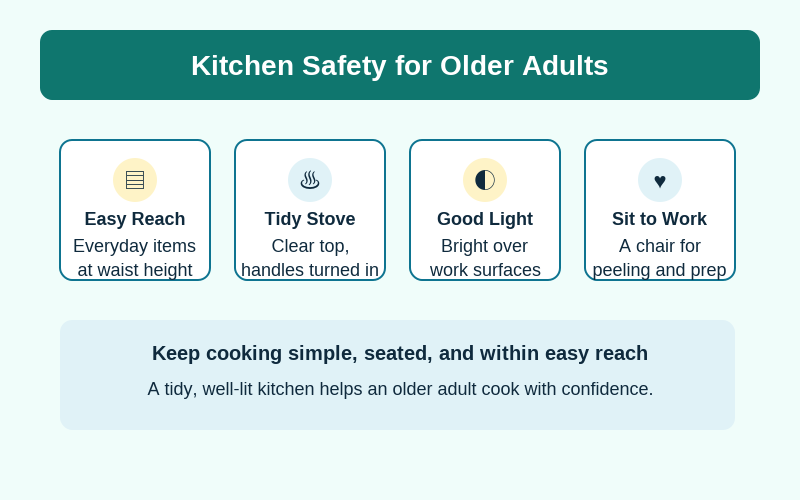
This guide is written for adult children caring for a parent at home. It walks through the kitchen step by step, from the stove to the shelves, and gives you simple, practical habits you can start this week. Most of the changes cost little or nothing: moving everyday items to waist height, turning pan handles inward, mopping up spills straight away, and sitting down to peel vegetables. Together, they make the kitchen a place your parent can use safely, rather than a place the family worries about. If you would like the wider picture first, read our complete family guide to dementia care at home, our complete guide to home care, and our fall prevention checklist, which covers the whole house room by room.
Why the Kitchen Deserves Attention
The kitchen combines more risks in one room than almost anywhere else in the house. There is heat from the stove and the oven, steam from the kettle, sharp knives and graters, heavy pots and pans, glass that breaks, and a floor that is often wet from washing up or a spilled drink. A person cooking must also do several things at once: watch a pan, remember a timer, carry a hot dish, and move around a small space, often while standing for a long time. For an older person, that combination is demanding. A moment of distraction, a forgotten pan, or a step back onto a wet floor can turn an ordinary meal into an accident. Memory problems make it harder still: a parent living with dementia may forget that the stove is on, leave a pan to boil dry, or put something in the oven and forget it is there.
That is why kitchen safety is about the room and the routine together. A tidy, well-lit kitchen with everything in its place is easier to use, and a simple cooking routine, with one task at a time and nothing left unattended, is safer than a complicated meal made in a hurry. The goal is to keep your parent involved in the kitchen for as long as it is safe, because cooking is not only about food. It is about independence, routine, and the pleasure of making something for the family. Our mealtime and nutrition guide covers eating well, and our daily routine guide shows how regular mealtimes anchor the whole day. This guide covers the room itself, so the cooking can go on safely.
Start With a Kitchen Walk-Through
Before you change anything, spend a morning in the kitchen watching how your parent actually uses it. Where do they stand to make tea? Where do they reach for a plate? Where do they put a hot pan down? Watch the whole journey of a meal, from taking food out of the fridge to carrying it to the table, and notice where the awkward moments are. Is there a cupboard that is too high, a drawer that sticks, a corner where the floor is uneven, or a spot where the light is poor? Is the kettle filled at the sink and carried across the room? Is there a chair to sit on, or must your parent stand for the whole meal preparation?
Write down what you notice, and sort it the way our fall prevention checklist suggests: things you can fix today, such as moving the kettle closer to the sink or clearing the worktop; things you can fix this week, such as adding a brighter light or a non-slip mat; and things that need a tradesperson, such as a new tap or a flooring repair. Ask your parent what they find hard in the kitchen, and listen to the answer. They may tell you that the oven is too low, that the pans are too heavy, or that they worry about forgetting the stove. Their answer tells you where to start, and it also tells you what matters to them, which is the part of the kitchen they most want to keep. Take photographs of the tricky spots, so other family members can see them, and so you can compare before and after.
The Stove and Cooking Safely
The stove is the first thing to look at, because it is where heat and distraction meet. Make a habit of turning pan handles inward, toward the back of the stove, so they cannot be knocked by someone walking past, and so a sleeve cannot catch them. Use the back burners first when you can, and keep the front of the stove clear. Keep tea towels, oven gloves, and paper away from the burners, and keep a lid nearby, so a pan can be covered quickly if it spatters. Never leave a pan on the heat and walk away from the kitchen, even for a moment, and make it a rule that if the cook leaves the room, the heat goes off. A simple kitchen timer, with a loud ring, helps your parent remember that something is cooking, and it is worth setting one every time the stove is on.
Think about what is cooked, as well as how. Simple meals, made one pan at a time, are safer than complicated meals with several pans on the go. A slow cooker or a microwave can take over some of the cooking, but only if your parent knows how to use them safely, and only if the food is heated right through and served on a plate that is easy to carry. If your parent forgets the stove often, talk to a doctor or an occupational therapist about whether a stove with an automatic shut-off, or a device that turns the stove off after a set time, would help. Never try to fit such a device yourself unless you know how. And if a pan ever catches fire, the rule for the family is simple: do not try to carry it, do not put water on it, and get everyone out of the kitchen and call the local emergency number. Our emergency plan guide explains how to prepare for kitchen emergencies, and our bathroom safety guide covers the other room where heat and water meet.
Knives, Sharp Tools, and Small Appliances
Knives are a normal part of cooking, but they deserve respect, especially when hands are weaker or less steady. Keep knives sharp, because a blunt knife needs more force and is more likely to slip, and store them in a block or a drawer with a guard, not loose in a drawer where a hand can find the blade. Offer your parent a knife with a large, comfortable handle that is easy to grip, and suggest cutting sitting down at the table, with a non-slip board, rather than standing at the worktop. If cutting is becoming hard, a simple food chopper, or vegetables bought already prepared, can keep your parent involved in cooking without the riskiest task. Keep graters, peelers, and scissors in the same place, and put them away after use, so they are not left on the worktop where they can be knocked to the floor.
Small appliances need the same care. A kettle should be light when full, easy to lift, and easy to pour, and it should sit close to the sink so it does not have to be carried across the room. Fill it only as full as needed, and put it back on its base after use. A toaster should be easy to reach without stretching, and the cord should be tucked away so it cannot be pulled. Unplug small appliances when they are not in use, and check cords regularly for damage. If an appliance is damaged, throw it away rather than trying to repair it. Keep the worktop clear of appliances that are not used every day, because a crowded worktop leaves no safe space to put a hot pan down. For more on keeping the house safe around appliances and cords, read our lighting and flooring guide.
Storage Within Easy Reach
Most kitchen accidents happen while reaching: up to a high shelf for a plate, or down to a low cupboard for a heavy pan. The rule is simple, and it applies to every room in the house: keep everyday items at waist height, between the shoulders and the hips. Plates, cups, and glasses belong in a cupboard at that height, near the sink or the dishwasher. Food used every day belongs in a cupboard at the same height, near the worktop. Heavy things, such as large pots and bags of flour, belong low down, where they can be lifted with both hands and without bending too far. Light things, such as plastic containers and baking trays, can go higher up, because they are easy to lift down with one hand.
Go through the cupboards with your parent, and move things to where they are used. The tea and coffee belong near the kettle. The plates belong near the table. The pans belong near the stove. Throw away or give away anything that is broken, duplicated, or never used, because a crowded cupboard is a cupboard where things fall out. Use shelf organisers, turntables, and pull-out drawers if they help, but keep the system simple: every item in the same place, every time, so your parent can find it without thinking. This matters even more for a parent living with dementia, for whom a familiar place is a memory in itself. Our guide to a calm, familiar home explains why, and our medication storage guide covers keeping anything that should not be eaten or drunk in a safe, labelled place.
Food Storage and Freshness
A safe kitchen is also a kitchen where food is stored properly and used before it spoils. Keep the fridge at a cool temperature, and check it regularly for food that is out of date or past its best. Throw away anything you are unsure about, and do not taste food to check whether it is still safe. Keep leftovers in clear containers with a label showing the day they were made, so nobody has to guess. Store raw and cooked food separately, and keep the fridge tidy, so nothing is hidden at the back and forgotten. A weekly fridge clear-out, when you check dates and throw away anything that is no longer fresh, is a simple habit that keeps the kitchen safe without a big effort.
Think about the cupboards too. Keep dry food in sealed containers, with labels your parent can read, and throw away anything that is out of date or has been open for a long time. Store cleaning products and anything that should not be eaten or drunk in a separate cupboard, away from food, and keep them labelled. If your parent sometimes confuses a bottle of cleaning product with a drink, keep such products in a locked or high cupboard, and talk to a doctor or a pharmacist if you are worried. Our medication storage guide has more on safe storage and clear labels, and our mealtime and nutrition guide covers food and eating in detail. Keep a simple shopping list on the fridge, so the same items are bought each week, and so nothing important runs out.
Lighting, Flooring, and Spills
The kitchen floor is often wet, and a wet floor with a hard surface is a fall waiting to happen. Mop up spills straight away, and keep a mop and a cloth where they can be reached without bending. Use a non-slip mat in front of the sink and the stove, where water and steam are most likely, and make sure the mat itself does not slide. Remove loose rugs, or fix them down with non-slip backing, and repair any loose tile or uneven floor as soon as you notice it. Keep the floor clear of pet bowls, bags, and anything else that can be tripped over, and keep the path from the kitchen to the table clear at all times.
Good light matters in the kitchen as much as anywhere else. The worktops should be bright enough to see what is being cut and cooked, with a light over the stove and a light over the sink. Use the brightest bulbs the fittings allow, and replace them the same day they fail. Avoid glare from a shiny worktop or a window, because glare can hide a knife edge or a spill. A light that comes on automatically in the kitchen at night means your parent can make a drink without fumbling for a switch in the dark. Our lighting and flooring guide covers light and floors in every room, and our seasonal home safety checklist reminds you to check them again as the days get darker.
Sitting Down to Work and Eat
Standing for a long time is tiring, and tiredness leads to mistakes. A sturdy chair or a high stool in the kitchen, at the worktop or the table, lets your parent sit down to peel vegetables, prepare a sandwich, or wait for the kettle. Choose a chair that is firm, with a back and armrests, and that does not slide across the floor. A chair with a wipe-clean seat is practical in a kitchen. If your parent sits to work, make sure the worktop or table is at a comfortable height, and that everything needed is within reach, so there is no need to stand up and down repeatedly. Sitting to eat matters too: a meal eaten sitting at the table, with time to enjoy it, is safer and more pleasant than a meal eaten standing up or carried to another room.
Carrying food is one of the riskiest kitchen jobs. A hot plate, a full mug, and a walk across the room are a difficult combination, especially for a person with weak hands or poor balance. Use a sturdy trolley to move food from the kitchen to the table, or carry one thing at a time, with both hands free. Use plates and mugs that are light and easy to grip, with large handles, and avoid overfilling them. A non-slip tray can help, and a mug with a lid can stop spills. If your parent finds carrying hard, serve the meal at the table, or eat in the kitchen itself, where the journey is short. Our mealtime and nutrition guide has more on making meals enjoyable, and our guide to daily activities shows how helping in the kitchen can stay part of a full day.
Simple Daily Habits That Help
Kitchen safety is mostly a matter of habit, and habits are easier to keep when they are simple and repeated at the same time each day. Make a short list of kitchen habits, and put it on the fridge where everyone can see it. The list might include: turn pan handles inward; set the timer every time the stove is on; turn the stove off before leaving the kitchen; mop up spills straight away; put knives away after use; and check that the stove is off before bed. A short, visible list is easier to remember than a long set of rules, and it helps everyone who uses the kitchen, not only your parent. If your parent lives with dementia, a list with pictures, or a simple picture of a stove with the word off beside it, can help even more.
Build the habits into the routine of the day. Breakfast at the same time, lunch at the same time, and a kitchen tidy-up after each meal, so the room is ready for the next one. A tidy kitchen is a safe kitchen, and a kitchen that is tidied after every meal never becomes overwhelming. Keep the routine in the same order, so your parent knows what comes next, and praise the effort when it goes well. Our daily routine guide shows how to build a steady day, and our medication reminders guide shows how simple checklists and routines help with the other daily tasks as well. If a habit is forgotten, do not scold; remind gently, and try again tomorrow.
Cooking With Memory Problems
When a parent lives with dementia, the kitchen needs extra thought, but it does not need to be closed. The key is to simplify, not to remove. Simplify the recipes: one pan, a few steps, and ingredients laid out in the order they are used. Simplify the room: fewer items on the worktop, fewer choices in the cupboard, and everything in the same place. Simplify the time: cook together, at a calm time of day, with no rush and no visitors. Your parent can still stir, peel, wash vegetables, set the table, and taste the food, even if they can no longer manage the whole meal alone. Those jobs matter, because they keep your parent part of the family and part of the day.
Watch for the signs that cooking alone is no longer safe: pans left on the heat, food left in the oven, the stove left on overnight, or your parent looking confused in the kitchen. When those signs appear, cook together, or take over the stove while your parent does the safer jobs, such as setting the table or washing vegetables. Talk to a doctor about what you have noticed, because a change in the kitchen can be a sign of a change in health. Never leave your parent alone with the stove on if they are confused or unsteady, and consider a stove shut-off device, fitted by a professional, if forgetting the stove is a regular problem. Our guide to communicating with calm and patience can help with the conversation, and our guide to managing sundowning explains why evenings, when the kitchen is busiest, can be the hardest time of day.
When to Ask for Extra Help
There comes a point when the kitchen needs more than a tidy-up and a new habit. If your parent has left the stove on more than once, if they have been burned or cut, if they are afraid to cook, or if you are worried every time they go into the kitchen alone, it is time to ask for more support. Talk to a doctor first, and ask for a home safety assessment from an occupational therapist, who can look at the kitchen with professional eyes and suggest changes, from a stove shut-off device to a different layout. If you need more hands at home, professional home care can help with cooking, mealtimes, and the morning and evening routines, at the times of day when help is needed most.
The median cost of home care in the United States is around $35 an hour, according to CareScout's 2025 cost of care data, and the exact cost in your area will depend on the provider and the hours you need, so ask local providers for a clear quote before you decide. Asking for help is not a failure, and it does not mean your parent has to leave home. It means the home is getting the support it needs to stay safe. Read our guide to when to ask for extra help, and our guide to home monitoring options, which explains how simple devices can add reassurance when you cannot be there. And remember to look after yourself: a tired caregiver misses risks, so build in breaks, share the cooking with other family members, and ask for respite before you reach breaking point.
Frequently Asked Questions
What is the most important kitchen safety habit? Never leave the stove unattended, and turn it off before leaving the kitchen. A kitchen timer, set every time the stove is on, helps your parent remember that something is cooking.
Should my parent still cook if they have dementia? For as long as it is safe, yes, with support. Simplify the recipes, cook together, and let your parent do the safer jobs, such as peeling, stirring, and setting the table. Talk to a doctor if you notice pans left on or food forgotten in the oven.
How can I stop spills causing falls? Mop up spills straight away, use a non-slip mat in front of the sink and stove, and remove loose rugs. Keep a mop and cloth within easy reach, and keep the floor clear of anything that can be tripped over.
What if my parent keeps forgetting the stove is on? Talk to a doctor and ask an occupational therapist about a stove with an automatic shut-off or a shut-off device fitted by a professional. In the meantime, cook together and do not leave your parent alone with the stove on.
How do I make the kitchen easier to use? Move everyday items to waist height, keep everything in the same place, and clear the worktops. A chair to sit on while preparing food, and a trolley to carry food to the table, make the kitchen much easier to use.
Sources and Further Reading
This guide draws on the following sources, all accessed 29 November 2026.
- Alzheimer's Association — Facts and Figures, and information on dementia care at home. alz.org/alzheimers-dementia/facts-figures
- National Institute on Aging (NIA) — information on Alzheimer's disease, dementia, and caregiving. nia.nih.gov/health/alzheimers-and-dementia
If this guide helped you, please share it with another family who needs it, and read our other guides on dementia care and home safety at home. If you would like to talk about care for your parent, start on our homepage or contact us — a friendly advisor is ready to listen, with no obligation. You can write to us at hello@homecare.biz.id.
Tags: home care safety, kitchen safety, senior living
Last reviewed: 26 June 2026. This guide is general information and is reviewed regularly. It is not a substitute for medical advice. Always talk to a doctor about diagnosis, treatment, or any change to care or medication.