
Home Care and Home Safety: Medication Storage and Safety at Home
Written by the HomeCare editorial team. Sources: Alzheimer's Association, National Institute on Aging (NIA).
If you are caring for a parent at home, you have probably looked at the bathroom cupboard or the kitchen shelf and wondered whether everything there is safe, in date, and in the right place. Most families have more medicines, creams, drops, and supplements in the house than they realise, and they are often spread across several rooms, in different bags and boxes, with labels that are hard to read. That is not a failure. It is what happens when care builds up over time, one prescription at a time. But a scattered, unclear store is a risk: the wrong item can be taken by mistake, an out-of-date item can be used without anyone noticing, and a visitor or a grandchild can reach something they should not touch.
This guide is about the home side of medication safety: where things are kept, how they are labelled, and how the daily routine around them is organised. It is written for adult children caring for a parent at home, and it does not give advice about any treatment, or about starting, stopping, or changing any medication. Those decisions belong to your parent's doctor and pharmacist, and this guide will keep pointing you back to them. What it will give you is a clear, practical system: one safe place, clear labels, a simple daily check-off, and a list you can share with the doctor, the pharmacist, and anyone else who helps with care. If you would like the wider picture first, read our complete family guide to dementia care at home, our complete guide to home care, and our medication reminders and organization guide, which covers the reminder side of the daily routine.
Why Safe Storage Matters
Safe storage matters for three reasons, and they are all simple. First, it prevents mistakes. When everything is in one place, with clear labels, it is much harder to pick up the wrong box, or to use something that is out of date, or to lose track of what has been used. Second, it protects other people. A grandchild visiting for the afternoon, a neighbour dropping by, or a pet exploring the house should never be able to reach something that could harm them. Third, it makes the daily routine calmer. When the store is tidy and the list is clear, the daily routine takes minutes rather than a worried search through cupboards, and everyone who helps with care can follow the same system.
Memory problems make safe storage even more important. A parent living with dementia may forget whether they have already used an item, may open a bottle and forget to close it, or may pick up a bottle that looks familiar and use it in the wrong way. A locked store, a clear label, and a simple check-off routine protect against those mistakes, and they protect your parent's dignity too, because they make it possible to keep care at home safely. Our guide to a calm, familiar home explains why keeping things in the same place matters so much, and our fall prevention checklist covers the rest of the house. Storage is not about locking things away and forgetting them. It is about knowing exactly what is in the house, where it is, and whether it is safe to use.
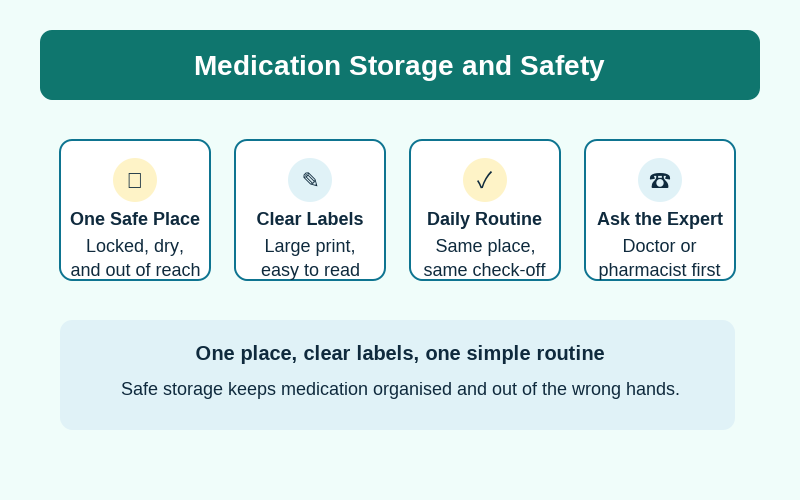
One Safe Place for Everything
The first step is to gather everything into one place. Go through the house, room by room, and collect every item that belongs in the store: the bathroom cupboard, the kitchen shelf, the bedside table, the handbag, the coat pocket, and the car. Put them all on a table, and look at what you have. You may be surprised by how much there is, and by how many duplicates, out-of-date items, and half-empty boxes you find. That is normal, and it is the reason this step matters. A store you cannot see is a store you cannot manage.
Choose one place for the store, and keep it there. The best place is cool, dry, and out of direct sunlight, away from the bathroom, where steam and damp can damage packaging and labels, and away from the kitchen stove, where heat can do the same. A high cupboard in a bedroom, or a cupboard in a hallway, often works well, as long as it is easy for the person who manages the routine to reach, and out of reach of children and visitors. Keep the store tidy: items standing upright, labels facing forward, and nothing piled on top of anything else. A small box or a tray inside the cupboard can keep things together, and a label on the outside of the cupboard, saying what is inside, helps everyone who helps with care. Once you have chosen the place, tell the whole family, and keep it there. A store that moves around the house is a store that gets lost.
Locked Storage and Keeping Things Out of Reach
Some items in the store should be locked away, and it is worth thinking carefully about which ones. As a general rule, anything that could cause harm if taken by the wrong person, or taken in the wrong way, should be kept in a locked box or a locked cupboard, with the key held by the person who manages the routine. A simple lockable box, or a cupboard with a small lock, is enough for most homes, and it does not need to be expensive. The key should be kept in a place the caregiver can reach easily, but a child or a visitor cannot. If your parent manages their own routine and is able to do so safely, they should have access too, but if they are confused or forgetful, the key should be held by the caregiver.
Out of reach means out of sight as well as out of hand. A bottle on a low shelf, or on a bedside table, can be reached by a small child in seconds, and a bottle left on a kitchen worktop can be picked up by mistake. Keep the store above the reach of children, and never leave items out on a table or a worktop after the daily routine is done. Put them back in the store straight away. If grandchildren visit regularly, be extra careful: tidy the store before they arrive, and keep handbags and coat pockets, where items are often carried, out of their reach. If you are unsure whether an item should be locked away, ask your pharmacist. They can advise on safe storage for the items your parent has, and on what to do if an item is accidentally taken by someone it was not meant for.
Clear Labels You Can Read
A label is only useful if it can be read, and many labels are small, faded, or covered by another sticker. Go through the store and check every label. Can you read it easily, in the light of the room where the store is kept? Is the name of the item clear? Is the date clear? If a label is faded, torn, or hard to read, ask the pharmacist for a new label, or for a larger-print label. Do not write over a label yourself, and do not move an item into a different container, because the original packaging and label are part of the safety information. If two items look alike, keep them apart in the store, and mark them clearly, so they cannot be confused.
Large print helps everyone, not only a parent with poor eyesight. A clear, handwritten label on the outside of a box, with the name of the item in large letters, can make the store much easier to use, and it helps anyone else who helps with care. Keep a torch or a small light near the store, so labels can be read even in poor light, and keep a magnifying glass there too, if it helps. If your parent has poor eyesight, talk to a doctor or an optician, because better glasses can make the whole house safer, and read our lighting and flooring guide for more on light in the home. Never remove a label, and never throw away the leaflet that comes with an item, because it carries information the doctor or pharmacist may need.
A Simple Daily Routine
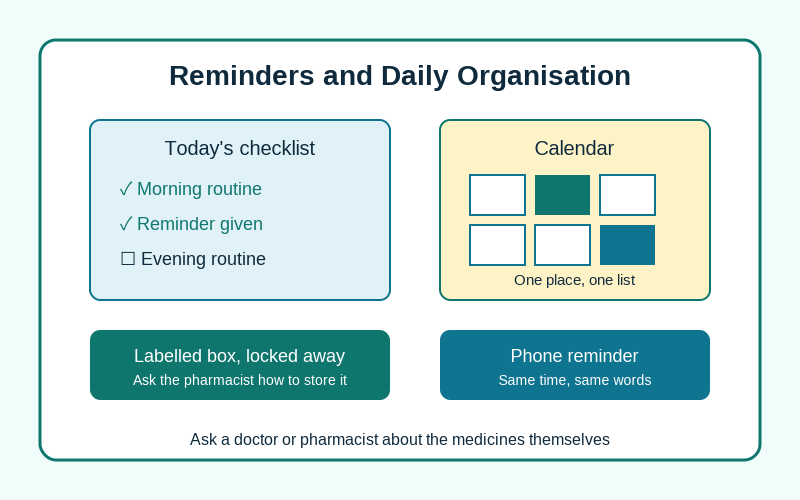
The daily routine around the store should be simple, steady, and in the same order every day. Choose a regular part of the day for the routine, such as after breakfast or before bed, and keep it at that time, so it becomes a habit. Lay out what is needed, check the labels, follow the routine your parent's doctor or pharmacist gave you, and then put everything back in the store straight away. A simple check-off list, on paper, on the fridge, or on a whiteboard, helps everyone remember what has been done, and it helps the next person who helps with care to see where things stand. Tick each item off as it is done, and keep the list where it can be seen.
Build the routine into the wider routine of the day, so it happens at the same time and in the same order, alongside meals and other daily tasks. Our daily routine guide shows how a steady day helps a person with dementia, and our medication reminders guide has more ideas for reminders and checklists. If your parent manages the routine themselves, check in regularly, and look at the check-off list together, so you can see whether it is working. If the routine is missed, or something is unclear, do not guess. Talk to the doctor or pharmacist promptly, and ask them what to do. Never try to make up for a missed step on your own, and never change the routine without asking the doctor or pharmacist first.
Using an Organizer Safely
Many families use a weekly organizer, a box with separate compartments for each part of the day, to keep the routine clear. An organizer can be very helpful, because it shows at a glance what has been done and what is still to do, and it keeps the items for the day in one place. But an organizer is only safe if it is filled correctly, and filling it is a job that needs care and attention. Fill the organizer in a quiet moment, with good light, and without distractions. Check each label as you fill each compartment, and check the list at the same time, so you can be sure the organizer matches the list. Never fill an organizer when you are tired, rushed, or interrupted, and never let a child fill it.
Keep the organizer in the store when it is not in use, and keep the original packaging as well, so the labels and leaflets are still there if the doctor or pharmacist needs them. If you are unsure how to fill an organizer, or whether an organizer is right for your parent, ask the pharmacist. Some pharmacists will fill an organizer for you, or will supply items in packaging that is already organised, and it is worth asking what help is available. If your parent has a complex routine, or if more than one person fills the organizer, talk to the pharmacist about the safest way to manage it, and keep a single list that everyone follows. Our medication reminders guide has more on organizers and reminders, and our kitchen safety guide covers safe storage of other household items.
Keeping a Clear, Up-to-Date List
A clear, up-to-date list is the most useful document in the house, after the store itself. The list should name every item in the store, in plain words, with the date it was started and the date it should be checked again. Keep the list in the store, and keep a copy in your parent's care records, so it can be shared with the doctor, the pharmacist, and anyone else who helps with care. Update the list every time something changes: when a new item is added, when an old item is finished, or when the doctor or pharmacist changes the routine. A list that is out of date is worse than no list, because it gives a false sense of certainty.
Take the list to every appointment with the doctor and the pharmacist, and ask them to check it. They can tell you whether the list is complete, whether anything on it is out of date, and whether anything should be stored differently. Keep a note on the list of the doctor's and the pharmacist's phone numbers, so you can call them quickly if you have a question. If your parent goes into hospital, or sees a new doctor, take the list with you, and take the store itself if the doctor asks for it. A clear list saves time, prevents mistakes, and helps the doctor and pharmacist give the best advice. You can read more about keeping care organised in our medication reminders guide and our emergency plan guide, which explains how to keep care information where it can be found in an emergency.
Expired and Unused Items
Out-of-date items should never be used, and unused items should not sit in the store forever. Go through the store regularly, at least once a month, and check the date on every item. Throw away anything that is out of date, and anything that has been open for a long time, unless the pharmacist advises otherwise. Keep a small bag or box for items to be returned, and take them to the pharmacy for safe disposal. Many pharmacies will take back unused or out-of-date items, and it is worth asking yours what they accept. Never throw items in the household bin if the pharmacy can take them, and never pour them down the sink or the toilet.
Be careful with items that look fine but are no longer needed. A half-used box from a routine that has changed, or an item that was bought for a short-term need, should be checked with the pharmacist before it is used again. Keep the store lean: only the items your parent currently needs, in the amounts needed, with nothing extra gathering dust at the back. A lean store is easier to check, easier to keep tidy, and easier to keep safe. If you are unsure whether an item is still safe to use, ask the pharmacist, and do not use it until they have advised you. Our bathroom safety guide covers safe storage of other bathroom items, and our seasonal home safety checklist reminds you to check the store as part of a seasonal tidy.
Visitors, Children, and Pets
The store needs to be safe not only for your parent, but for everyone who comes into the house. Grandchildren are the biggest worry, because they are curious, quick, and low to the ground, and they can reach a low shelf or an open bag in seconds. Before children visit, tidy the store, lock it, and check the house for any items left out on tables, worktops, or bedside tables. Keep handbags and coat pockets, where items are often carried, out of reach, and remind visitors to do the same. If a child does take something, or you think they may have, call the doctor or the local emergency number promptly, and take the packaging with you, so the doctor can see what it was.
Pets need thought too. A dog or a cat can knock a bottle off a low shelf, or chew packaging that is left within reach. Keep the store in a cupboard with a door that closes, and keep items off the floor. Visitors who help with care should be told where the store is, how the routine works, and where the list is kept, so they can follow the same system. If a visitor brings their own items into the house, ask them to keep them in their bag, out of reach, and to take them home again. A clear system, shared with everyone who comes into the house, keeps the store safe for all. Our guide to safe exits covers keeping the house safe for visitors, and our guide to daily activities has ideas for safe, enjoyable visits with grandchildren.
Travel, Outings, and Overnight Stays
When your parent goes out for the day, or stays overnight somewhere else, the store needs to travel too, but in a safe way. Pack only what is needed for the trip, in the original packaging, with the labels intact, and keep it in a bag that stays with the caregiver, not in a suitcase that is out of reach. Keep the list with the bag, so anyone who helps during the trip can follow the same routine. Keep the bag cool and dry, out of direct sunlight, and never leave it in a hot car. When you arrive, put the bag in a safe place straight away, out of reach of children, and put it back in the store as soon as you get home.
For an overnight stay, pack the store the day before, in a quiet moment, and check the labels and the list before you leave. Tell the person your parent is staying with where the store is, how the routine works, and where the list is kept, and give them the doctor's and the pharmacist's phone numbers. If your parent is going into hospital, take the list and the store with you, and hand them to the staff. A little preparation before a trip prevents a worried search during it, and it means the routine can carry on safely away from home. Our emergency plan guide covers what to pack and who to tell, and our guide to home monitoring options explains how simple devices can add reassurance when you cannot be there.
When Something Goes Wrong
Even with the best system, something can go wrong: an item is spilled, a bottle is dropped, a label is damaged, or the routine is missed. The first rule is not to guess. If an item is spilled or damaged, do not try to salvage it. Put it aside, and ask the pharmacist what to do. If a label is damaged and you cannot read it, do not use the item until the pharmacist has given you a new label or advised you. If the routine is missed, or you are unsure whether it was done, do not try to make up for it on your own. Talk to the doctor or pharmacist promptly, and follow their advice. Write down what happened, with the date and time, so you can share it with them.
If someone takes something they should not have, or you think they may have, call the doctor or the local emergency number promptly, and take the packaging with you, so the doctor can see what it was. Keep the doctor's and the pharmacist's phone numbers on the list, and on the fridge, so they can be found quickly. After something goes wrong, look at the system, not only the moment: was the store in the wrong place, was the label hard to read, was the routine too complicated? Fix the system, so the same mistake cannot happen again. Talk to the doctor or pharmacist about what happened, because they may want to change the store, the labels, or the routine. Our emergency plan guide explains how to prepare for the unexpected, and our guide to when to ask for extra help explains how to get more support when the routine becomes hard to manage.
Frequently Asked Questions
Where is the best place to store medication at home? In one place, cool and dry, out of direct sunlight, away from the bathroom and the stove. A high cupboard in a bedroom or hallway often works well, as long as the person who manages the routine can reach it easily and children cannot.
Should medication be locked away? Anything that could cause harm if taken by the wrong person should be kept in a locked box or cupboard, with the key held by the person who manages the routine. If you are unsure, ask your pharmacist.
Can I move medication into a different container? No, keep items in their original packaging, with the original labels intact. The packaging and label carry safety information the doctor or pharmacist may need. If a label is damaged, ask the pharmacist for a new one.
What should I do with out-of-date or unused medication? Do not use it. Keep it aside and take it to the pharmacy for safe disposal. Many pharmacies will take back unused or out-of-date items, so ask yours what they accept.
What if the daily routine is missed or I am unsure what was done? Do not guess, and do not try to make up for it on your own. Talk to the doctor or pharmacist promptly, follow their advice, and write down what happened so you can share it with them.
Sources and Further Reading
This guide draws on the following sources, all accessed 29 November 2026.
- Alzheimer's Association — Facts and Figures, and information on dementia care at home. alz.org/alzheimers-dementia/facts-figures
- National Institute on Aging (NIA) — information on Alzheimer's disease, dementia, and caregiving. nia.nih.gov/health/alzheimers-and-dementia
If this guide helped you, please share it with another family who needs it, and read our other guides on dementia care and home safety at home. If you would like to talk about care for your parent, start on our homepage or contact us — a friendly advisor is ready to listen, with no obligation. You can write to us at hello@homecare.biz.id.
Tags: home care safety, medication safety, senior home care
Last reviewed: 26 June 2026. This guide is general information and is reviewed regularly. It is not a substitute for medical advice. Always talk to a doctor about diagnosis, treatment, or any change to care or medication.